KPMG markets advisory as fast-paced, collaborative and career-building
KPMG sells advisory as fast and broad, but the real test is whether training, coaching and mobility keep pace with the workload.

What KPMG is really saying about Advisory
KPMG’s advisory pitch starts with speed, but it does not stop there. The firm describes the practice as a dynamic, fast-paced world built around collaboration, adaptability and cross-disciplinary work, which is a useful signal for anyone weighing a move inside the firm or into it from another Big 4 shop.

The message is simple on the surface: this is not a narrow specialist lane. KPMG wants Advisory to feel like a place where you solve business problems across functions, use market tools, and keep learning while the work keeps moving. For consultants and advisory staff, that is less a branding slogan than a set of expectations about how you are supposed to perform, grow and survive.
Fast-paced work, but with guardrails
The words KPMG chooses matter. “Fast-paced” usually means shifting client demands, tighter turnaround times and less room for doing the same thing the same way twice. The firm offsets that with language about learning and career development opportunities, a world-class training facility and leading market tools. Taken together, the pitch is not “we move slowly but thoughtfully”; it is “we move quickly, and we expect the infrastructure around you to help you keep up.”
For current employees, that should translate into a practical question: do managers actually coach people through the churn, or does support appear only in the form of formal training decks and promised development programs? For prospective hires, the signal is that advisory work at KPMG is likely to reward people who like variety, quick context switching and constant client interaction more than people who prefer a stable, narrowly defined role.
That matters in a professional-services environment where promotion cycles often depend on visible performance across multiple engagements. If your work is spread across changing teams and clients, the path to the next level is likely tied to how well you can show judgment, speed and teamwork under pressure, not just technical knowledge.
Why KPMG’s model is meant to feel cross-functional
KPMG is not presenting Advisory as a silo. The firm says its broader U.S. business uses a multi-disciplinary approach with deep, practical industry knowledge, and it notes that KPMG LLP was the first of the Big Four to organize itself along the same industry lines as clients. That is a big clue to how the firm wants people to operate: not as isolated specialists, but as part of a client-facing machine that mirrors the way businesses are actually structured.
In practice, that can be a career accelerant if you want breadth. It means a consultant may need to work across audit-adjacent issues, technology questions, operational challenges and industry-specific concerns, often with different internal experts at the table. It can also make mobility inside the firm easier on paper, because a multi-disciplinary structure creates more possible routes from one client problem set to another.
The tradeoff is familiar to anyone in a large partnership model: breadth can come with blurred ownership. When work spans functions, the burden often falls on the individual to coordinate, translate and keep relationships warm across teams. If you are evaluating the culture, the key question is whether that cross-disciplinary setup comes with real team support or simply a more complicated matrix to navigate.
Lakehouse shows the training pitch is more than branding
KPMG’s training story has real physical scale behind it. The firm opened its $450 million KPMG Lakehouse training and development facility near Orlando International Airport in January 2020. The site covers 55 acres and includes 800 single-occupancy guest rooms, 90 learning and innovation spaces and a 1,000-seat town hall space.
That investment makes the careers-page language about development much more concrete. KPMG said Lakehouse was designed to host roughly 800 employees per week in its first year, totaling more than 1 million hours of in-person professional development. Corey Muñoz, KPMG’s chief learning officer at the time, said the facility was built around a facilitation model rather than a traditional classroom model, with a focus on learning that continues after the classroom.
For employees, that suggests KPMG wants coaching to be built into the culture, not bolted on afterward. The question is whether the day-to-day experience matches the campus rhetoric. A facility like Lakehouse can create stronger onboarding, better peer learning and more consistent leadership development, but it can also raise expectations: if the firm is investing at that level, workers will expect managers to use the system well, not just point to it in recruiting conversations.
What the scale of the firm implies for your workload and mobility
KPMG International reported FY25 global revenues of $39.8 billion for the year ended 30 September 2025, and global headcount of 276,030. Those numbers matter because they show the size of the machine behind the advisory brand. A firm that large can offer real mobility, broader exposure and access to multiple industries, but it also depends on people being able to plug into standardized processes and deliver consistently across geographies.
KPMG’s experienced-professionals page reinforces that scale at the U.S. level, saying the firm has more than 75 U.S. offices and 40,000-plus employees and partners. It also says the culture rewards high performance, collaboration, integrity, ethics and inclusion, and that its career development programs have won multiple awards, including Training magazine’s Top 10 Hall of Fame.
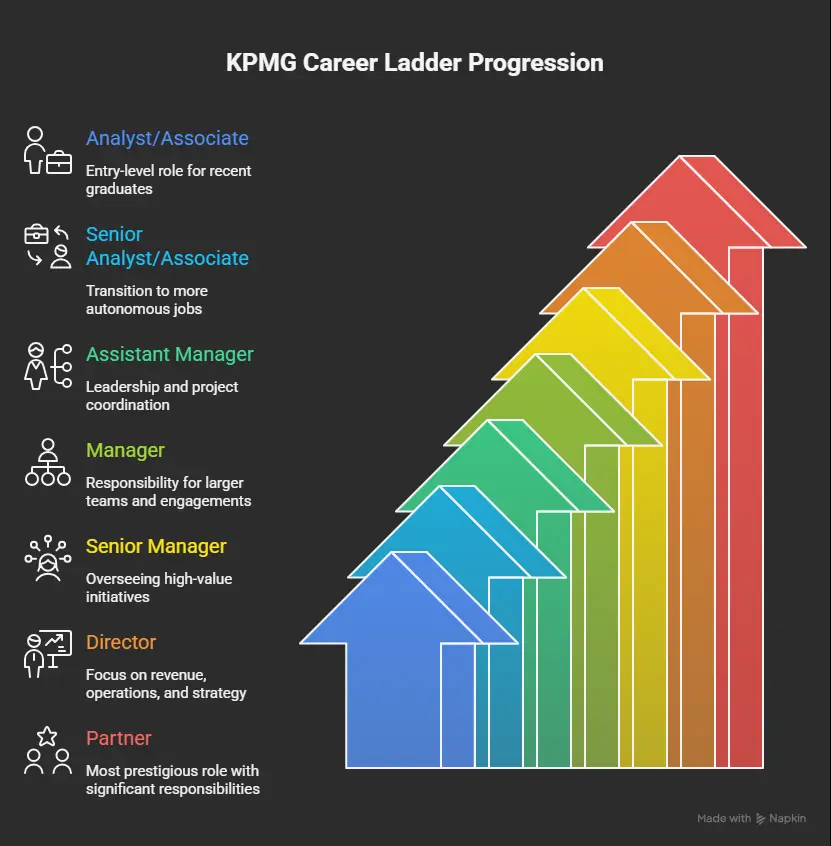
For someone thinking about the partner track, the implication is clear. Big-firm advancement at KPMG likely rewards people who can build a reputation across teams, not just within one niche. The upside is that strong performers can move between industries and capabilities. The downside is that mobility can feel less like freedom and more like constant adaptability, especially when client demands and internal expectations both move quickly.
The practical test for candidates and current staff
KPMG’s advisory message is strongest when you translate it out of employer-brand language and into daily work. “Fast-paced” means you should expect compressed timelines and quick pivots. “Collaborative” means you will need to operate across teams, not just within your immediate group. “Career-building” means development is supposed to happen through live client work, formal training and exposure to different parts of the firm.
That is a compelling pitch for people who want breadth, learning and repeated exposure to new problems. It is less appealing if you want a narrow scope, predictable cadence or a manager who can shield you from the churn. The firm’s investments, from Lakehouse to its industry-aligned structure, suggest it understands that advisory talent is won not just with slogans, but with a system that makes coaching, mobility and skill-building feel real.
For KPMG workers, the useful takeaway is not that Advisory is simply demanding or simply supportive. It is that the firm is trying to make both true at once, and your experience will depend on whether that balance holds in the team, the client and the promotion cycle you actually live in.
Know something we missed? Have a correction or additional information?
Submit a Tip