KPMG report says childcare crisis is hitting workers and growth
KPMG’s own data shows childcare breakdowns are cutting hours, raising burnout, and pushing workers out. For firms like KPMG, that is a staffing and retention problem, not a perk issue.

Childcare is becoming a staffing risk, not just a family stressor
At KPMG, the childcare crunch is no longer a side issue for working parents. It is showing up where professional-services firms feel pain fastest: missed hours, uneven staffing, strained managers, and the risk that high performers quietly step back before they leave altogether. KPMG’s own report says the crisis was “simmering prior to the pandemic” and “come to a boil” as pandemic-era aid lapsed.

That matters in a business built on predictable utilization and last-minute responsiveness. Consultants, auditors, and advisory professionals are often expected to absorb travel, late nights, and seasonal spikes, but childcare failures do not respect busy season calendars or promotion cycles. When care falls through, someone else on the team has to cover, and that ripple effect can quickly become a retention problem for the people carrying the extra load.
The cost is high, and it has been rising for decades
KPMG says daycare and preschool costs rose at nearly twice the pace of overall inflation between 1991 and 2024. That long-term squeeze helps explain why the issue is structural, not temporary, and why even households with two incomes can struggle to buy consistent care that matches office schedules.
The U.S. Census Bureau adds the hard-edged business context. In March 2021, there were 77,383 U.S. employer child care establishments with 875,114 paid employees, down from 77,629 establishments and 1,015,242 paid employees in 2020. The bureau also said child care services businesses fell from 2020 to 2021. In other words, supply was not expanding to meet demand, even as parents were trying to rebuild routines after the pandemic.
Price is the other wall. In a 47-state sample, the Census Bureau found annual child care costs ranging from $4,810 for school-age home-based care in small counties to $15,417 for infant center-based care in very large counties. Those prices amounted to about 8% to 19.3% of median family income per child in paid care. For a KPMG associate, manager, or senior manager trying to juggle rent, student debt, and client demands, that is not a marginal expense. It is a recurring constraint on whether work stays sustainable.
Why the problem hits professional-services firms so hard
KPMG’s report says work-from-home and flexible schedules helped some parents, but most workers still need to work in person. That distinction is crucial in a firm where office presence, client site travel, and in-person coordination still shape day-to-day performance. Flexible work helps around the edges, but it does not solve the basic problem of who is watching the child when a meeting runs long or a flight gets moved.
The report also flags Millennials as a key affected group because many are now in their thirties, forming households, and having children. That lines up with the ranks where firms expect to build long-term leadership pipelines. If that cohort is forced to choose between caregiving stability and career momentum, the firm risks losing the people it has spent years training for the partner track.
KPMG says women bear more of the costs, though men are affected too. That should not be read as a household issue alone. In practice, it means one side of the talent pipeline keeps carrying a heavier burden, which can widen promotion gaps, reduce availability for stretch assignments, and make work distribution less fair across teams.
The work disruption is measurable
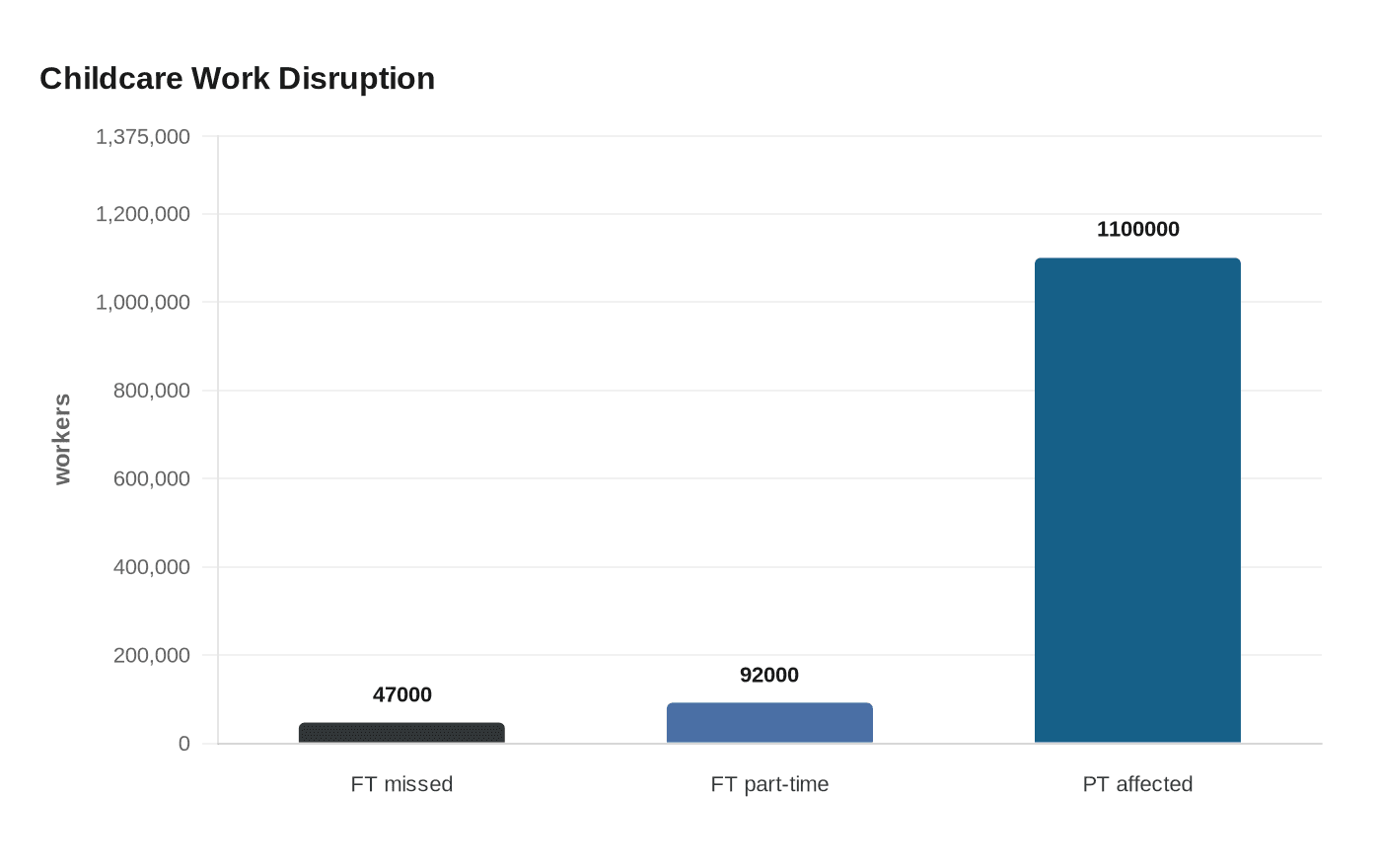
KPMG’s September 2024 Parental Work Disruption Index puts numbers on what managers often see only anecdotally. Using Bureau of Labor Statistics data, the firm estimated that in 2023 an average of 47,000 full-time workers missed work because of childcare problems, 92,000 full-time workers worked part-time because of childcare problems, and 1.1 million part-time workers were affected.
By December 2024, KPMG said 1.3 million workers were impacted by childcare problems, and 89% of them were women. The firm also said that figure was 22% above the pre-pandemic baseline. That is the operational story inside every large employer: absences remain elevated, hours parents can work are dropping, coworkers are picking up the slack, and children are suffering in the process.
For a professional-services firm, those effects are not abstract. They show up as reshuffled staff plans, delayed reviews, manager strain, and the kind of low-grade burnout that does not always make it into HR dashboards until a valued employee resigns.
What the market has already been saying for years
The access problem is not new. The Center for American Progress said in 2018 that roughly half the country had too few licensed child care options. Its 2026 update said just fewer than half of the nation’s young children still live in child care deserts. That tells you the problem has survived policy cycles, employer promises, and a long stretch of public attention.
The persistence matters for firms that think of childcare as a temporary emergency or a benefit employees should solve on their own. If the supply of care remains thin, then employee flexibility without employer support becomes a limited fix. People can bend their schedules only so far before the work itself starts to suffer.
What KPMG-like employers would need to change
KPMG’s 2025 Working Parents Survey points to what support needs to look like in practice. It found that 53% of working parents were struggling with ongoing childcare arrangements, 49% said their companies did not offer onsite or back-up care, and 50% wanted more flexible work schedules. Those numbers suggest that many employers are still relying on informal resilience from workers rather than building systems that make family stability part of workforce planning.
KPMG talent leader Sandy Torchia said flexibility, paid leave, back-up childcare, mental health support, and tailored career advancement are essential lifelines rather than perks. That is the right lens for a professional-services firm. If leadership wants family support to matter, it has to be built into staffing, promotion timing, leave access, and travel expectations, not parked in a benefits page that most employees read only after a crisis.
SHRM has pointed to a UPS pilot offering back-up child care at its Lathrop, California, distribution center after workers struggled with coverage gaps. The lesson for KPMG is not that one model fits every workplace. It is that employers who want consistent performance have to treat childcare as part of the operating model, not a nice-to-have.
The bottom line is simple. When childcare breaks, work breaks with it. For firms that sell judgment, deadlines, and client trust, the cost of ignoring that reality lands not just on parents, but on teams, margins, and the future workforce the business needs to keep growing.
Know something we missed? Have a correction or additional information?
Submit a Tip