KPMG staff get clearer view of consulting fees, rates and margins
KPMG’s fees sit in the middle of the market, but the pressure lands on staff through tight utilization, discounting and a constant push to prove value fast.
Opacity is part of the business model
KPMG’s pricing puzzle is not just about what clients pay. It is about how much pressure lands on the people doing the work when fees are hard to benchmark and every project has to defend its margin. Consulting rates are still treated like trade secrets because they vary by region, client and service line, and firms know that more transparency can trigger public debate or force renegotiation.

That opacity matters inside KPMG because staff do not experience pricing as an abstract finance issue. They feel it in the shape of the team, the pace of delivery, the scrutiny on realization and the constant demand to show value quickly. If a client is unsure what “fair” looks like, the burden shifts to the firm to justify price, then to the team to deliver enough proof of value before trust, scope or margin starts to slip.
Where KPMG sits in the fee stack
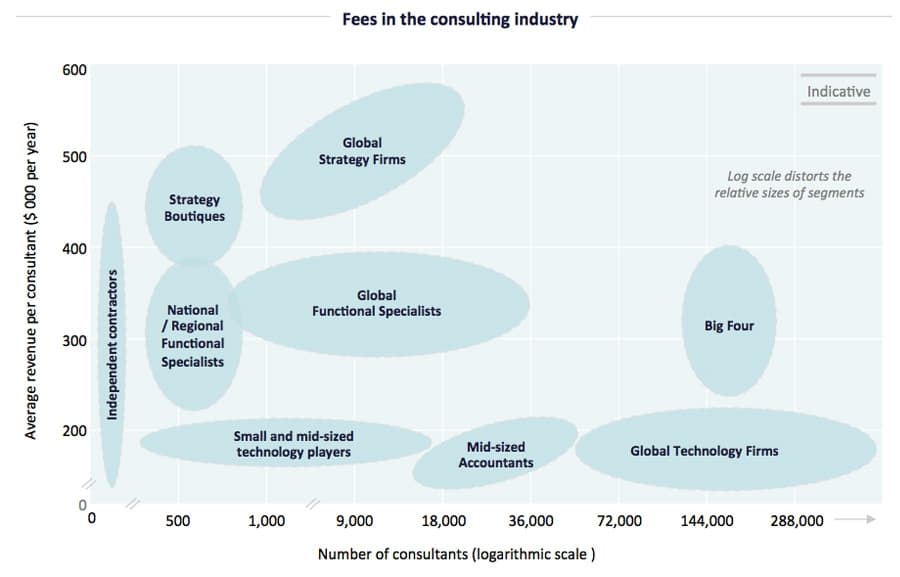
The consulting market has a clear if uncomfortable hierarchy. Consultancy.org says an operational interim consultant may charge around £50 an hour, while a leading strategy consultant can charge £300 or more. The Big Four, including KPMG, Deloitte, PwC and EY, generally compete in the same broad middle range, even though some of their lower-fee work comes from accountancy, audit and operational IT rather than premium strategy.
That middle position is exactly why the internal conversation matters. KPMG is not trying to win every deal by being the cheapest, but it also is not operating only at the top end of the strategy market. For people on the ground, that means a constant balancing act: the firm has to win enough work to keep teams busy, but not so cheaply that every engagement becomes a race to protect margin with thinner staffing and tighter delivery expectations.
The distinction between services also matters for career progression. Higher-value advisory work can create room for better pricing, stronger narratives in sales meetings and more visible routes to promotion. Lower-fee work, by contrast, can still be critical to the business, but it tends to be more exposed to discount pressure and harder to turn into the kind of revenue that supports faster advancement toward manager, director or partner track.
What the numbers say about the pressure
KPMG’s FY24 results show why pricing discipline is such a big deal. The firm reported global revenue of US$38.4 billion, up 5.1% in local currency, with headcount at 275,288. Advisory was its largest revenue line at US$16.3 billion, while tax and legal rose 10%, audit rose 6% and advisory rose 2%.
Those figures are large enough that even small shifts in discounting or mix can have an outsized effect. A narrow change in how deals are priced can ripple into utilization targets, staffing decisions and the amount of time managers spend defending scope instead of serving clients. In a firm this size, pricing is not just about winning the next mandate. It is a lever that affects how many people are needed, which teams are under the most pressure and which service lines get the internal investment.
That is why employees often experience fee pressure as workload pressure. If margins are tight, partners push harder on realization. If realization comes under strain, teams are asked to do more with the same hours. And when the work sits in the crowded middle of the market, there is less room to hide behind premium pricing and more pressure to prove that the team’s output deserves every pound or dollar on the invoice.
Why pricing affects the day-to-day inside the firm
For staff, the practical consequence of opaque pricing is that delivery becomes part of sales. A consultant or auditor may not be setting the fee, but they are living with its consequences every day through staffing plans, budget burn and how quickly a client challenge is turned into a commercial discussion.
That has direct implications for work-life balance. When a project has been priced tightly, there is less tolerance for slippage and less appetite for extra hand-holding. Busy season dynamics already make KPMG life demanding in audit and tax; in advisory, the pressure can come in a different form, with tighter turnaround times and a sharper need to show measurable impact. Either way, pricing decisions made far above the project team eventually arrive as longer hours, compressed timelines or both.
It also changes how people talk about value internally. A team that knows it is on a lower-fee engagement may feel pressure to justify every role on the project. A team on a higher-end strategy assignment may have more room to shape the work, but it also faces more visible expectations to deliver insight, not just output. In both cases, the message is the same: the firm is not only selling labor, it is selling credibility.
The strategic push upward
KPMG is not standing still in the middle of the market. Javier Rodriguez, who leads the Global Strategy Practice, has publicly described pricing strategy as part of his remit, and Reuters reported in 2024 that KPMG aimed to use AI and data science to help double strategy consulting fees to US$2.5 billion by 2027. That is a clear signal that the firm wants more of its work to sit closer to the premium end of the fee model.
The logic is easy to see. Strategy and management consulting sit at the top end of the Big Four’s fee structure, and they are less exposed to pure hourly comparison than more commoditized services. If KPMG can push more of its revenue mix toward higher-value work, it can reduce reliance on discounted engagements and create more room for margin. The catch is that this usually demands stronger specialization, better proof of outcomes and a more intense push to turn technical expertise into commercial differentiation.
For employees, that ambition can cut both ways. It may open paths into more prized assignments and give teams better room to sell insight rather than hours. But it can also raise the bar on performance, because higher-priced work leaves less room for generic delivery. If the firm is asking clients to pay more, it has to show faster, sharper and more defensible value from the people doing the work.
The lesson from Carillion still hangs over the market
The Big Four have already seen how opaque fees can become a public problem. In February 2018, UK Parliament committees published responses from KPMG, PwC, Deloitte and EY on Carillion after the outsourcer’s collapse, and contemporaneous reporting said the firms had collected more than £71 million to £72 million in Carillion-related fees over the previous decade.
That episode is a reminder that pricing opacity is not only an internal management issue. It can become a reputational problem when outsiders start asking what was paid, what was delivered and whether the economics encouraged enough challenge. For KPMG, that history reinforces why pricing, margins and scope discipline are watched so closely: the firm has to defend both the commercial model and the quality of the work.
The practical question now is the one every partner and team lead eventually has to answer: when a firm sits in the market middle on fees, how does it defend price without burning out the people delivering the work? For KPMG staff, the answer will shape not just margins, but the pace, pressure and sustainability of the job itself.
This article was produced by Prism’s automated news system from verified source data, official records, and press releases, then run through automated quality and moderation checks before publishing. The system is built and supervised by the people who set the standards it runs under. Read our full AI policy.
Did this article answer your question?


.pdf%2F_jcr_content%2Frenditions%2Fcq5dam.thumbnail.319.319.png&w=1920&q=75)