California's AB 1228 Sets $20 Minimum Wage for McDonald's Workers Statewide
California's $20 fast food wage floor reshaped McDonald's payrolls overnight in 2024, and the Fast Food Council holds authority to push the rate higher through 2029.

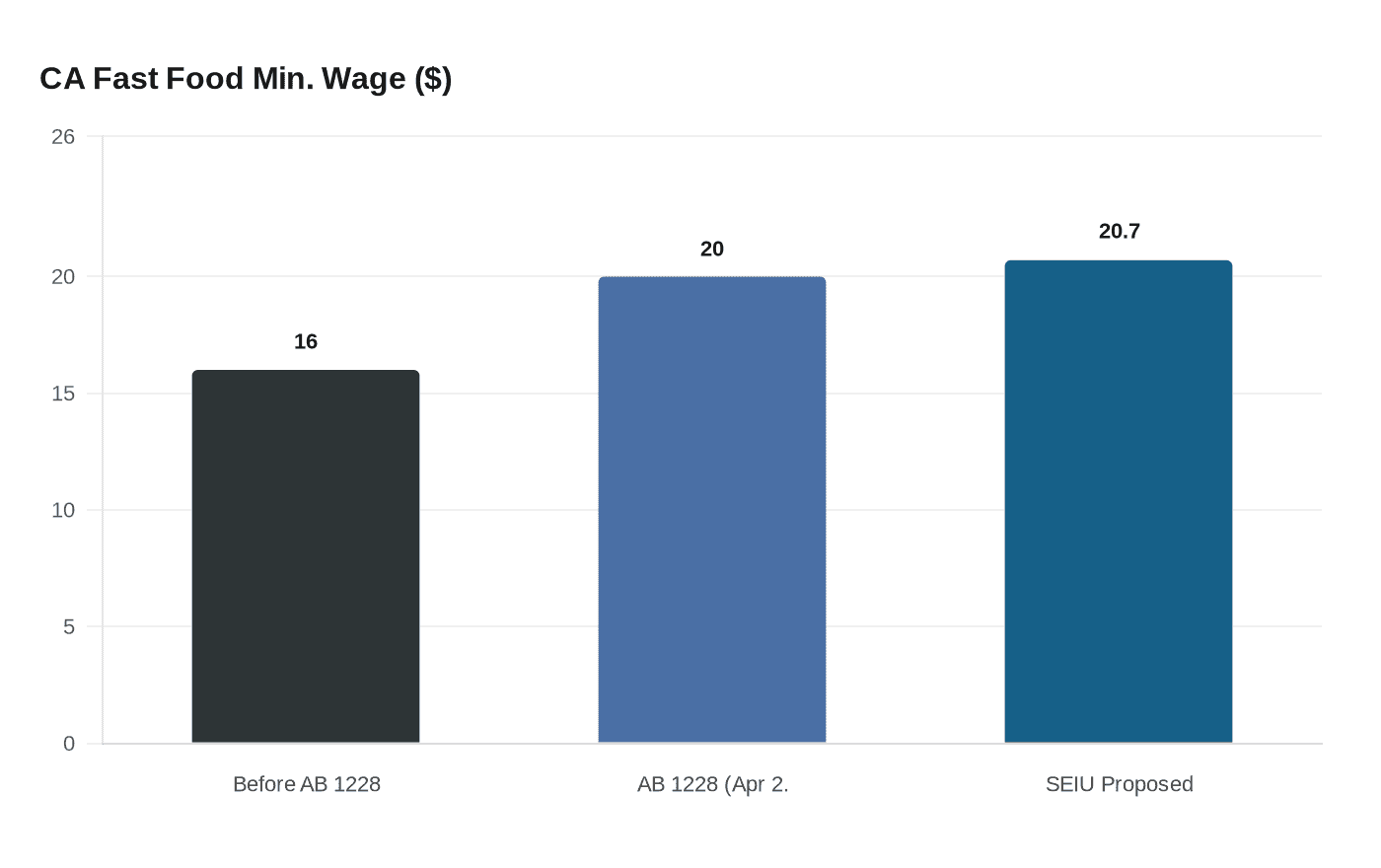
The wage jump was blunt and fast. When AB 1228 took effect April 1, 2024, California McDonald's workers saw their minimum hourly rate rise from $16 to $20 in a single move, a 25 percent increase that applied the same day at every covered location statewide. For McDonald's, there was no gray area on coverage: the law applies to all limited-service restaurants belonging to national chains with more than 60 locations, counting every McDonald's in the country regardless of whether the California location is corporate-owned or franchised. Roughly 500,000 fast food workers in California fell under the law at the same moment.
The dollars showed up in paychecks. What also showed up, documented at 18 McDonald's franchise locations in California's Central Valley, was a nearly 12 percent decline in total labor hours over the two years spanning April 2023 to March 2025, equivalent to the loss of 62 full-time jobs for a year. Franchise owners who appeared before California's Fast Food Council described a familiar pattern: reduced weekly hours, eliminated overtime, and accelerated rollout of order kiosks to offset a labor line that jumped overnight.
The Fast Food Council sits at the center of what happens next. The nine-member body, seated within California's Department of Industrial Relations and composed of worker representatives, franchise owners, and industry voices, holds authority to set annual wage adjustments through 2029. Each increase is capped at the lesser of 3.5 percent or the change in the Consumer Price Index. The Service Employees International Union had pushed for a raise to $20.70 per hour, arguing that inflation since April 2024 had already eroded the real value of the $20 floor. A final council vote on that increase was expected in the spring of 2025, though the council went leaderless for months following those proceedings, stalling formal action. Its statutory authority to raise the rate remains intact.
Three things are worth verifying on this month's paystub and schedule. First, confirm your base rate: the $20 floor is not just a wage line, it recalculates overtime premiums, meal and rest period penalties, split-shift pay, and waiting time damages, all of which are tied to the base rate under California law. Second, examine your weekly hour total against the same period last year; franchisees have used scheduling adjustments as the primary lever for managing higher labor costs, and the pattern at the 18 Central Valley locations suggests those reductions can be significant without triggering obvious legal exposure. Third, track the council's calendar: when a public comment period opens before any rulemaking on wages, health and safety, or training standards, AB 1228 explicitly bars operators from retaliating against workers who testify or submit comments. That protection is enforceable through the Labor Commissioner.
For managers coordinating payroll, the coverage test runs on the brand, not the individual location. A franchisee cannot claim a specific restaurant is too small to qualify. The 60-location threshold counts McDonald's as a whole, and compliance documentation requirements fall on the franchisee operating the store.
What the council cannot touch, by design: AB 1228's legislative compromise stripped the council of jurisdiction over predictable scheduling, paid sick leave, and vacation. Those remain governed by California's standard labor law. Its reach is wages, safety standards, and training, and whichever direction it moves next will land directly on the shift schedule.
This article was produced by Prism’s automated news system from verified source data, official records, and press releases, then run through automated quality and moderation checks before publishing. The system is built and supervised by the people who set the standards it runs under. Read our full AI policy.
Did this article answer your question?