Evergreen explainer — What drive‑thru voice AI, kiosks and predictive scheduling mean for McDonald’s crew and managers (practical guidance)
McDonald's killed its IBM voice-AI pilot in 2024 after viral misorders, but the tech is coming back. Here's what that means for your next shift.
The failed pilot that still tells you everything
In June 2024, McDonald's confirmed it was ending a three-year automated order-taking partnership with IBM, a pilot that had run in roughly 100 U.S. drive-thru locations before producing the kind of errors that go viral: one customer's order reportedly accumulated nine sweet teas she never asked for. The problems were systemic, not fringe. Sources familiar with the trial told reporters that the system struggled with accents and dialects, directly hurting order accuracy. McDonald's pulled the plug on July 26, 2024, but the company's own statement said the test "has given us the confidence that a voice ordering solution for drive-thru will be part of our restaurants' future." That phrase is the one worth paying attention to. The IBM chapter closed; the broader story did not.
Understanding where this goes requires understanding what these three technologies actually do, separately and together, and what they change about the work of every person standing in a McDonald's uniform.
What the three technologies actually do
Drive-thru voice AI accepts orders at the speaker, converts speech into POS entries, and routes tickets directly to the kitchen, removing the crew member from the first step of the transaction. The IBM trial showed the failure modes clearly: complex customizations, heavy accents, and background noise all degrade accuracy. McDonald's had originally acquired the underlying technology in 2019 when it bought a startup called Apprente, rebranded it as McD Tech Labs, then sold that unit to IBM in 2021 to run a larger-scale test. The lesson from roughly 100 locations is that voice AI is not a drop-in replacement for a skilled order-taker; it is a system that needs a human backstop to be reliable.
Self-order kiosks are further along. McDonald's began testing them in 2015 and expanded rapidly after 2017; more than 80% of global locations now operate them. The operational impact is measurable: according to data from Appetize, self-service kiosks in quick-service restaurants reduce total order time by nearly 40%. They also lift average ticket size, because customers who browse a digital menu without a line behind them are more likely to add items or upgrade. The kiosk's upsell logic runs automatically; the crew member who used to suggest a large or add an apple pie now works a different part of the flow.
Predictive scheduling uses machine-learning models to forecast demand by time of day and day of week, then generates suggested staffing levels and shift assignments. Instead of a manager estimating next Tuesday's breakfast rush from memory, the system models historical sales data and outputs a labor plan. This changes when shifts get posted, how many people are called in, and which stations get coverage first.
A shift walkthrough: what actually changes hour by hour
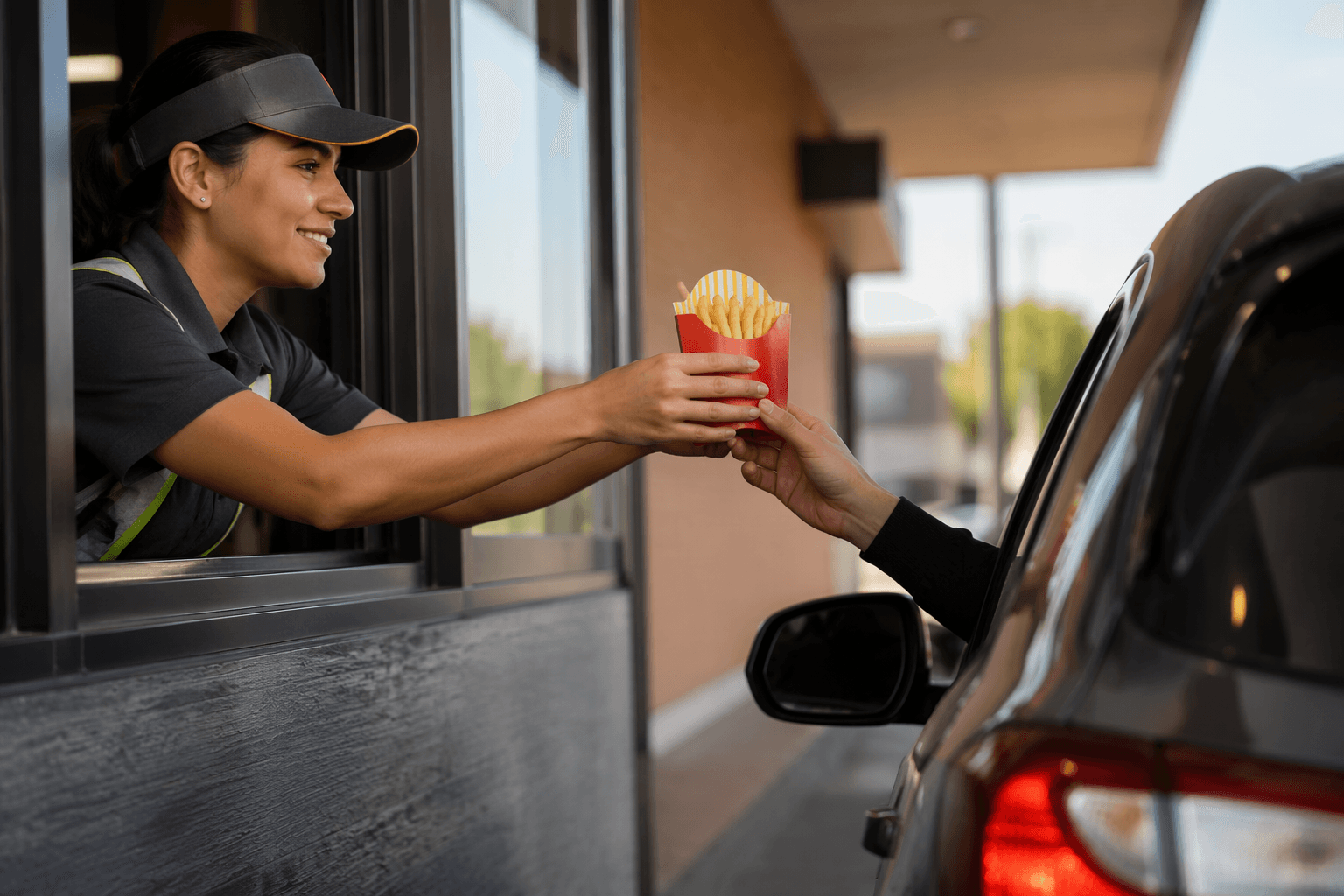
Think through a standard drive-thru shift with voice AI active. At the speaker, an AI handles the base order. The first moment a crew member is required is the window, which is now a quality-control checkpoint rather than an order-taking station. Confirm the toppings, verify the customization, catch the modifier the system dropped. During a normal lunch push this is manageable; during a late-night rush with back-to-back cars and a system that mishears "no onions" as an affirmative, it becomes the bottleneck.
Exception handling is where the role expands, not contracts. When the AI misorders, that becomes a customer-facing problem at the window, under time pressure. The crew member needs to know the comp policy, understand when to call a manager, and de-escalate a frustrated customer in under 30 seconds. That is a more demanding job than reading back an order from a headset. The same dynamic plays out at the counter when kiosks hand off to a human: the customer who couldn't navigate the touchscreen, whose coupon didn't scan, or who ordered the wrong size and wants it corrected has already lost patience by the time they reach a crew member.
Late-night shifts amplify every gap. Fewer staff, more unusual orders, higher proportion of drive-thru volume, and the same AI system that underperformed IBM's accuracy benchmarks in controlled pilots. The quality-checkpoint role matters most precisely when staffing is thinnest.
How labor math changes
Automation doesn't erase labor at McDonald's; it redistributes it. The front-counter order-taking role shrinks as kiosks absorb routine transactions. Speed-of-service tasks, order consolidation, and customer recovery roles grow in relative importance. McDonald's reported drive-thru service times improved by more than 20 seconds in recent years, a metric that depends heavily on how well the handoff between automated systems and human staff works during peak windows.
The skills premium shifts accordingly. Multi-station flexibility, which used to be a nice-to-have, becomes the factor that determines whose hours are protected when a predictive schedule trims labor to match a slower forecasted period. A crew member who can work the drive-thru window, rotate to fry station, and cover front counter is harder to schedule around than one who only takes orders. The same cross-training that builds job security also makes a location run better when a kiosk goes offline or voice AI logs an error cascade.
For managers, predictive scheduling changes the administrative burden but adds a compliance dimension. When an algorithm generates a schedule, the manager is still legally responsible for what it produces. Schedule predictability laws in a growing number of cities require advance notice of shifts, minimum shift guarantees, and premium pay for last-minute changes. If a predictive model cuts someone's shift because it forecasts a slow Tuesday, that cut still has to comply with local labor law. Automation does not transfer that obligation to the software vendor.
Practical playbook for crew and managers
The concrete steps that matter most right now:
- Master the failure modes, not just the features. IBM's pilot failed partly because crews weren't equipped with fast protocols for correcting AI errors. A quick-reference script at the window for the five most common misorders (missed modifier, wrong size, duplicate item, wrong sandwich, missing special request) cuts recovery time and protects customer satisfaction scores.
- Cross-train before you need to. Ask for cross-training explicitly. Rotate stations during slower periods. The predictive schedule will favor crew who can be moved where volume is, and it will flag fixed-station workers as lower-priority when hours get trimmed.
- Audit your schedule for legal compliance. Managers reviewing a predictive schedule output should check it against local notice requirements before posting. If the model shortens a shift that was already communicated to a worker, that change may trigger predictability pay obligations depending on jurisdiction.
- Document automation-driven changes in writing. When a location changes shift structures because a kiosk or voice AI alters how many people are needed per station, that change should be communicated clearly and in advance. Verbal adjustments made because "the kiosk handles it now" create conflict when workers see their hours reduced without explanation.
- Treat AI uptime as a contingency planning problem. When the voice AI goes down or a kiosk screen freezes during a peak, the location needs a crew member who can step into the order-taking role immediately. That person needs to be identified and trained before the outage, not during it.
McDonald's has already committed publicly to returning to voice AI after the IBM exit; its Ready on Arrival geofencing system, which uses mobile order data to prep food before a car arrives, was rolling out to its six largest markets by the end of 2025. The trajectory is clear. The IBM failure bought time, not a permanent reprieve. Workers who treat the current window as a preparation period, building cross-functional skills and learning where automated systems break down, will be the ones whose hours and roles look stable when the next iteration goes live.
This article was produced by Prism’s automated news system from verified source data, official records, and press releases, then run through automated quality and moderation checks before publishing. The system is built and supervised by the people who set the standards it runs under. Read our full AI policy.
Did this article answer your question?