McDonald’s can grow by protecting execution, not chasing novelty
McDonald’s may win more by simplifying the line than by piling on new items. That puts crew speed, training, and shift stress at the center of growth.
Execution beats novelty on the line
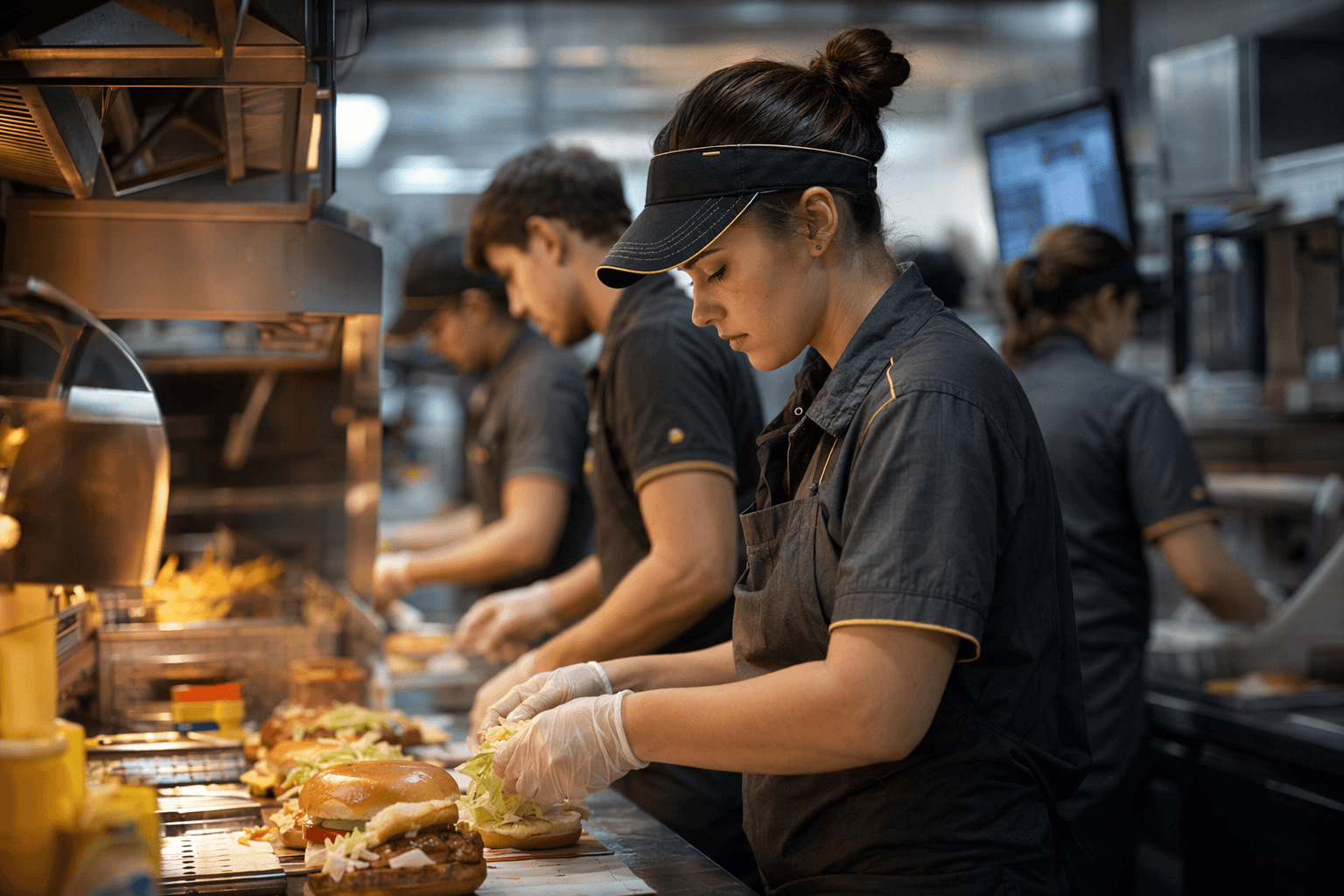
The most important growth story for McDonald’s workers is not a flashy launch. It is whether the company can keep the kitchen from becoming harder to run every time it tries to grow. When menu change stays disciplined, crew members face fewer modifier mistakes, less inventory confusion, and less chaos on busy shifts, which matters in a system this large because even a small increase in complexity gets multiplied across thousands of restaurants.
That is why the current lesson from chicken chains matters far beyond that category. The fastest-growing players in 2025 did not win by piling on random innovation. They won by staying on-brand, and that is a useful signal for McDonald’s, where execution already carries a heavy labor load. In a labor market shaped by Fight for $15 campaigns and minimum wage laws, the hidden cost of every new item is not theoretical. It shows up in how much extra training a shift requires, how fast a new product can be built without slowing service, and how many times managers have to reset the line when something new hits the board.
A wide menu already asks a lot of the crew
McDonald’s is not operating with a narrow playbook. Its U.S. menu currently includes McCrispy Strips, Snack Wrap, Big Mac, Quarter Pounder, Filet-O-Fish, McNuggets, breakfast items, McCafé drinks, and McFlurries. That breadth is part of the brand, but it also means the average restaurant is already balancing a lot of moving parts before any new promotion appears.
For crew members, a broad menu means more ways for service to go wrong if the system is not tight. More SKUs mean more chances for inventory misses, more chances for a modified order to slow down the line, and more pressure on people working the grill, fryer, assembly, and drive-thru all at once. For managers, the challenge is just as real: forecasting becomes harder, station placement matters more, and a launch that looks simple on paper can create a wave of retraining on the floor.
That is why a tighter core menu can feel like a staffing strategy as much as a product strategy. When the restaurant can rely on a smaller set of repeatable builds, employees get faster and more confident sooner. The shift feels less like constant firefighting and more like operating a system.
Value programs can drive traffic, but they also raise the execution bar
McDonald’s own 2025 value push shows how the company is trying to balance demand generation with operational reality. The McValue platform launched nationwide in U.S. restaurants on January 7, 2025, with Buy One, Add One for $1 and a $5 Meal Deal. It also came with app promotions, including free medium fries with a $1 purchase every Friday in 2025 and a free McCrispy sandwich for new app users.
That matters to workers because value programs often increase traffic while narrowing margins for error. More customers can mean more drive-thru pressure, faster handoff expectations, and tighter service windows, especially when app offers add another layer of order complexity. A value strategy can help restaurants stay busy, but if it is not matched with simpler execution, the crew absorbs the strain first.
The company framed McValue as a way to give customers “more variety, choice and flexibility,” and that is exactly where the labor issue sits. Variety may help sales, but flexibility on the customer side can become fragmentation on the employee side. The best version of value is the one that keeps the line moving instead of turning the lunch rush into a modifier marathon.
McDonald’s is also reorganizing around execution
The company’s internal structure shows it knows this. In March 2025, McDonald’s created a Restaurant Experience Team and separate global category management teams for beef, chicken, and beverages and desserts. The point was to move “vision and big ideas to execution with even greater speed,” while giving the core menu “a specialist’s focus.”
That is not just corporate language. It is an acknowledgment that menu complexity is a strategic problem, not just a store-level annoyance. When a company with McDonald’s scale starts organizing around execution rather than novelty alone, it signals that the real work is not inventing more products. It is making sure the products it already has can be rolled out cleanly, trained effectively, and executed consistently across the franchise system.
For workers, that kind of reorganization can be good news if it translates into fewer poorly timed launches and clearer priorities. It can also reduce the gap between corporate ambition and what happens in a restaurant at 12:30 p.m. when the line is full, the fryer is slammed, and one new item has already started throwing off the rhythm.
Franchisees are signaling what they want
The franchise side of the business is giving a similar message. QSR Magazine reported in April 2025 that franchisees were growing more optimistic as McDonald’s rolled out McCrispy Strips, a familiar and revamped product rather than a totally new concept. It was McDonald’s first permanent U.S. menu release since 2021, and nationwide availability was slated to begin by May 4, 2025.
That timing matters because it shows what operators tend to value most: products that can be explained quickly, trained quickly, and executed without blowing up the shift. Franchisees were also reportedly bullish on the return of Snack Wraps, in part because it was a known customer request. Snack Wraps had left most U.S. menus in 2016, though some locations kept them until 2020. A comeback like that is easier to absorb than a completely new build because the team already understands the item’s shape, its customer appeal, and the kind of prep it demands.
That is where the corporate versus franchise tension becomes most visible. Corporate strategy may reward headline-grabbing launches, but franchise operators live with the labor cost every day. The products that win are the ones that work in real restaurants, not just in presentations.
What tighter menu discipline means for the job
For McDonald’s workers, the bigger lesson is practical. The chain does not need to stop innovating, but its best innovations are the ones that fit the brand, protect speed of service, and do not turn every launch into a training sprint. In a system built on intense, hands-on training, McDonald’s says new owners and operators spend 12 to 18 months training in a restaurant, with 20 hours per week of self-directed work, plus seminars, conferences, one-on-one training, and Hamburger University courses available in 28 languages.
That scale of training tells you how much the company already depends on operational discipline. McDonald’s also says field operations staff help operators maximize quality, service, and cleanliness, and that each restaurant must spend at least 4% of gross sales annually on advertising and promotion. So when the brand makes a menu decision, it is never just about the food. It affects training, staffing, marketing, forecasting, and the pressure each shift carries from open to close.
The clearest path to growth is not endless novelty. It is protecting execution so well that the crew can run the restaurant fast, customers can recognize what works, and the company can expand without making the job harder than it needs to be.
Know something we missed? Have a correction or additional information?
Submit a Tip