McDonald's Cloud and AI Rollout Signals Big Changes for Crews
McDonald's is wiring thousands of restaurants to Google Cloud and piloting AI order-verification tools — here's what that actually means for the crew running the line.
The Infrastructure Shift Underneath Your Shift
McDonald's isn't just updating an app or swapping out a menu board. The company is rewiring the operational backbone of roughly 43,000 restaurants worldwide, and the scale of what's coming touches nearly every station on the floor. Google Distributed Cloud, a combined hardware and software offering, is planned to be deployed to thousands of McDonald's restaurants so they can leverage both cloud-based software applications and their own software and AI solutions locally on-site. With Google Cloud edge computing capabilities, McDonald's will be able to draw new insights into how equipment is performing, enact solutions that reduce business disruptions, and diminish complexity for crew. That last phrase, "diminish complexity for crew," is doing a lot of work. What it actually means on the floor is that the systems handling order flow, kitchen sequencing, and equipment monitoring are all becoming interconnected in ways they never were before.
McDonald's laid out these ambitions in its 2023 investor update, announcing plans to grow its loyalty program from 150 million to 250 million 90-day active users by 2027, and to increase annual systemwide sales to loyalty members from $20 billion to $45 billion. Those targets aren't just marketing goals. They're the demand-side rationale for spending heavily on cloud infrastructure: more mobile orders, more app-driven drive-thru pickups, and more loyalty-linked transactions mean the in-store tech stack has to handle far greater complexity than it was built for.
What Happened With Voice AI, and What Comes Next
The most visible AI experiment of the last few years was also, publicly, a stumble. McDonald's tested automated order taking (AOT) at its drive-throughs in partnership with IBM, but ultimately ended the program in 2024 after the technology caused several mistakes, including adding nine sweet teas to one customer's order and offering another bacon-topped ice cream. McDonald's USA Chief Restaurant Officer Mason Smoot informed franchisees that the company was ending the AOT partnership with IBM, with the technology shut off at all restaurants testing it by July 26, 2024.
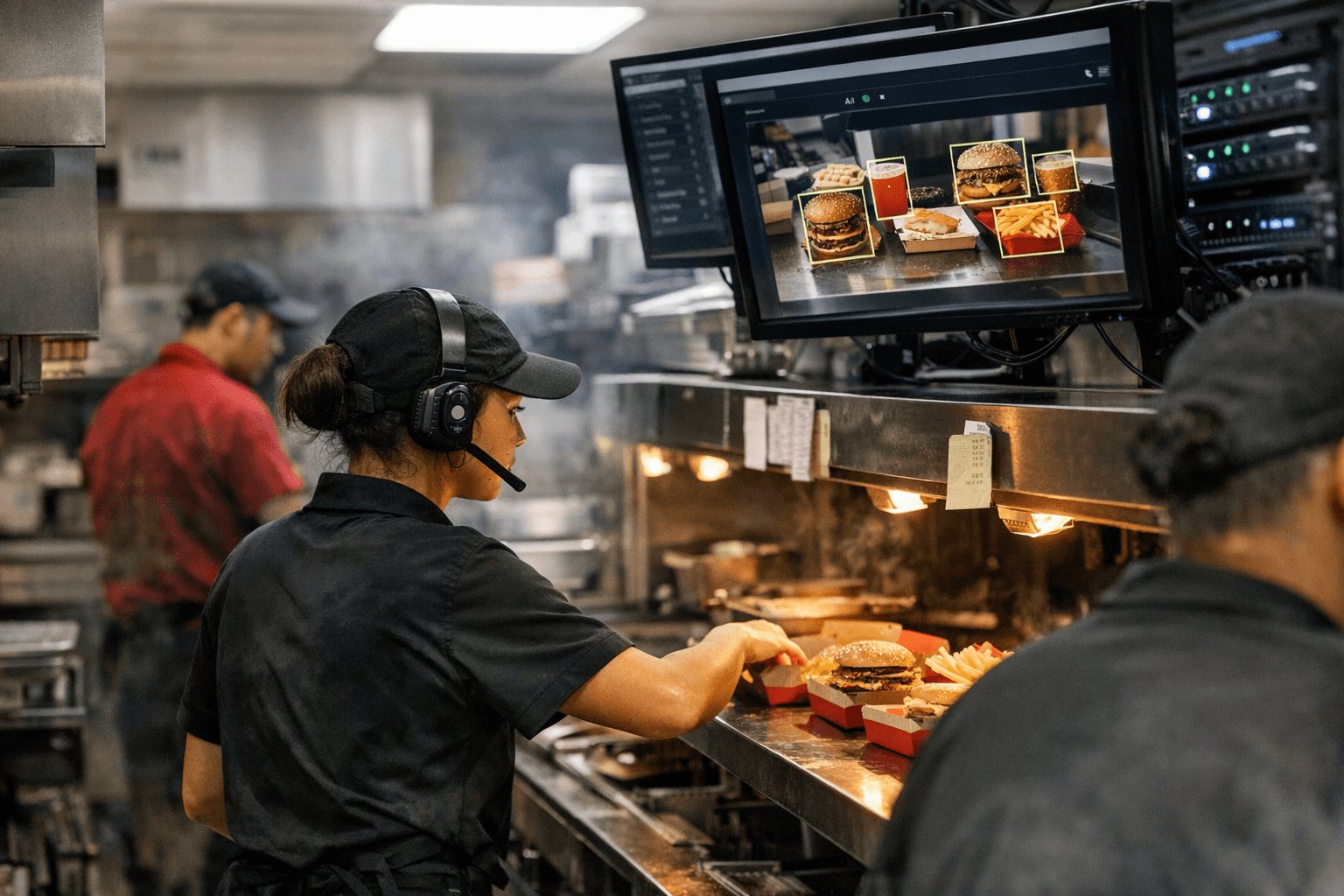
Killing the IBM pilot didn't end McDonald's AI ambitions for the drive-thru; it redirected them. Now, McDonald's is exploring the use of computer vision, the AI that underpins facial recognition technology, to determine whether orders are correct before they're handed to the customer. Simultaneously, McDonald's is implementing a feature called Accuracy Scales, intended to improve order accuracy by weighing bags to determine whether they meet a target weight. If the target and actual weights are mismatched, McDonald's personnel can check the bag before it's passed to the customer. The computing backbone for both systems runs on an in-house platform courtesy of Google called Edge, which also accommodates smart devices in the restaurant's kitchens.
Sensors in the Kitchen, Not Just the Drive-Thru
The technology push extends well past the order window. McDonald's plans to equip vital kitchen appliances, such as fryers and McFlurry machines, with AI-powered sensors that will facilitate predictive maintenance and notify staff about potential equipment failures, ensuring proactive problem management before operational impacts occur. For anyone who has spent a shift nursing a broken fryer or fielding complaints about a McFlurry machine that's been "down for cleaning," this has obvious appeal. The company's own CIO framed it plainly: "If we can proactively address those issues before they occur, that's going to mean smoother operations in the future."
The broader integration goal is equally ambitious. McDonald's and Google's technology strategy aims to connect predictive customer demand signals all the way through stock levels and kitchen operations, creating an end-to-end system. In principle, that means fewer stockouts and less waste, but it also means the kitchen operates increasingly to system-generated cues rather than the experienced judgment of a long-tenured crew member.
How Your Job Changes at Each Station
For crew on the floor, the practical shift is less about headcount and more about job content. When voice AI handles order intake, the front-line role pivots from order-taker to accuracy verifier: you become the human backstop when the system misreads a custom request or fails to register a no-pickle modification. The Accuracy Scales rollout formalizes this dynamic, making bag-checking a defined step in handoff rather than an occasional quality check.
Predictive scheduling, fed by the same demand-forecasting infrastructure, creates a different kind of pressure. Tighter demand forecasts can mean tighter shift windows, with less scheduled slack built in for slow periods. For cross-trained crew who can cover multiple stations, that's manageable; for workers locked into a single role, it can mean fewer hours when the algorithm determines that station is overstaffed for a given window. Throughput technology that speeds order volume, like accuracy scales and improved kitchen displays, can drive higher order intensity with similar headcount, meaning each shift gets busier even if it doesn't get shorter.
The workers who emerge from this period in the strongest position are those who treat the technology as part of the job rather than separate from it. Crew who understand how kiosks fail, how app-order pickup workflows sequence, and how drive-thru verification steps work become more difficult for a scheduling algorithm to treat as interchangeable. Workers who resist or receive no training may find their hours subject to exactly the kind of optimization pressure the technology was designed to create.
What Managers and Franchisees Need to Do Before Pilots Arrive
For shift managers, the most important window is before a pilot deploys, not after. Managers should insist on human-centric rollout plans that preserve dedicated time for cross-training rather than launching technology mid-rush and expecting crews to absorb it on the fly. Monitoring substitution effects, specifically which roles see reduced scheduled hours once a technology goes live, enables redeployment rather than de facto cuts.
Franchisees and HR leads need to work with field ops to secure training windows and temporary staffing support during deployments. Underprepared rollouts don't just frustrate crew; they generate the kind of order errors and customer complaints that justify pulling back a pilot entirely, which is precisely what happened with AOT. A deliberately paced deployment with trained staff produces better outcome data.
The practical checklist for crew at locations that are scheduled for or approaching pilots:
- Volunteer for kiosk, app, and drive-thru tech training as soon as it's offered, even informally
- Learn the common failure modes: a mismatched order weight, a misread custom modification, a geofencing pickup that doesn't trigger
- Document recurring errors that generate remakes; patterns are what managers can escalate to field ops for a system fix
- Ask your manager directly for schedule protection language during the rollout transition
The Bigger Picture
CEO Chris Kempczinski has said, "We've got a number of teams looking at how we can use AI to deliver an even better experience for our customers and for our crew members." That framing, crew members alongside customers, is intentional. McDonald's has publicly positioned this technology push as expanding capability rather than contracting labor. The more precise read is that the transformation is real, the timeline is multi-year, and the workers who build fluency with the new systems now will be the ones defining what the job looks like when the rollout is complete.
This article was produced by Prism’s automated news system from verified source data, official records, and press releases, then run through automated quality and moderation checks before publishing. The system is built and supervised by the people who set the standards it runs under. Read our full AI policy.
Did this article answer your question?