McDonald’s growth pillars explain focus on value, core menu, and speed
McDonald’s says its growth plan is really a labor plan: more value orders, more coffee, more app traffic and more pressure to move fast.
What the growth pillars really mean
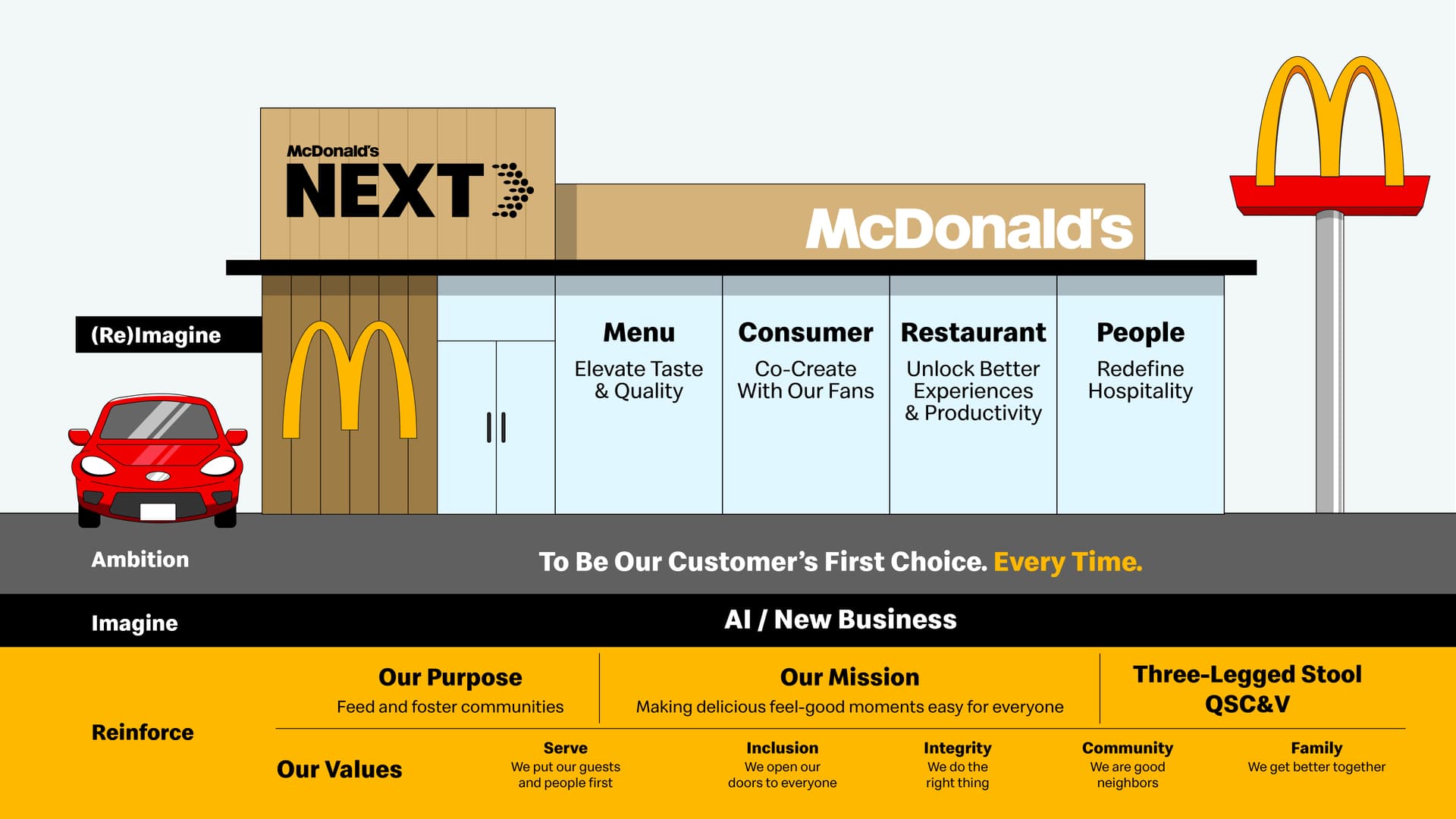
McDonald’s likes to describe its strategy in tidy corporate language, but the worker-level message is blunt: the company is betting on a smaller set of bets that drive a lot more of the day. Its growth pillars, Maximize Our Marketing, Commit to the Core, and Double Down on the 4Ds of Digital, Delivery, Drive-Thru and Restaurant Development, are really a map for where the labor pressure is going.
The reason that matters on the floor is simple. McDonald’s says core customer favorites make up about 70% of sales, which helps explain why burgers, chicken, coffee, breakfast, and value bundles keep crowding out one-off novelty items. When the company says it wants to be the leading omni-channel restaurant in every market, it is saying the same meal has to work through the app, the drive-thru, delivery, and in-store service without slowing down the line.
Value is not just a pricing story
For crew members, McDonald’s push on value shows up as more guests arriving with a specific deal in mind and less patience for surprises. The company said in 2024 that it reclaimed leadership in value and affordability, and it framed its 2024 strategy around value, core menu and digital. That is not just a marketing line. It tells managers to protect traffic with price-sensitive offers, which can mean faster turns, more bundle questions, and more guests measuring the visit against the app before they ever pull up to the speaker.
That trend became even more concrete with McValue. In November 2024, McDonald’s announced the platform for the U.S., with nationwide rollout starting January 7, 2025. The menu was built around everyday value, including mix-and-match options and breakfast value items, which matters because value is no longer being treated as a side offer. It is the traffic engine.
For workers, the consequence is familiar: the same labor hour has to stretch across more price-sensitive customers. In the Fight for $15 era, and in the years of minimum wage fights that followed, companies learned that labor is one of the few costs they can keep trying to compress while still promising affordability. McDonald’s value push sits right in that tension.
Core menu means more repetition, not more novelty
The phrase Commit to the Core sounds abstract, but on the floor it means the company keeps leaning on what already sells. If about 70% of sales come from core favorites, then crews are going to spend far more time assembling familiar burgers, chicken sandwiches, breakfast items and coffee orders than chasing limited-time experiments.
That has a few direct effects. It gives managers a clearer script for training and kitchen flow, because the same items matter day after day. It also creates a different kind of pressure: the company expects consistency on the products that matter most, so there is less room for sloppiness when demand spikes at lunch or breakfast.
It also explains why breakfast traffic keeps coming back into the conversation. Breakfast is not just a daypart. It is one of the easiest ways to capture repeat visits, especially when coffee and value are tied together. For crews, that means the morning rush is still one of the most important parts of the day, even when the brand is talking about digital transformation in the same breath.
Digital, delivery and drive-thru are one system now
McDonald’s says the 4Ds remain central to its strategy, and that is where the everyday work gets more complicated. The company’s loyalty program reached over 175 million users across 60 markets in 2024, and systemwide sales to loyalty members were about $30 billion for the full year. That is a huge signal for restaurant teams: the digital customer is not a niche customer anymore, and app-driven traffic is now a real share of the business.
The company’s global systemwide sales topped $130 billion in 2024, which helps explain why digital tools get so much management attention. If loyalty users are generating that much sales volume, then every offer, push alert and app promo becomes part of the operating plan. For restaurants, that means more order channels arriving at once, more labor juggling, and more pressure to keep hot food moving without missing digital timing targets.
On the floor, that can look like this:
- More app orders landing alongside front-counter and drive-thru tickets
- More delivery bags waiting in the kitchen or at handoff points
- More pressure to keep the drive-thru moving because that channel still does most of the business in the United States
- More attention to service timing, accuracy and order assembly across channels
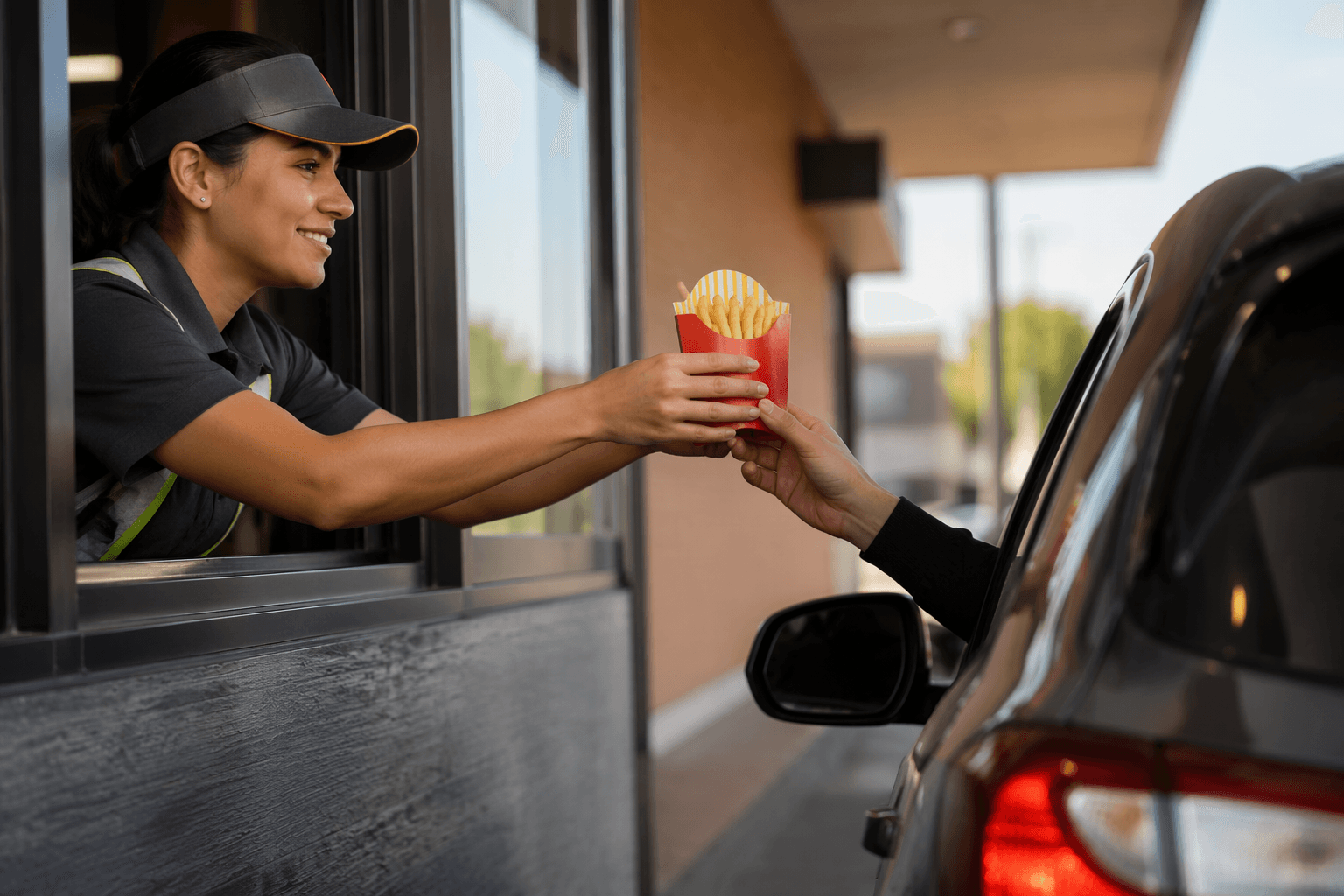
McDonald’s says drive-thru accounts for roughly 70% of its U.S. business, so it makes sense that drive-thru remains one of the 4Ds. The channel has been central to the company for decades. McDonald’s says its first drive-thru opened in 1975 after regional managers raised the idea in the early 1970s, which shows how long the company has treated speed as a competitive advantage, not a convenience feature.
Coffee and marketing are part of the labor equation too
McDonald’s also keeps tying coffee to morning traffic, and that matters because coffee changes the rhythm of the day. Coffee is not a standalone product in McDonald’s strategy. It is part of the effort to pull people into the restaurant earlier, keep them coming back more often, and create a reason to attach breakfast items to a drink order.
Maximize Our Marketing sits in the same bucket. The more McDonald’s leans on marketing, the more pressure lands on restaurants to execute the promise created by the ad campaign. A value commercial or app offer only works if the store can deliver the deal quickly, correctly and without slowing the line. That means managers have to align staffing, product prep and service flow with the message customers saw on their phones or screens.
For crew members, this often turns into upsell pressure that feels less like classic counter selling and more like script compliance. The company wants each visit to be more valuable, more digital and more routine, which can leave workers carrying the burden of making a highly standardized system feel personal.
The franchise system has to absorb the strategy
The franchise structure is where McDonald’s growth pillars meet real-world limits. The company said approximately 95% of its more than 41,000 restaurants at the end of 2023 were franchised, which means most of the operational lift sits with franchisees and their crews, not with corporate headquarters. That gap matters whenever the company adds value offers, digital expectations or restaurant-development targets without changing the physics of labor.
McDonald’s has also said it wants to reach 50,000 restaurants by the end of 2027. That target puts more weight on restaurant development, but it also suggests the system is still expanding around a model built for repeatable, high-volume execution. The company’s history backs that up: it opened the first restaurant for the McDonald’s System in Des Plaines, Illinois, in 1955, and acquired the brothers’ company in 1961 for $2.7 million. From the start, growth has been about scaling a few reliable formats rather than inventing a new one every quarter.
That is the real lesson of the growth pillars. McDonald’s is not just chasing sales in the abstract. It is organizing the workplace around speed, repeat visits, and repeatable menu execution, with digital channels now sitting beside the drive-thru window as permanent parts of the job. For employees, the strategy is visible in every rush, every app ticket, every coffee run and every value meal handed out across the counter.
This article was produced by Prism’s automated news system from verified source data, official records, and press releases, then run through automated quality and moderation checks before publishing. The system is built and supervised by the people who set the standards it runs under. Read our full AI policy.
Did this article answer your question?