McDonald’s highlights pay, benefits and flexible time off for workers
McDonald’s is marketing pay, time off and tuition as a full package, but the value shifts fast between corporate jobs, company stores and franchise restaurants.

McDonald’s is trying to sell workers a bigger promise than an hourly wage. Its careers pages now frame compensation as base pay plus short- and long-term incentives, a 401(k) plan, benefits and time away that is meant to cover family needs, personal development, caregiving and recovery. The message is straightforward: after years of Fight for $15 pressure, minimum wage fights and constant labor churn, the company wants total rewards to sound like a reason to stay, not just a perk to mention in recruiting ads.
A benefits story with two very different workforces
The first thing McDonald’s own pages make clear is that benefits are not uniform across the system. Its talent-and-benefits materials separate Corporate Staff, Restaurant Staff, company employees and franchisee employees, which is a reminder that McDonald’s operates as both a corporate employer and a brand that relies heavily on independent owners. That split matters on the ground, because a crew member in a franchise restaurant can be in a very different position from someone in a company office, even if both wear the same logo.
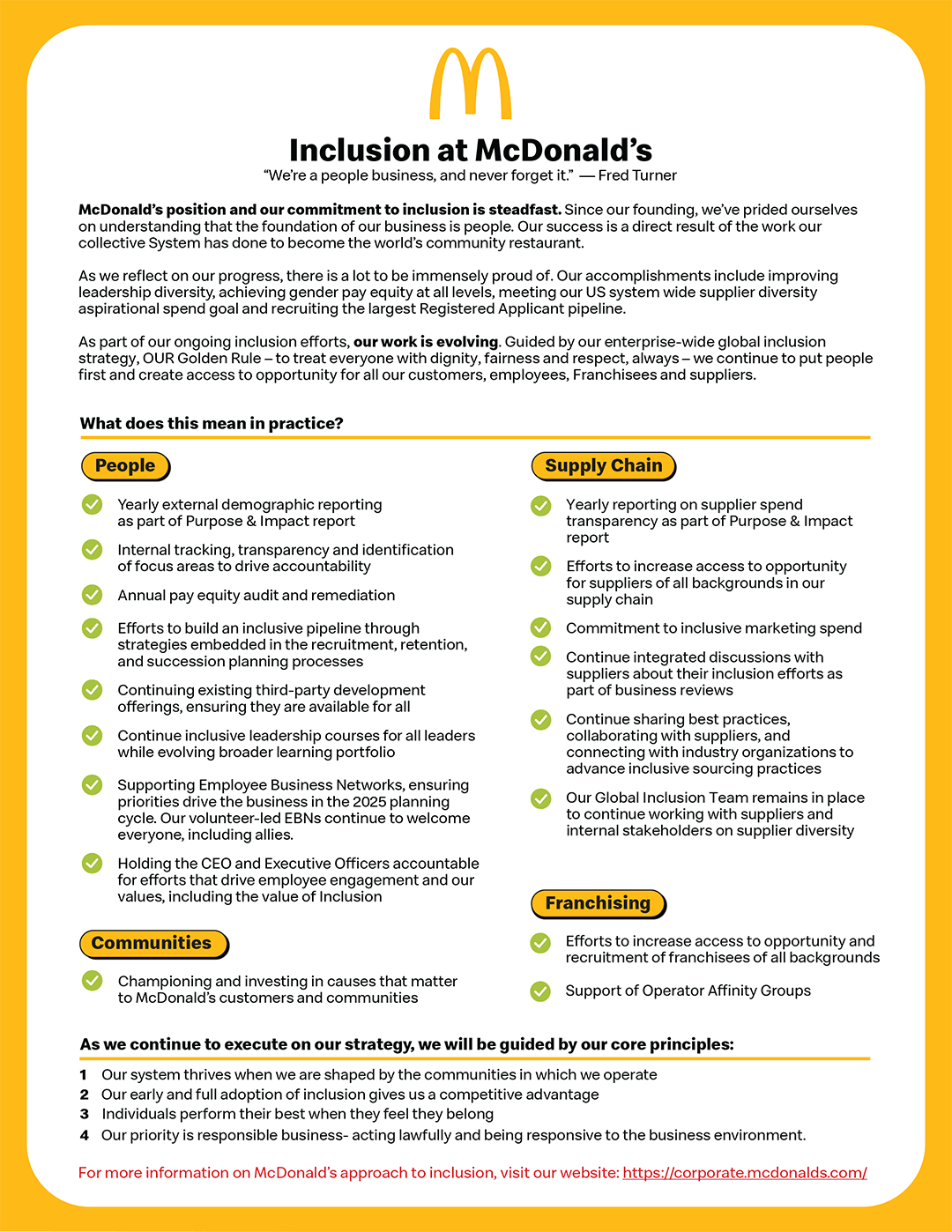
McDonald’s says its Global Pay Principles are meant to help ensure good pay practices are consistently implemented across its owned markets. The company also says its restaurant and corporate systems are different, and its career pages say benefits can vary by role, market and whether the job is in a company-owned restaurant, a franchisee-run restaurant or a corporate office. In other words, the total rewards pitch is real, but the floor under it changes depending on where you clock in.
What corporate staff are being offered
Corporate job postings show the clearest version of the package McDonald’s wants to project. The listings highlight medical, prescription drug, mental health, dental and vision coverage, along with life insurance, adoption assistance, educational assistance, flexible ways of working and time-off policies. Some corporate roles also include sabbatical programs and tuition assistance, which pushes the company’s white-collar offer well beyond the basics that many hourly workers still have to fight to obtain elsewhere.
That corporate layer is also where McDonald’s can point to outside partnerships that make the package look more competitive. The company highlights a DePaul University arrangement that offers a 25% tuition discount for eligible corporate staff who combine it with McDonald’s educational assistance benefits. It is a telling detail: McDonald’s is not just advertising jobs, it is advertising career stacking, the idea that work inside the company can be paired with school in a way that lifts employees into higher-paid roles.
The company’s jobs page currently shows hundreds of corporate roles open across multiple countries, which suggests McDonald’s is still hiring for a wide range of functions while asking candidates to buy into the benefits story. That matters because a company under labor pressure often uses benefits to compete for talent in roles that are harder to fill than they used to be.
Restaurant workers get a different promise
The strongest part of McDonald’s restaurant pitch is education, but even there the fine print matters. Archways to Opportunity launched in 2015, and McDonald’s said in 2020 that it had already reached more than 50,000 restaurant employees and awarded more than $90 million in tuition assistance. By 2023, the company said McDonald’s and its franchisees had contributed more than $26 million more in tuition assistance for restaurant employees.

That is not pocket change, and it tells you where the company sees value in spending money. McDonald’s has long understood that a fast-food job can be either a dead end or a ladder, depending on whether it offers a path to manager, supervisor or something beyond the grill line. Tuition aid is one of the few benefits that can make that ladder feel tangible for crew members and restaurant managers who want to move up without leaving the brand.
Still, the eligibility rules are the story. The Archways site says tuition assistance is available to eligible employees of company-owned or independently franchised restaurants, which means access exists across the system but not automatically in the same form for everyone. McDonald’s restaurant hiring site goes a step further, saying eligible employees can combine Archways tuition assistance with a Colorado Technical University commitment grant for 100% tuition coverage toward associate or bachelor’s degrees. That is a powerful recruiting message for crew members looking for a way out of hourly work and into a credentialed career, but it also shows how heavily the company leans on layered programs and outside partners to make the promise work.
The human case McDonald’s likes to tell
McDonald’s uses Charletta Thomas to show how the education pitch is supposed to work. Thomas started as a crew member with the MacLaff Organization in Louisiana, rose to training supervisor and later earned both a bachelor’s degree and an MBA. The point of the example is not subtle: McDonald’s wants employees to see that a restaurant job can be a starting point, not a ceiling.
That story lines up with the company’s broader emphasis on early career development. McDonald’s says it offers world-class early-career programs with hands-on development, a phrase that speaks less to formal HR language than to a recruiting need. In a labor market shaped by tighter staffing and inflationary pressure, the company needs workers to believe there is a future inside the system, not just a shift schedule.
What the fine print says about culture
McDonald’s says its People Brand Standards apply across company-owned and franchised restaurants to promote safe, respectful and inclusive workplaces. That is important because it shows the company knows benefits alone do not keep people if the day-to-day culture is harsh, inconsistent or arbitrary. In a business where franchisees control much of the labor experience, standards can narrow the gap on paper, but they do not erase the fact that worker experience still varies by owner, market and store.
The annual report adds another layer. McDonald’s says inflationary pressures and tighter labor markets continued to affect the operating environment, which helps explain why the company keeps leaning on pay, benefits and flexible time off as part of its pitch. The practical reading is simple: when labor gets tighter, McDonald’s has to compete on more than the base wage, and when workers have more options, the company has to make advancement and time away look as valuable as the shift itself.
That is the real reality check in McDonald’s total rewards story. The company is offering more than a paycheck, but the strongest benefits remain unevenly distributed across corporate, company-owned and franchised jobs. For workers, that means the value of McDonald’s package depends less on the headline and more on where the job sits in the system, who owns the restaurant and how much of the promise survives the fine print.
This article was produced by Prism’s automated news system from verified source data, official records, and press releases, then run through automated quality and moderation checks before publishing. The system is built and supervised by the people who set the standards it runs under. Read our full AI policy.
Did this article answer your question?