McDonald’s spotlights global impact team shaping policy and brand reputation
McDonald’s global impact team sits far from the fryer, but its policy, community and reputation work can still shape hiring, labor rules and store stability.
McDonald’s is putting a name to the work that often decides what happens inside the restaurant without ever touching the grill. Its Global Impact team covers strategists, communicators, government relations professionals and policy experts, and the company says that work is part of how it tries to feed and foster communities while protecting the brand that sits behind more than 43,000 restaurants worldwide.
What the Global Impact team is actually for
This is not a pure messaging shop. McDonald’s says the team helps lead the work that brings its purpose to life, which means dealing with policy, public affairs, stakeholder relationships and the company’s reputation at scale. In a system this large, those functions are not abstract. They help shape how McDonald’s responds when labor debates, local politics, supplier questions or community tensions reach a store’s front door.
The company’s own framing makes that clear. McDonald’s says its global brand serves customers in more than 100 countries through more than 41,000 restaurant locations, and about 95% of those restaurants were franchised at the end of 2023. When a business is that dispersed, headquarters cannot control every store with a memo. It needs people who can translate outside pressure into something franchisees, managers and crew can actually work with.
Why policy work reaches the restaurant floor
McDonald’s says its Public Policy Engagement is built around the company, franchisees and suppliers, a structure it calls the “three-legged stool.” That matters because decisions on labor rules, sourcing, packaging, climate, human rights or community investment do not land on a blank slate. They land in a system where most stores are independently run and where consistency depends on coordination across corporate and franchise ownership.
The company says it engages policymakers and other stakeholders on issues including the franchise business model, community impact and philanthropy, jobs, inclusion and empowerment, human rights, climate, packaging and waste, and food safety and sourcing. For workers, that list sounds far from the lunch rush, but it shapes the conditions around the shift. Policy on wages, scheduling, workplace standards and workforce development can affect hiring, retention, training and manager pressure just as much as a new menu item.
That is why this career path matters to employees who want to move beyond the kitchen or counter. If you are good at explaining how restaurants actually work, or you care about the policy side of food service, this is one of the few McDonald’s career families that sits directly at that intersection.
Community work that is meant to show up in stores
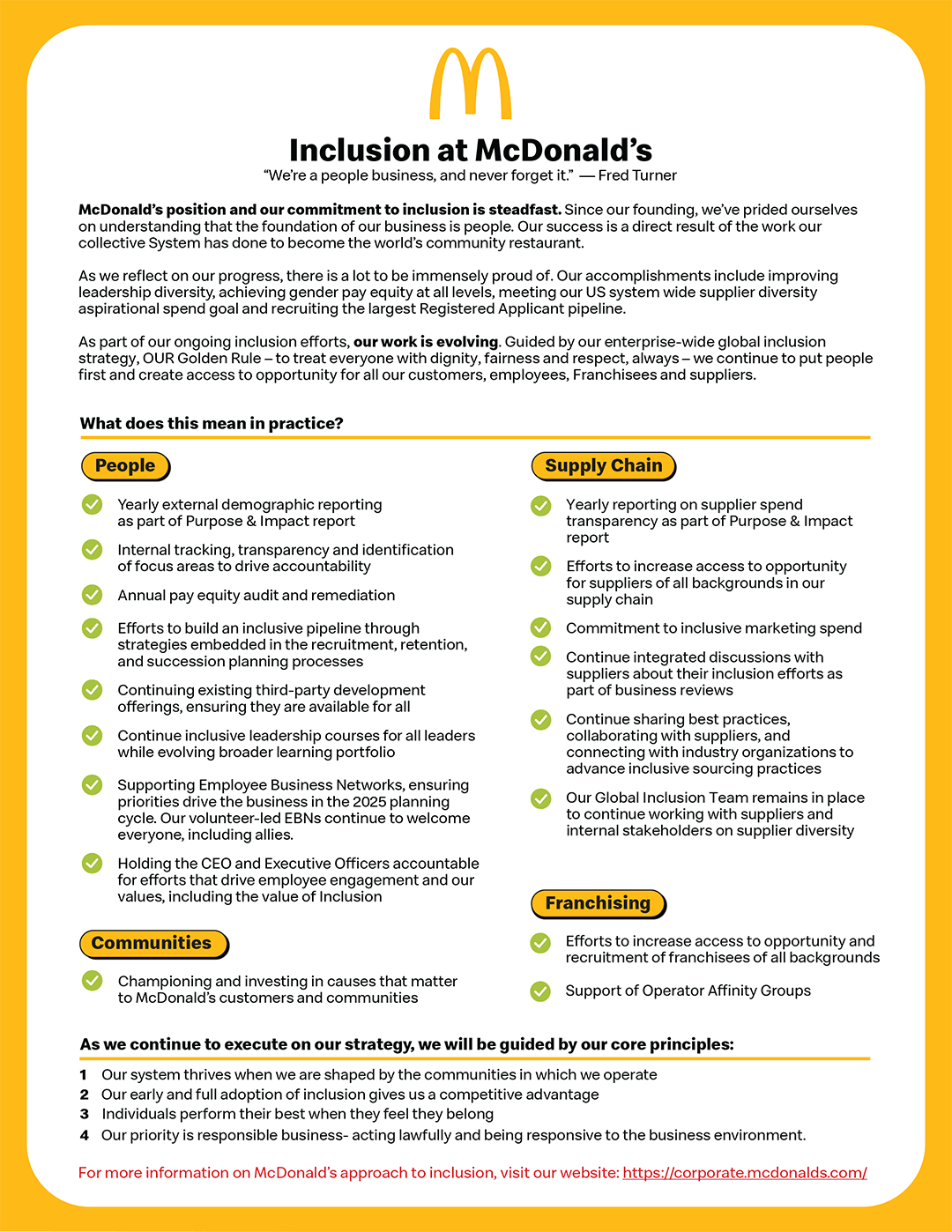
McDonald’s says its Community Impact & Philanthropy strategy centers on three outcomes: supporting families, responding in times of need and reducing systemic barriers through opportunity employment. That is not just philanthropic language on a corporate website. It is tied to operations in a way that can affect local relationships, workforce pipelines and the stability of individual restaurants.

The company says it updated its Community Impact Strategy in 2021, launched an internal platform in 2022 to organize corporate contributions and employee philanthropic investments, and formalized its Global Volunteer Program in 2019. Those dates show the work has been built into the company’s operating model over time, not bolted on after the fact. McDonald’s also says employees, customers, franchisees and suppliers donate time, funds and in-kind services to Ronald McDonald House Charities, linking the brand’s community work to the broader network around it.
For restaurants, that can mean more than charitable good will. Local partnerships can strengthen hiring pipelines, improve community trust and give stores a better footing when the brand faces scrutiny or needs to work through a neighborhood issue. In a franchise-heavy system, those relationships can make the difference between a store feeling embedded in its community or simply present in it.
The scale behind the strategy
McDonald’s latest Purpose & Impact Report says the company has more than 43,000 restaurants in over 100 countries serving millions of customers every day, and it marked its 70th anniversary in 2025. The company also says it serves around 70 million customers in 43,000 restaurants and counting. That scale explains why policy and reputation work get treated as operational functions, not just corporate extras.
A change that looks small at headquarters can ripple fast across a chain this large. A shift in labor expectations can affect staffing and retention. A change in community sentiment can affect a restaurant’s local standing. A sourcing or packaging debate can become a store-level issue when customers and local officials start asking questions. The global impact team exists partly to keep those changes from hitting every restaurant as a surprise.
What workers and franchisees should read into it
The most useful part of McDonald’s framing is that it shows where the company thinks its external relationships actually live. The brand says it works with investors, franchisees, suppliers, crew, customers, communities, NGOs and academics because the external landscape keeps changing and because those relationships help inform management discussions and drive industrywide change. That is a clue to how McDonald’s sees the job: not as a PR shield, but as a pressure valve and a translation layer between the system and the world around it.
McDonald’s also says its impact areas include jobs, inclusion and empowerment, economic mobility, workforce development, inclusion and safe and respectful workplaces. For a crew member, that may sound far removed from the shift. For a manager or franchisee, it can shape the rules, expectations and public conversations that determine how hard it is to hire, train and keep a crew together.
That is the real story behind the global impact label. It is one of the places where McDonald’s tries to keep a huge franchised system aligned with local realities, and where policy, community ties and reputation management can end up changing what happens in the store before the first order ever hits the screen.
This article was produced by Prism’s automated news system from verified source data, official records, and press releases, then run through automated quality and moderation checks before publishing. The system is built and supervised by the people who set the standards it runs under. Read our full AI policy.
Did this article answer your question?