McDonald’s operators seek labor-saving tech, menu ideas at NRA Show
McDonald’s operators are hunting for tools that save seconds, not just sell hype. At the NRA Show, the real test was whether tech would lighten shifts or add another layer of work.

Labor-saving was the real headline on the show floor
The 2026 National Restaurant Association Show ran May 16-19 at McCormick Place in Chicago, and the scale alone explained why operators were there to shop for fixes, not slogans. More than 55,000 foodservice professionals from 112 countries came through about 2,300 exhibitors spread across 720,000 square feet and more than 900 product categories, with attendance up nearly 4% from 2025. Restaurant and foodservice operator attendance rose 10%, first-time attendance rose 8%, and 70% of exhibitors came back from prior years.

That kind of turnout matters because it shows where the industry’s pressure points are. The show’s organizing pitch centered on “real business solutions,” including AI-assisted cooking equipment, guest-facing ordering tools, systems for tracking costs in real time, and technology meant to reduce repetitive labor. The 2026 Kitchen Innovations awards followed the same logic, recognizing 20 products with labor pressure and operational efficiency at the center of the judging.
For McDonald’s crews, that framing is more useful than another round of trade-show spectacle. When the industry is talking this loudly about labor savings, it usually means managers are still trying to make the same shift math work with fewer people, tighter margins, and more digital complexity. The question is not whether restaurants will get new tools. It is whether those tools actually make a busy lunch or dinner service easier to run.
Why operators are chasing anything that saves time
The National Restaurant Association’s own forecast helps explain the urgency. It projected just 1.3% real sales growth for 2026, equal to $1.55 trillion in total restaurant and foodservice sales, while warning that high food and labor costs, a tightening labor market, and softer traffic will keep squeezing profitability. More than 60% of operators reported traffic declines in 2025, only 15% saw traffic increases, and 40% of consumers said they were cutting restaurant visits.
That is the backdrop for every labor-saving pitch on the show floor. If traffic is weak and labor is tight, operators will look hard at anything that promises fewer handoffs, less rework, faster order entry, or easier cleanup. They are also likely to judge menu ideas the same way: not by whether they look new, but by whether they can survive a rush without clogging the line or forcing crews into extra steps.
For a McDonald’s restaurant, that means the useful ideas are usually the boring ones. A menu item that can be built with fewer custom moves, a beverage platform that cleans up faster, or a kitchen system that catches mistakes before the bag leaves the building will do more for the shift than a flashy demo that looks good under convention lighting. The show’s emphasis on practical solutions reflected that reality.
What McDonald’s workers should read into this trend
McDonald’s is already well into the same operational shift, so the show’s themes are not abstract. In August 2025, the company described its digital transformation strategy, “Digitizing the Arches,” as a “once-in-a-generation transformation.” It said Restaurant Platform Edge was live in hundreds of U.S. restaurants and expanding globally, with AI- and Internet of Things-enabled kitchen tools built into the system. McDonald’s also said it was deploying AI-powered Accuracy Scales across thousands of restaurants in a dozen markets to catch missing items before orders leave the restaurant.
That matters on the floor because accuracy technology changes how a shift runs. A tool that flags missing items can reduce remakes and customer complaints, but it can also add another checkpoint if it is not integrated cleanly into the flow of a busy kitchen. The best version of this kind of tech takes pressure off the crew. The worst version adds another screen, another beep, and another place where workers are expected to slow down to satisfy management metrics.
McDonald’s said the payoff from its digital push is not limited to the kitchen. It reported more than 185 million 90-day active loyalty users across 60 markets, and said loyalty members more than double their visits in the first year after joining. That tells you the company sees digital as a traffic engine as much as an operations tool. For employees, though, more app traffic and more loyalty traffic usually means more complex order streams, more special instructions, and more pressure on the front counter, drive-thru, and handoff point.
The shift is already changing in the drive-thru
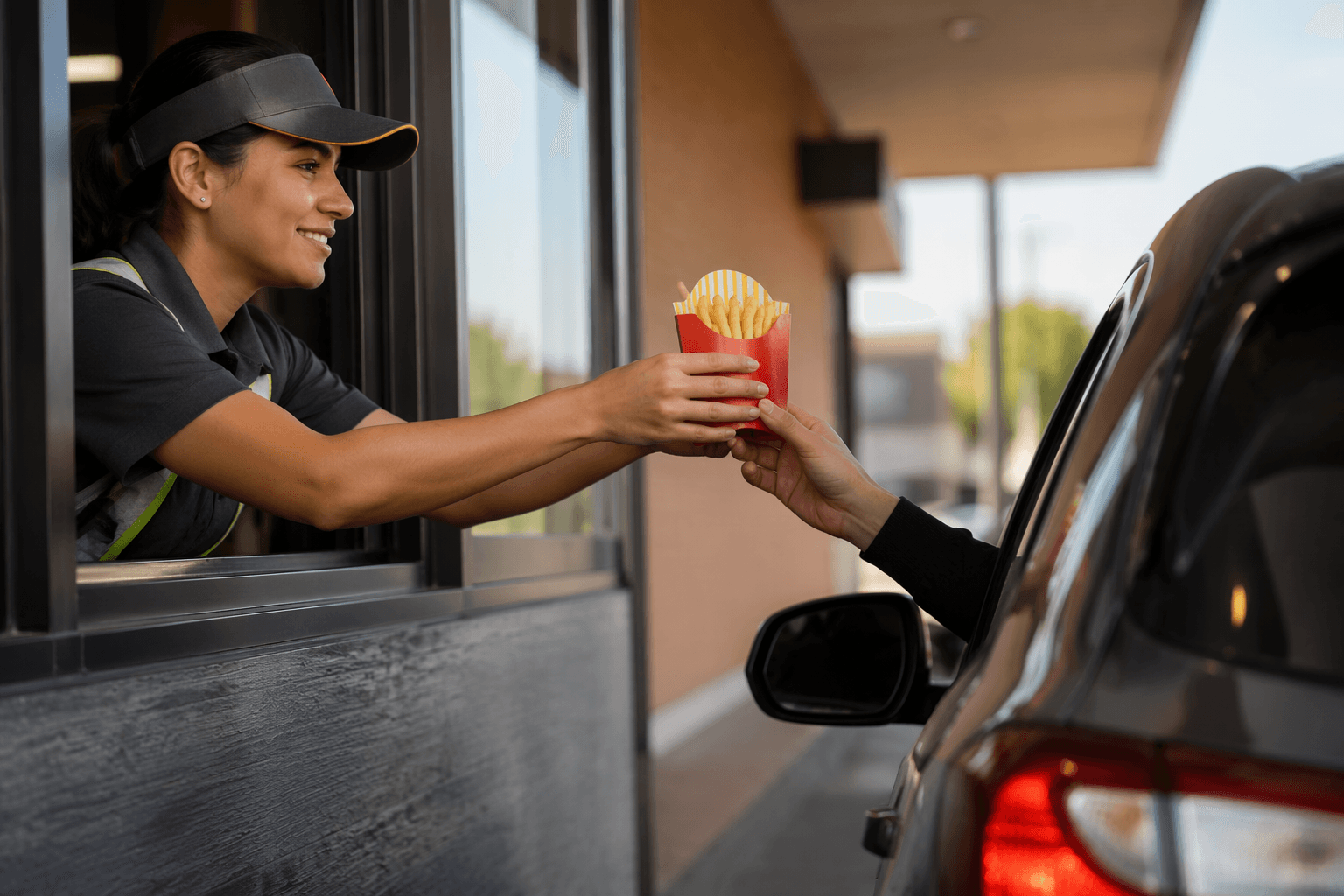
Previous reporting has said digital orders, including app, kiosk, and delivery, accounted for more than 40% of McDonald’s sales in a quarter. The company has used that channel shift to move labor away from cashiering and toward other tasks, especially as kiosks and digital ordering become more central to the store. More recent reporting says McDonald’s is redesigning drive-thrus with AI ordering, digital menu boards, mobile pickup lanes, and vehicle-identification technology.
That mix could help crews if it cuts order-entry errors and shortens waits. It could also make the drive-thru harder to manage if it creates more handoffs, more exception handling, or more confusion about where a guest is supposed to go. Any labor-saving system that adds more visual cues, more device prompts, or more menu changes can become a training issue as much as an efficiency gain.
This is where the worker lens matters. McDonald’s has spent years pushing digital ordering into more parts of the business, and the trade-show interest in labor-saving tools suggests that trend is still accelerating across the industry. But frontline teams know the difference between a tool that removes a step and one that simply moves the work somewhere else. A better accuracy system can save a remake. A poorly designed menu change can make every sandwich build slower.
What to watch for when the next round of “innovation” reaches the store
The useful question for McDonald’s operators is simple: does the new tool reduce the number of repetitive tasks, or does it just rename them? A system that helps the kitchen keep pace during peak periods, simplify training, or cut cleanup is worth attention. A system that looks efficient on a vendor slide but creates more exception handling in the middle of a rush is not labor-saving in any real sense.
That is why the show’s mix of equipment, technology, and food ideas matters. Operators were not just shopping for new menu items or nicer hardware. They were looking for ways to keep restaurants moving in an inflationary environment where staffing remains tight and consumers are eating out less often. For McDonald’s crews and managers, the bottom line is not whether the industry is innovating. It is whether those innovations make the restaurant easier to run, or simply give management a new way to demand the same output from the same exhausted shift.
This article was produced by Prism’s automated news system from verified source data, official records, and press releases, then run through automated quality and moderation checks before publishing. The system is built and supervised by the people who set the standards it runs under. Read our full AI policy.
Did this article answer your question?