McDonald's says safe, respectful workplaces apply across its restaurant system
McDonald’s says safe-shift rules reach every restaurant, but the real test is whether crew can report abuse, violence, and intimidation without fear.
McDonald’s is drawing a line that matters for anyone on a grill, in a drive-thru, or running a shift: safe and respectful workplaces are supposed to apply everywhere in the system, not just in a corporate memo. The company says that means more than food safety or equipment rules. It includes how people are treated on the floor, what managers do when conflicts escalate, and whether crew in franchised stores have a real reporting path when a shift turns hostile.
What the standard is supposed to cover
McDonald’s says its People Brand Standards are designed to promote safe, respectful, and inclusive workplaces, and that those standards apply across all McDonald’s restaurants, whether company-owned or franchised. That language matters because it turns workplace conduct into an operational requirement, not a feel-good value statement. For crew members, it suggests the baseline should cover harassment, intimidation, violence, and other behavior that makes a shift unsafe, not just hazards tied to the fryer or the freezer.
The company also says its Human Rights approach requires company-owned and franchisee-operated restaurants to put workplace-violence mitigation measures in place. In practice, McDonald’s says that means policies, employee communication, training, and reporting mechanisms. That is the part workers and managers can use to judge whether the standard is real: if there is no policy on the wall, no way to report a problem, or no training on what to do when a customer or coworker becomes threatening, the standard is not being carried through to the restaurant level.
What the 2022 rollout was meant to change
McDonald’s said in 2022 that it was implementing global brand standards for safe and respectful workplaces across all 39,000 McDonald’s restaurants worldwide. The rollout included e-learning for managers and crew, workplace-violence-prevention workshops, and special training for restaurants facing specific challenges. That is the closest thing McDonald’s has to a systemwide playbook, and it shows the company was trying to standardize how a violent or disrespectful incident gets handled, no matter which franchise or market you are in.
For workers, the practical question is whether training happens before trouble starts, not after someone files a complaint. For shift leaders and restaurant managers, the measure of enforcement should be visible in routine operations: are crew told how to escalate a threat, do managers know how to document an incident, and does the store have a channel for reporting behavior that crosses the line? If the answer is no, then the gap is not abstract. It shows up in the moment a worker asks who will protect them on an overnight shift or during a confrontation at the counter.
Why franchise workers should care
This is not just a corporate-office issue. McDonald’s says it operates about 44,000 locations globally, with more than 2 million people working in franchised restaurants and more than 150,000 people working in company offices and company-owned restaurants. That scale is why the company’s safe-workplace language has to reach franchisees, not just corporate crews. A rule that stops at the company-owned store would leave most of the workforce outside the fence.
That is also where the tension inside the brand shows up. McDonald’s can set the standard, but franchisees still run the daily operation, control staffing, and shape how complaints are handled. For crew members, that makes the difference between policy on paper and enforcement on the floor. For franchise managers, it means workplace safety is not only about turnover or labor costs; it is a brand requirement that can affect how the store is run, trained, and documented.
What outside scrutiny has tested
The issue has not stayed theoretical. In 2023, the Associated Press reported on a lawsuit filed by McDonald’s workers in Virginia alleging discrimination and harassment at franchise restaurants run by Soweva Co. The case put a hard edge on a question that has followed McDonald’s for years: when problems happen inside a franchised store, how much responsibility does the brand bear for what happens under its arches?
Worker-rights organizer Kendall Fells said the allegations were not isolated. That matters because it frames the dispute as a recurring workplace problem, not a one-off clash. For employees and managers, the lesson is straightforward: if McDonald’s says its standards apply across the system, the company has to show how complaints move from one restaurant to the next level of accountability, especially when the store is franchised and the pressure to keep labor costs tight can make reporting feel risky.
What a safe and respectful shift should look like day to day
- A written policy that explains workplace-violence prevention, respectful conduct, and reporting steps in plain language.
- Crew and managers who have actually gone through training, not just signed off on a checklist.
- A reporting path that employees can use without having to go through the person they are complaining about.
- Follow-up after incidents, including documentation and a response that is visible enough to show the complaint did not disappear into the system.
Those are the signs that matter on a Tuesday night with a short-staffed line and a tense dining room. If they are missing, workers are left with a slogan instead of a safeguard. If they are present, the standard becomes something a crew member can point to when a shift goes bad.
Why McDonald’s language is broader than one safety policy
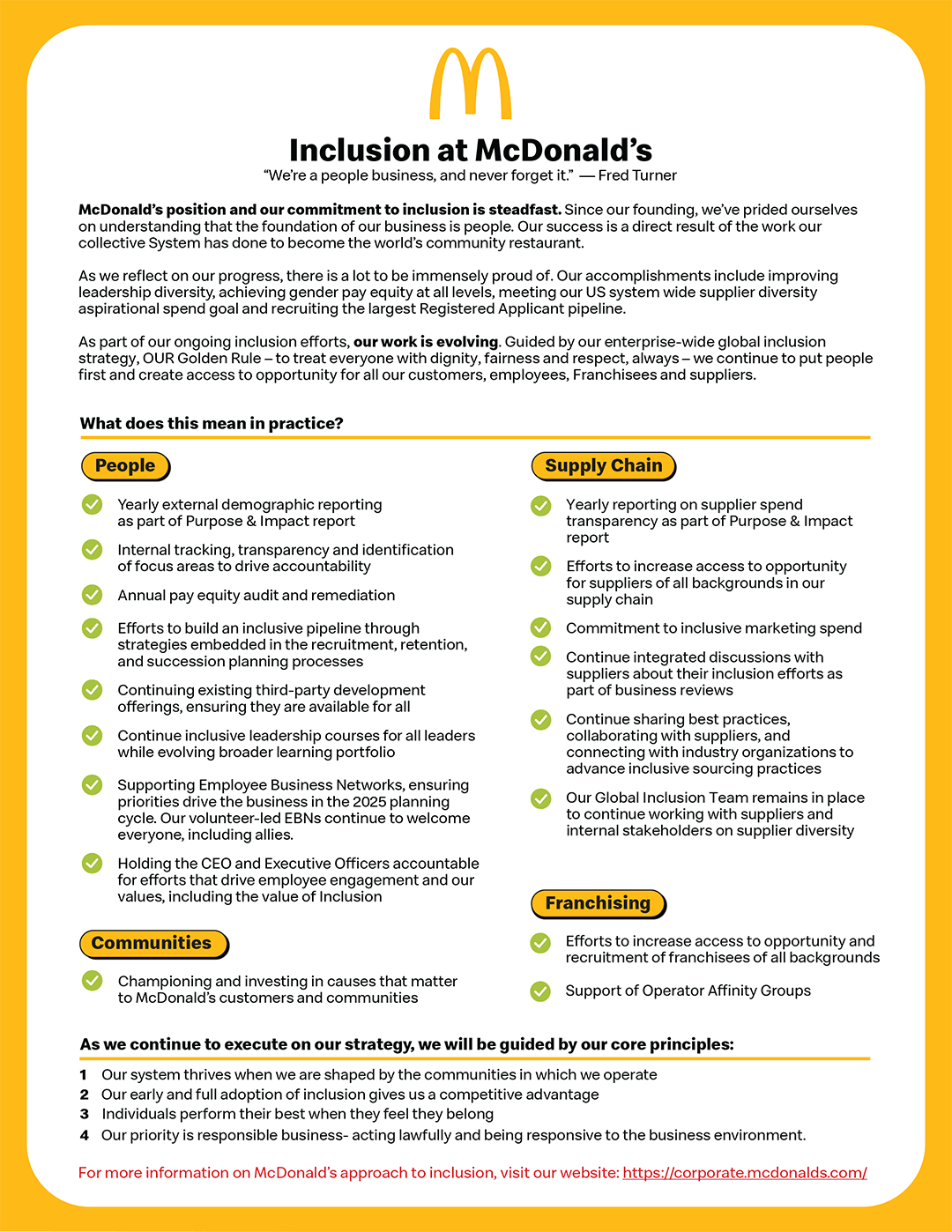
McDonald’s ties this to its broader values, saying it is committed to fostering a safe, respectful, and inclusive workplace, providing quality jobs, and making opportunity open to all. The company also says its inclusion approach is grounded in its Golden Rule, which it defines as treating everyone with dignity, fairness, and respect. That is the language of culture, but the real test is operational: whether a manager is trained, whether a franchisee is required to act, and whether a crew member can raise a concern without being ignored or punished.
For a workforce this large, the difference between values and enforcement is not cosmetic. It shapes who feels safe enough to stay, who can move into management, and whether McDonald’s can claim its workplace standards mean the same thing in a corporate office, a company-owned restaurant, or a franchise store run by someone else.
This article was produced by Prism’s automated news system from verified source data, official records, and press releases, then run through automated quality and moderation checks before publishing. The system is built and supervised by the people who set the standards it runs under. Read our full AI policy.
Did this article answer your question?