McDperks explains McDonald’s employee discounts by workplace type
McDperks can save McDonald’s workers time, but only if they use the portal tied to their workplace type. Company-owned, franchisee, and corporate staff all start in different places.
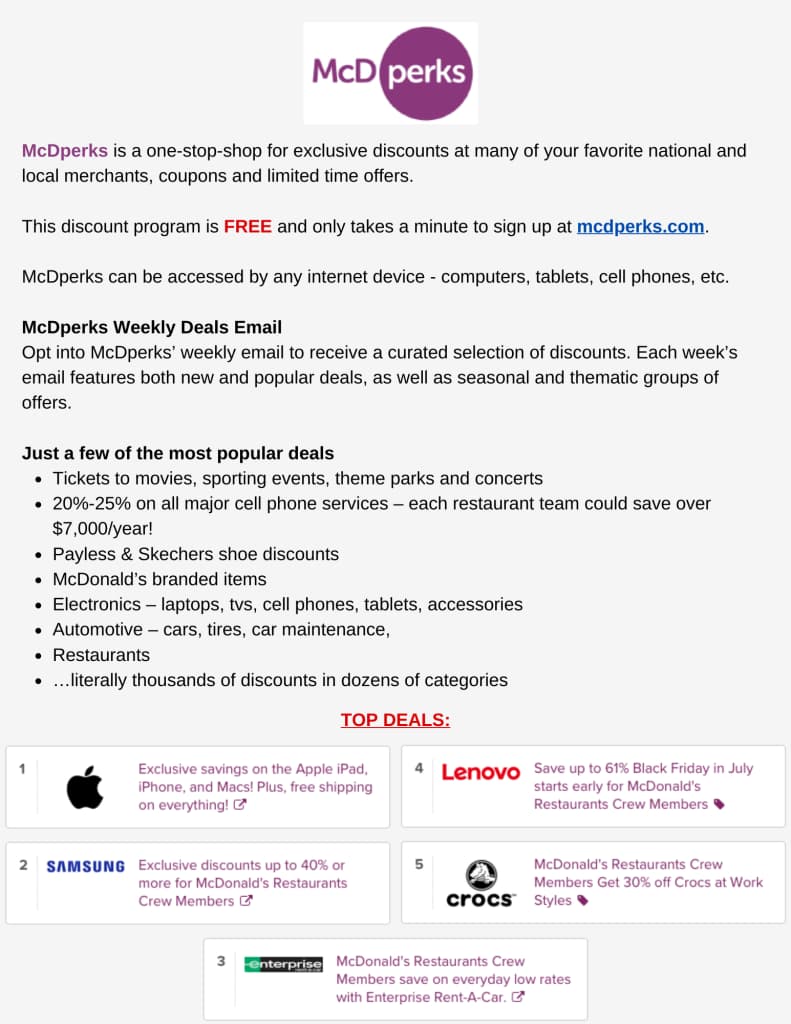
The fastest way to waste time at McDonald’s is to ask the wrong desk for a benefit that belongs to a different employer. McDperks cuts through that confusion by routing workers to different discount portals for company-owned restaurants, franchisee restaurants, and corporate staff, and it does it for free. For crew, managers, and payroll staff trying to sort out who gets what, that split matters more than the brand name on the sign out front.
Start by figuring out who actually employs you
McDperks is built around a basic question that trips up a lot of new hires: are you working for McDonald’s company-owned operations, a franchisee, or McDonald’s Corporation itself? The homepage gives separate sign-in paths for McOpCo restaurant employees, franchisee restaurant employees, and corporate staff employees, which tells you immediately that the answer is not one-size-fits-all.
That distinction is the first thing to settle before you chase a discount, a perk, or an HR answer from a local manager. The McDperks homepage also says owner/operators are independent employers and make their own policies regarding employment-related matters, so a perk that exists in one store can be off-limits in another even when the golden arches look the same from the parking lot.
Use the portal that matches your job, not the one someone guesses is right
McDperks says it offers access to “exclusive discounts at many of your favorite national and local merchants,” but the path to those discounts depends on where you work. Company-owned restaurant workers are sent to one PerkSpot portal, franchisee restaurant workers to another, and corporate staff employees to a third. That structure is the point of the site: it keeps a worker from losing time clicking through the wrong login and wondering why nothing matches their employee status.
If you work on the corporate side, McDonald’s corporate careers site has a separate Talent & Benefits page for corporate employees. That is a good reminder that headquarters jobs and restaurant jobs are not handled the same way, even when they sit under the same corporate umbrella. For someone new to the system, that can mean the difference between finding a benefit in minutes and hearing three different answers from three different people.
Why franchise workers hear different answers
McDonald’s franchise system is large enough that employee systems often sit with outside HR and payroll partners instead of a single central office. ProLiant says it supports over 4,000 McDonald’s locations with HR and payroll solutions, which is exactly the kind of setup that produces confusion when a crew member asks about discounts, onboarding, or payroll access and gets sent in a circle.
That is also why local managers need to be precise when they talk about benefits. Saying “McDonald’s offers it” is not enough if the benefit is tied to a particular ownership group, payroll system, or region. If you are working in a franchise restaurant, the first question is not whether the brand has a perk somewhere in the system, but whether your specific employer has adopted it.
What to do when a manager gives you conflicting information
When the answers do not line up, start with the employer type, then move to the written source that matches it. Ask whether the store is McOpCo, franchisee-operated, or part of corporate staff, and ask for the exact portal or policy that applies to your payroll group. If a manager points you to a discount that does not work for your account, the likely problem is not your login, it is that you are in the wrong employment lane.
- confirm whether your badge, paycheck, or onboarding paperwork names a company-owned restaurant, franchisee, or corporate role
- use the McDperks portal that matches that category
- if the store is owner-operated, follow the owner/operator’s own guidance, not a general brand assumption
- ask for the rule in writing when local answers disagree
A practical way to save yourself time is to keep the details straight before you ask again:
That approach matters in a fast-food world where pay, scheduling, and benefits have become flashpoints in fights over minimum wage, the legacy of Fight for $15, and the pressure automation puts on crew roles. When labor systems get more fragmented, workers lose the most time trying to guess what applies.
McDonald’s other employee programs are also eligibility-based
McDperks is not the only place where McDonald’s splits access by worker type. Archways to Opportunity offers tuition assistance to eligible employees, which means education help is tied to eligibility, not just employment in the abstract. Career Online High School says it has 2,000+ McDonald’s graduates, another sign that the company’s worker programs are built around specific pathways rather than a single universal benefit package.
That same pattern shows up outside the U.S. as well. McDonald’s UK has a help page titled “Where can I find employee discounts?” and separate Employee Discount Terms and Conditions, which reinforces the broader point for workers everywhere: the company’s discounts and support tools are often segmented by region, employer type, and system partner.
The main takeaway for workers and managers
McDperks is useful because it tells the truth about how McDonald’s is organized: one brand, many employers. If you work in a store, the right next step is not to assume you have the same portal as the restaurant across town, or the same benefit package as someone in corporate. It is to identify your employer type, use the correct access path, and push back when a local answer does not match the written policy that governs your payroll group.
For McDonald’s workers, that saves time, missed discounts, and a lot of unnecessary back-and-forth. For managers, it is a reminder that clear communication is part of the job, especially in a system where the logo is uniform but the rules often are not.
This article was produced by Prism’s automated news system from verified source data, official records, and press releases, then run through automated quality and moderation checks before publishing. The system is built and supervised by the people who set the standards it runs under. Read our full AI policy.
Did this article answer your question?