Restaurant operators cool on AI hype as McDonald’s pushes real gains
Operators are cooling on AI hype, and McDonald’s now has to prove every tool saves time, cuts errors, or becomes one more burden on the shift.

AI is losing its halo on the restaurant floor
The newest restaurant technology pitch is running into an old problem: crews still have to live with it. At the National Restaurant Association Show in Chicago, operators moved past AI phone systems, drive-thrus, cashiers, inventory tools, and marketing bots with less wonder than fatigue, because a label that once sounded futuristic now sounds like sales copy.
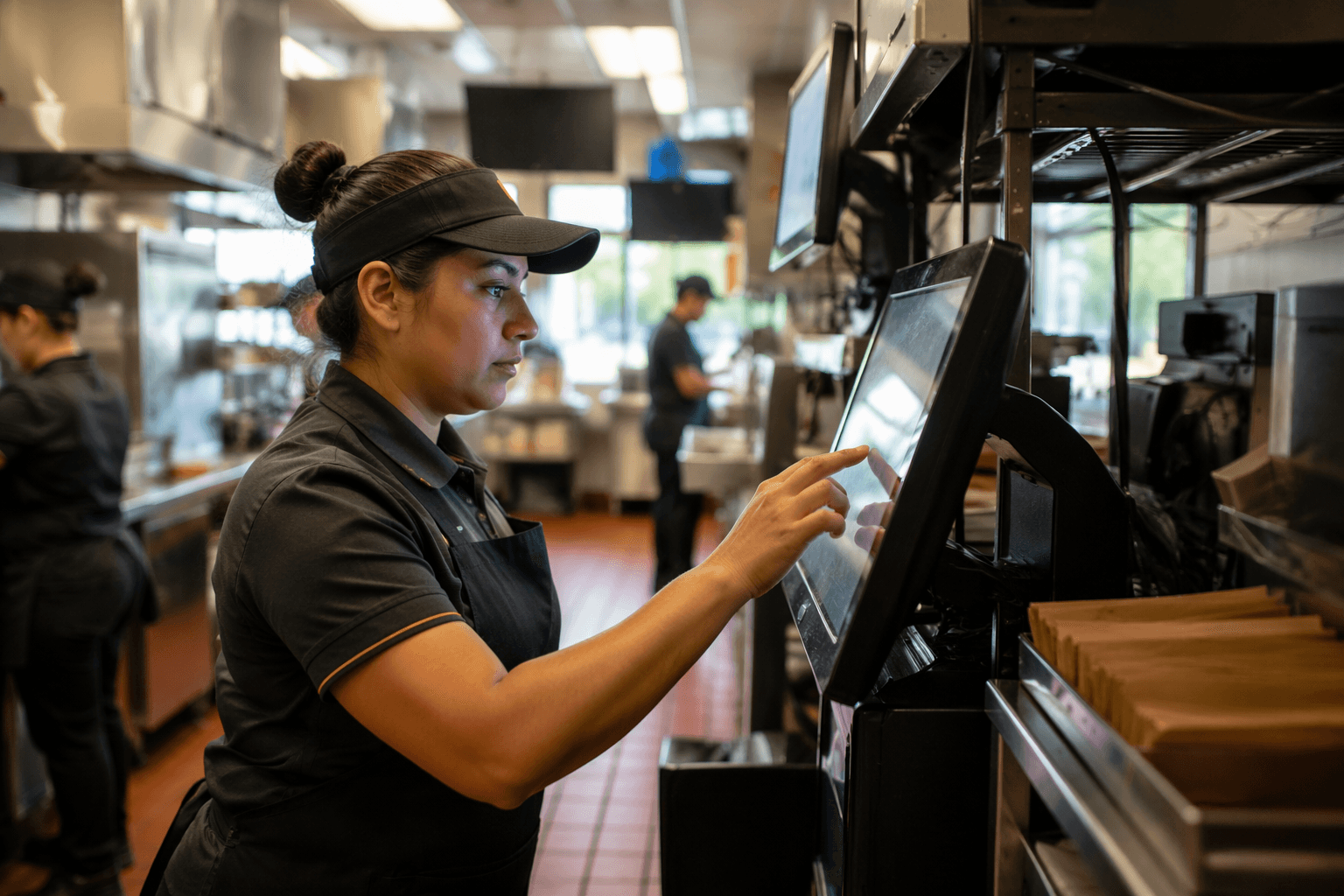
That skepticism matters at McDonald’s, where every new system reaches the most unforgiving test in food service: the rush. A tool that looks smart in a demo can still slow down a line, confuse a manager, or create another screen for a crew member to babysit. For a chain that sits inside the larger fight over labor costs, Fight for $15, and minimum wage politics, the question is not whether technology sounds modern. It is whether it makes the shift easier.
What McDonald’s is actually trying to fix
McDonald’s has spent years building a digital strategy around restaurants, guests, and crews, and its own language makes clear that the goal is operational, not decorative. In August 2025, the company described Digitizing the Arches as a once-in-a-generation transformation and said Restaurant Platform Edge was already live in hundreds of U.S. restaurants and expanding globally. McDonald’s said that platform would power AI- and IoT-enabled kitchens designed to increase uptime, improve food quality, and smooth the experience for customers and crew.
That is the right standard for workers to use when judging the next rollout. If a system helps keep a grill running, keeps fries and sandwiches moving, or cuts down on missing items, crews notice immediately. If it only adds jargon, training time, or troubleshooting calls, the burden lands on the people earning the least and moving the fastest.
McDonald’s also said in December 2023 that it planned to connect thousands of restaurants worldwide with Google Cloud technology beginning in 2024. The company framed that partnership around improving operations and the customer and crew experience, which is the more useful way to think about AI in a restaurant: not as a headline, but as infrastructure. In a system this large, the only meaningful question is whether the technology reduces friction where people actually work.
The strongest tools are the ones crews barely notice
McDonald’s recent Accuracy Scales are a good example of the gap between useful automation and hype. The company says the system compares target versus actual order weight and flags missing items before an order reaches the customer. It has already been deployed across thousands of restaurants in Drive Thru and Delivery channels in a dozen markets.
That kind of tool does not need a flashy pitch to matter. If it catches a missing burger before the customer gets home, that saves a remake, a complaint, and a manager intervention. If it helps a drive-thru lane move without a last-minute scramble, the entire shift feels the benefit. But the flip side is just as important: when technology is slow, confusing, or unreliable, the crew gets stuck doing the cleanup work. The burden of a bad system is never distributed evenly.
For McDonald’s managers and franchisees, that is the practical test for any AI product coming through the door. It should lower error rates, improve speed, or save time in a way that store-level teams can actually feel. If it does not, it is not operational innovation. It is another layer of work with a polished name.
McDonald’s has already seen what happens when AI does not hold up
The company’s recent history makes the current skepticism easier to understand. In October 2021, McDonald’s and IBM announced an agreement to accelerate automated order taking at the drive-thru. The pitch was straightforward: make ordering faster and better for customers and crew. By June 2024, McDonald’s said it would end the AI drive-thru test at more than 100 restaurants and remove the technology by July 26, 2024 after a two-year trial.
That retreat matters because it shows McDonald’s is willing to pull back when a tool does not work in real restaurant conditions. Drive-thru AI had to face noise, accents, fast speech, menu changes, and the pressure of a live line. Those are exactly the kinds of realities that turn a clean demo into a messy shift. The lesson for workers is not that automation is dead. It is that the company has already learned that some products do not survive contact with the restaurant.
At the same time, McDonald’s is still thinking at massive scale. In December 2023, it said it wanted to grow its loyalty program from 150 million to 250 million 90-day active users by 2027 and was targeting 50,000 restaurants by 2027. That scale raises the stakes for every software decision. A tool that fails in one store is a nuisance. A tool that fails across thousands of stores becomes a staffing, training, and brand problem.
Why the operator mood shift matters for crews and franchisees
The mood shift at the restaurant show is important because it changes the burden of proof. Vendors can no longer assume that slapping AI on a product makes it compelling. One operator’s impatience, even with a service as routine as hood-degreasing, captures the moment: not every task needs a machine-learning rebrand.
For McDonald’s workers, that is a useful line in the sand. Store teams should expect more tech in scheduling, routing, marketing, inventory, and drive-thru support, but not all tech is equally useful. Crew members, managers, and franchise operators should judge each tool by three blunt questions:
- Does it make the shift faster?
- Does it reduce errors or rework?
- Does it save time without adding new headaches?
Those questions matter because McDonald’s is a system built on speed, consistency, and thin margins. Corporate strategy may talk about AI, cloud, and transformation, but the real measure is whether a tool helps the person on headset, the person on fries, or the manager covering a call-out at lunch rush.
The restaurant industry is done giving AI the benefit of the doubt. McDonald’s still has a chance to make technology feel useful instead of ornamental, but only if it keeps proving that the gains reach the floor. In a business as labor-intensive as fast food, that is the only kind of innovation that counts.
Know something we missed? Have a correction or additional information?
Submit a Tip