Anthropic Claude Usage Limits at Peak Hours Pose Risk to Monday.com Agent Workflows
Anthropic's 5-hour Claude session allotments deplete faster at peak hours, threatening reliability of Monday.com's agent automation at the worst possible time.
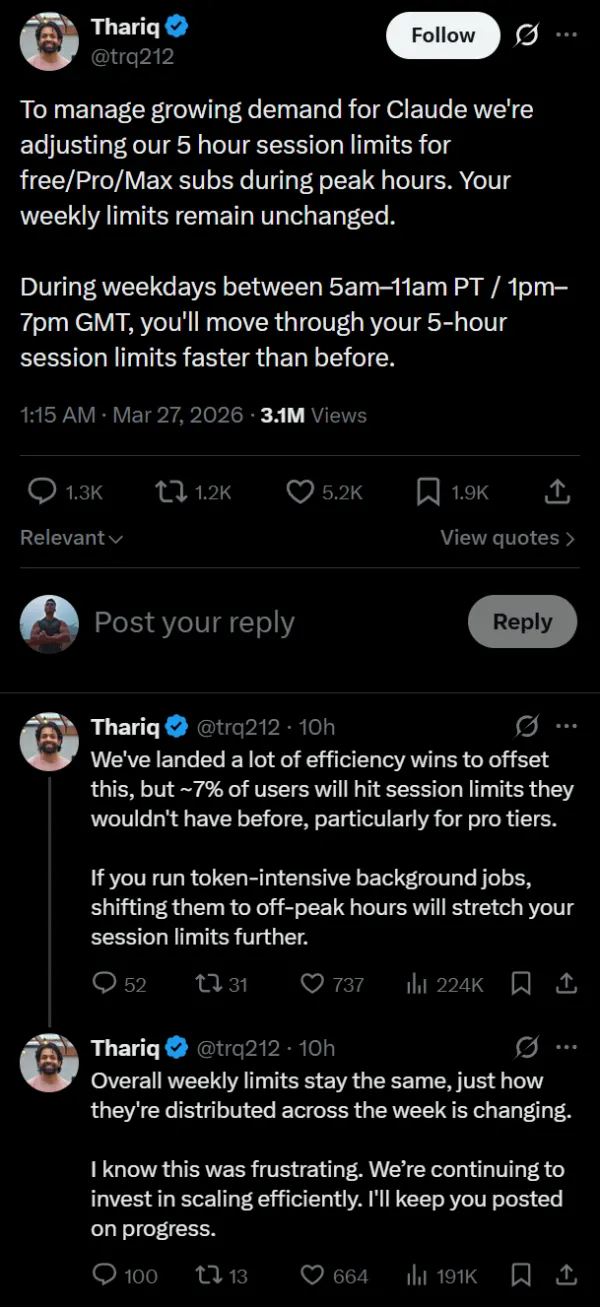
Anthropic confirmed last week that its Claude session allotments, nominally set at five hours, consume quota faster during weekday peak hours than the stated limit implies. The disclosure, which came in response to user reports about inconsistent session behavior, landed with particular weight for Monday.com engineering and product teams whose agent workflows depend on predictable, low-latency access to Claude in production environments.
The practical consequence is not abstract. When an agent executing a multi-step business process inside a customer account hits a vendor-imposed rate ceiling mid-run, the result is not a clean failure. It is a partial execution: records partially updated, tasks partially assigned, automations partially triggered. That kind of incomplete state requires manual cleanup, which converts a promised productivity gain into a support ticket and an SRE incident.
Monday.com's agent strategy, and the broader competitive positioning of its Work OS platform, rests on the assumption that model access is reliable enough to serve as operational infrastructure. The Anthropic situation illustrates that public quota pools are subject to contention, and that peak-hour degradation is a structural feature of shared API access, not a bug that will be patched away.
For engineering teams, the near-term remediation work is clear: agent runtimes need a provider-agnostic orchestration layer capable of retrying failed calls, backing off on rate-limit signals, and falling back to alternate models or cached behaviors when Anthropic's quota is exhausted. That requires prompt and response adapters normalized across providers, which is non-trivial engineering work but increasingly table stakes for any platform competing on agent reliability. Agent schedulers should also run preflight quota checks before initiating multi-step flows, with configurable degradation modes, so that a constrained session triggers a reschedule or a stakeholder notification rather than a silent partial execution.

On the observability side, SRE and reliability teams should be building toward explicit SLOs that cover agent-driven tasks specifically, not just API uptime. Metrics tracking end-to-end task success rates, partial-completion rates, and vendor-induced latency spikes are the instrumentation needed to detect these incidents before enterprise customers do.
The commercial dimension matters too. Sales engineers and customer success managers running agent demos or proofs of concept need to build vendor-dependency language into their scripts and set explicit performance expectations before contracts close. For high-value accounts with zero tolerance for automation gaps, the viable options include dedicated model capacity or pre-purchased compute allotments where Anthropic's programs allow, which sidestep the public quota contention that drives peak-hour degradation.
The deeper issue for Monday.com is timing. The company is in the middle of an aggressive agent buildout, and enterprise buyers are evaluating agent platforms on reliability, not feature lists. A vendor quota constraint that surfaces as a production incident inside a customer's account does not read as an Anthropic problem; it reads as a monday.com problem. Building resilient runtimes before that happens is cheaper than explaining it after.
This article was produced by Prism’s automated news system from verified source data, official records, and press releases, then run through automated quality and moderation checks before publishing. The system is built and supervised by the people who set the standards it runs under. Read our full AI policy.
Did this article answer your question?