Cloudflare cuts 1,100 jobs, says AI made roles obsolete despite record revenue
Cloudflare cut more than 1,100 jobs while revenue hit $639.8 million, signaling how fast AI is moving from productivity tool to headcount test.

Cloudflare just drew one of the clearest lines yet between AI adoption and headcount reduction in SaaS. The San Francisco company said it was cutting more than 1,100 employees globally, about 20 percent of its workforce, even as first-quarter revenue reached a record $639.8 million, up 34 percent from a year earlier.
That combination matters far beyond Cloudflare. The company reported a GAAP loss from operations of $62.0 million, but its business was still growing sharply, and current remaining performance obligation rose 34 percent year over year. This was not a collapse-driven layoff. It was a restructuring tied to how Cloudflare says AI has changed the amount of work it needs to keep doing.
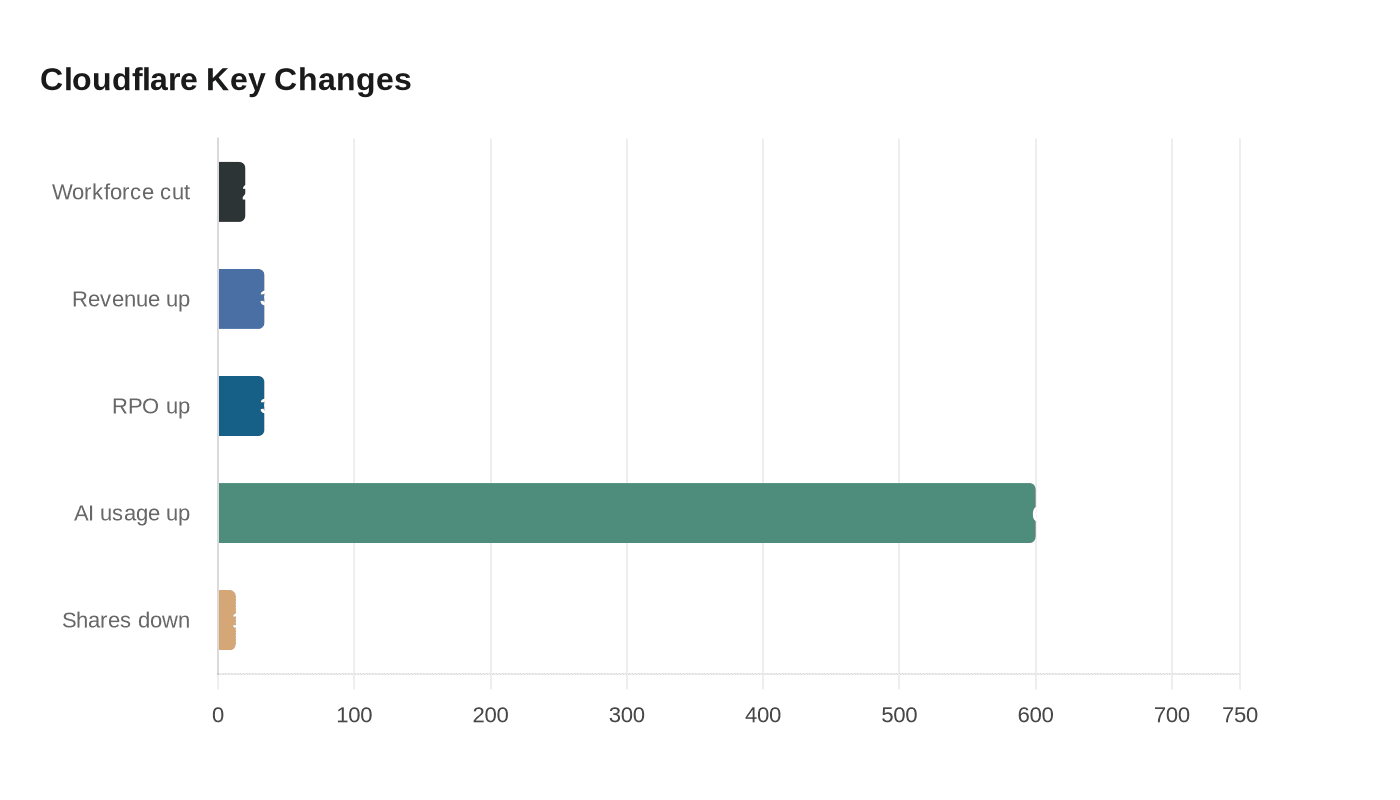
Matthew Prince said the company had never made a move like this before, and Cloudflare framed the cuts as part of an AI-driven operating model rather than a standard cost-cutting exercise. Internal AI usage at the company rose more than 600 percent in the prior three months, and staff in engineering, HR, finance and marketing were already running thousands of AI-driven workflows each day. For people working inside monday.com, that is the real signal: productivity is no longer being measured only by output per person, but by how quickly a company can redesign the team around software that does some of the work itself.
The layoffs also showed how selectively that logic is being applied. Cloudflare said salespeople who carry revenue quotas would be treated differently, while headcount was reduced across functions and geographies. In other words, roles closest to direct revenue still have a stronger shield than support, coordination and process-heavy work. That puts pressure on product, operations and back-office teams across SaaS to prove that their work is not just useful, but hard for AI to absorb or automate.
Cloudflare had 5,156 full-time employees at the end of 2025. The company said departing workers would receive full base pay through the end of 2026, U.S. health care support through the end of the year and additional equity vesting treatment through August 15. Even with those terms, this was the first large-scale layoff in Cloudflare’s 16-year history, which makes it a useful marker for how quickly the AI narrative has moved from experimentation to workforce planning.
The market reaction was immediate. Reuters reported that Cloudflare shares fell more than 13 percent in extended trading after the announcement, even as the company forecast second-quarter revenue of about $664 million to $665 million. For public SaaS companies, the message is blunt: strong growth no longer protects teams from cuts if leadership believes AI can compress the work.
Know something we missed? Have a correction or additional information?
Submit a Tip