Google Workspace updates spotlight AI expansion and tighter access controls
Google is making Workspace more useful and more locked down at once. For monday.com teams, that raises the bar on AI that works inside routine tools and stays governed.
AI is moving deeper into everyday work
Google Workspace’s latest updates point to a familiar but important shift in enterprise software: less jumping between tools, more assistance inside the tools people already use. Gemini in Chat now supports message refinement in French, German, Italian, Japanese, Korean, Portuguese, and Spanish, alongside English, which makes the feature more practical for distributed teams that do not work in one language all day. For employees, that means fewer rough drafts sent out of Chat and fewer extra steps to polish a message before it goes to a client, manager, or internal partner.

That language expansion matters because it shows where mainstream workplace AI is headed. The best use cases are no longer limited to flashy prompt boxes or standalone copilots. They are embedded in routine communication, where speed and clarity matter most. In practice, this makes AI feel less like a special project and more like a daily utility, especially for global teams that already live in Slack-style or chat-first workflows.
Governance is becoming part of the product, not an afterthought
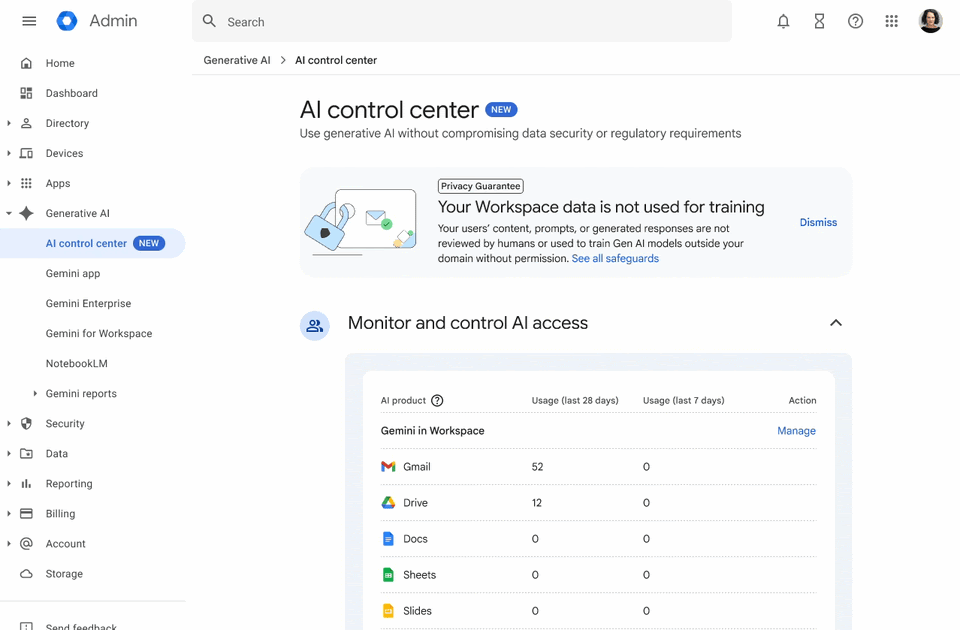
The other half of Google’s update is just as telling: administrators can now apply a default Context-Aware Access policy to all SAML applications as a universal security baseline. Google’s Help Center says that default policy acts as a backup when a SAML app does not have its own Context-Aware Access policy, which gives security teams a cleaner way to cover gaps without managing every app one by one.
Google’s documentation also shows how granular that control can get. Context-Aware Access can use signals such as user identity, location, device security status, and IP address. Google’s rollout guidance recommends monitor mode before active enforcement, a detail that will sound very familiar to any manager who has seen automation and security changes stall because no one wanted to break access for a critical team. The message is clear: AI may be expanding, but the approval and enforcement layer around it is getting stricter and more formal.
Why this changes the day-to-day experience
For employees, the practical effect is fewer manual steps in routine work, but not fewer rules. A polished message in Chat, a better-integrated support workflow, or a notebook pulled into an automated flow all reduce friction. At the same time, access policies are being pushed toward defaults, baselines, and monitoring, which means people will run into more system-level controls on where they can work, from which device, and under what conditions.
That combination is the real workplace story. Companies do not just want AI that helps someone write faster or route a task faster. They want AI that can be audited, scoped, and measured. In day-to-day terms, that means workers may notice smoother handoffs and fewer app switches, while managers and IT teams spend more time deciding which automations are allowed to run, which data they can see, and when a policy should trigger a block instead of a warning.
The integrations show where work software is converging
Google’s updates to Datadog and ServiceNow reinforce the same direction. The Datadog app for Google Chat gained new features, including link previews, which makes operational data easier to surface without leaving the conversation. Customers can also deploy ServiceNow Now Assist Virtual Agent for Google Chat directly from the Google Workspace Marketplace, which reduces the friction of bringing support automation into a place employees already use.
That matters because the modern workplace is being shaped by a simple expectation: information should arrive in context, not after a long chain of clicks. A marketer wants to see the status of a campaign without digging through dashboards. An engineer wants an alert and the relevant link in the same thread. A service desk wants employees to get help without opening yet another portal. Google’s moves suggest it understands that the battle is now about blending operational data, support workflows, and conversational interfaces into one surface.
NotebookLM inside flows pushes AI from helper to workflow ingredient
The NotebookLM update goes one step further. Google Workspace said users can now use NotebookLM as an AI knowledge source inside Workspace Studio flows, turning notebooks into part of the automation layer rather than a separate reference tool. That is a meaningful shift because it gives enterprise AI more context-rich behavior. Instead of generating generic output, a flow can draw from structured knowledge and then act on it.
For managers, this creates a different kind of oversight problem. If AI can use notebook content inside a workflow, the question is no longer whether the tool can answer a question. It becomes whether the knowledge source is current, approved, and appropriate for the action it triggers. That is exactly the kind of use case where governance has to keep pace with automation, not trail it.
Workspace Intelligence shows the direction of travel
Google’s April 2026 Workspace Intelligence framing makes the bigger strategy even clearer. It says generative AI tasks in Workspace will be grounded in data across Gmail, Chat, Calendar, and Drive, and admins can control which data sources are allowed. That is the model enterprise buyers increasingly expect: broad AI capability, but only inside defined boundaries.
This is also where the implications for monday.com become sharper. If Google can keep adding app integrations and automated knowledge flows while tightening access controls, the baseline for any work OS rises quickly. Users will expect better context across systems, fewer disconnected handoffs, and clearer permissioning around every AI action that touches work data.
What it means inside monday.com
monday.com has already started describing itself as an AI Work Platform, and that positioning makes Google’s updates feel less like outside noise and more like a competitive benchmark. The company says its AI agents draw on live data across departments, workflows, and priorities while still operating within existing permissions, security, and governance. It also said it launched infrastructure for external AI agents to sign up, authenticate, and operate directly within the platform, where they can organize projects, update workflows, trigger automations, generate reports, and coordinate work across teams.
For product and engineering teams, the pressure is obvious: the next wave of workplace AI will be judged less by novelty and more by how safely it can execute. For sales teams, the conversation with customers will keep shifting toward integration depth, security posture, and whether AI can work on top of existing systems without creating risk. That is especially important for a company that said it finished fiscal 2025 with more than 250,000 paying customers, 4,281 customers generating more than $50,000 in ARR, and net dollar retention of 110% overall and 116% for customers above that threshold, alongside revenue of $1.232 billion, up 27% year over year.
The takeaway for monday.com is straightforward: the market is no longer asking whether AI belongs in work software. It is asking whether AI can be made useful enough for everyday employees and controlled enough for the people responsible for the workflow. Google’s latest Workspace changes show that both requirements are now table stakes.
This article was produced by Prism’s automated news system from verified source data, official records, and press releases, then run through automated quality and moderation checks before publishing. The system is built and supervised by the people who set the standards it runs under. Read our full AI policy.
Did this article answer your question?