Monday.com shared inbox guide turns email replies into revenue workflows
A campaign reply can disappear in minutes. monday.com’s shared inbox guide reframes that risk as a revenue problem, not an email problem.
Why inbox chaos costs revenue
A campaign reply can disappear in minutes, and that is the real problem monday.com is trying to solve. When a high-intent lead answers an email, the question is not whether someone saw the message. The question is whether the right person owned the next step fast enough to keep the deal alive.

That is why the shared inbox guide matters. It treats inbox management as workflow design: every reply, inquiry, and follow-up gets pulled into one central feed so the team can see what is happening, assign ownership, and stop relying on forwarded messages and informal handoffs. For sales and marketing teams, that shift is bigger than convenience. It is the difference between a response being handled as a routine note and a response being treated like pipeline.
What monday.com is really selling
monday.com’s argument is that generic inboxes flatten urgency. They treat a lead who just raised a hand the same way they treat a mundane internal thread, and that is where conversion opportunities get lost. The shared inbox guide is framed around 11 shared inbox platforms for marketing teams, but the through line is simpler: if the team cannot see the conversation, route it quickly, and tie it back to the source campaign, it cannot manage revenue with any discipline.
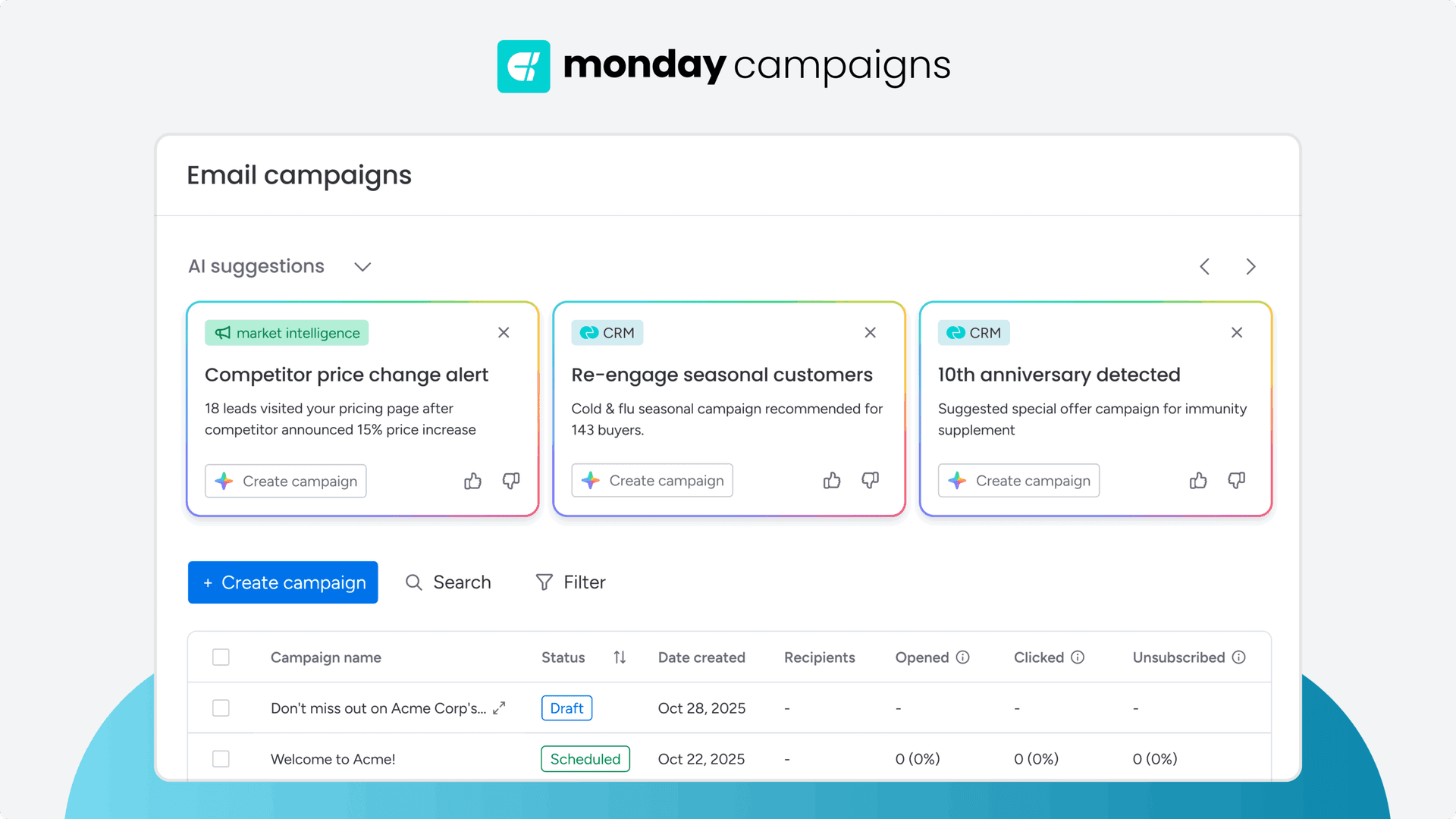
That is where monday campaigns fits. monday.com says the product is an AI-powered addition to the monday CRM suite that helps marketers create, launch, and optimize campaigns connected directly to revenue. The company’s own positioning is explicit: this is not just a tool for sending messages. It is built to connect replies back to the campaign that generated them, so the team can understand which efforts are producing attention and which ones are producing actual business.
From shared inbox to revenue workflow
The practical value of a shared inbox is not the inbox itself. It is the workflow around it. In monday.com’s framing, shared inbox software helps teams do three things that matter immediately in a revenue org: track conversations, assign ownership, and connect responses to results.
That matters because cross-functional work breaks down when nobody knows who owns the next move. Sales wants the hot lead. Marketing wants proof the campaign worked. Customer success wants the context so the follow-up does not start from zero. Shared inbox systems answer that ownership problem by making the next step visible inside the same workflow that captured the lead in the first place.
For monday.com employees working on CRM, campaigns, or automation, that is also a clue about how the market is changing. Buyers are not asking for another communication layer. They want a system that can turn attention into action, then prove the action led somewhere measurable. That is why revenue attribution, lead qualification automation, and AI-powered routing of high-intent prospects show up as core capabilities, not add-ons.
The feature set that makes the model work
The guide and monday.com’s support materials point to a specific operating model inside monday campaigns. The product emphasizes workflows, segmentation, analytics, UTM tracking, and campaign setup, all inside the CRM environment. Put together, those functions turn a shared inbox from a passive message bucket into a live control room for campaign response.
The useful pieces are straightforward:
- Centralized replies so campaign responses do not split across personal inboxes
- Ownership assignment so one person is accountable for the next step
- Revenue attribution so teams can trace a reply back to the campaign that drove it
- Lead qualification automation so the highest-value prospects are surfaced faster
- AI routing so high-intent replies move to sales without delay
- UTM tracking and analytics so the team can see which campaigns are generating real engagement
That is the logic behind monday.com’s broader message: response speed is not just a service metric. It is a sales outcome. If a lead has to sit in a queue while people forward the message around, the company is already paying for the delay in lost momentum.
Why this fits monday.com’s broader product strategy
monday campaigns did not appear in isolation. monday.com introduced it at Elevate 2025 in September 2025, and the launch fit a larger product push around AI-powered capabilities across the platform. In Q3 2025, the company said new products accounted for more than 10% of total ARR, which is a strong signal that monday is not treating these launches as side projects.
The CRM side of the business has also become more central to the story. In Q2 2025, monday.com said monday CRM had recently reached $100 million in ARR. That matters because it shows the company’s move deeper into revenue workflows is not theoretical. It is becoming a meaningful part of the product and financial mix.
The scale behind that push is substantial. monday.com reported 2025 fiscal-year revenue growth of 27%, said it ended 2025 with more than 250,000 customers, 4,281 customers above $50,000 in annual recurring revenue, and 3,155 employees as of December 31, 2025. Those numbers help explain why a shared inbox guide is more than a how-to article. It is a window into how monday.com wants the market to understand its platform: as infrastructure for revenue execution, not just task tracking.
What sales, support, and marketing leaders should take from it
For sales leaders, the lesson is ownership. A lead reply is only valuable if it reaches a person fast enough to respond with context. For support and customer success, the lesson is continuity. Customers should not have to repeat themselves because a thread fell through a crack. For marketing, the lesson is attribution. If a campaign generates replies but the team cannot trace the handoff, the campaign is not fully measurable.
That is the deeper story in monday.com’s shared inbox guide. The company is saying inboxes are no longer just places where messages live. They are where revenue either moves or stalls. And by putting campaigns, automation, analytics, and routing into one flow, monday.com is making a larger case about how work should be organized in 2026: every reply should have an owner, every owner should have context, and every interaction should be tied back to business results.
Know something we missed? Have a correction or additional information?
Submit a Tip