Nintendo Engineers Reveal How Donkey Kong Bananza Recycles Assets for Voxel Destruction
Nintendo's Maya-to-Houdini pipeline lets artists recycle existing 3D models as voxel terrain, helping a small team pack 347 million destructible voxels into every average Bananza level.
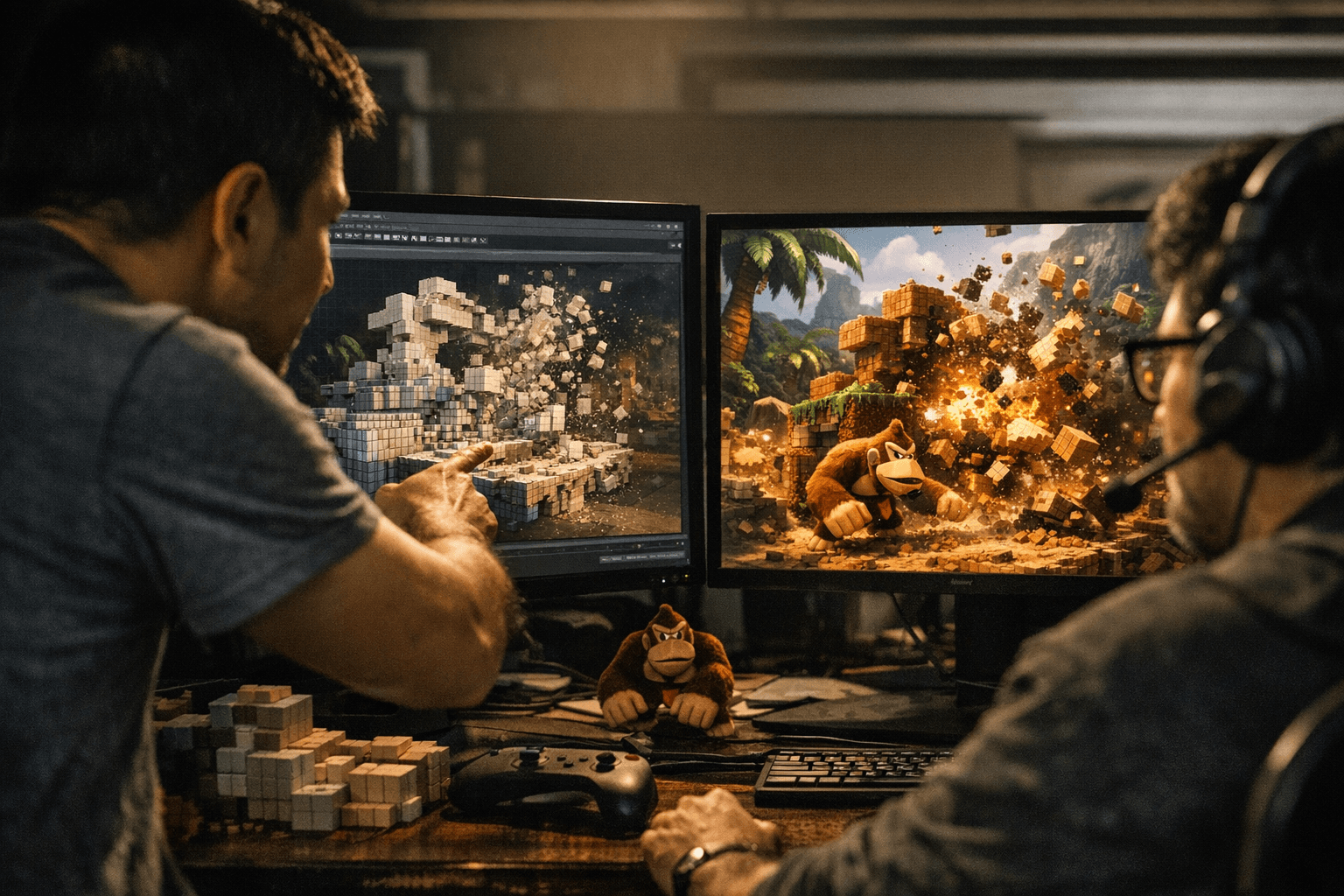
Tatsuya Kurihara walked a packed San Francisco room through a Void Kong head at GDC 2026 on March 26: modeled in Maya, run through Houdini, delivered at runtime as fully destructible terrain. No bespoke voxel model. No second authoring pass. The same 3D asset an artist already built, converted into smashable landscape for Donkey Kong Bananza.
That single demo encapsulated the production principle Kurihara and producer Kenta Motokura spent their GDC Festival of Gaming session detailing. Their Maya-to-Houdini pipeline lets artists sculpt objects in conventional 3D workflows, then hands those assets to a deterministic conversion step that generates voxel data before the engine voxelizes them at runtime. In a post-talk interview, Kurihara confirmed Nintendo applied the pipeline to previously-made 3D assets, reusing existing models inside voxel environments rather than commissioning replacements. The result: an average level in Bananza contains 347,070,464 individually destructible voxels.
The production logic behind that number is what teams building similar systems should study. The conversion pipeline did not replace direct artist tooling. It extended it. Kurihara noted that the voxelization step came later in Bananza's development, after the programming team had already given artists and designers their own tools to create voxel content from scratch. The pipeline gave those same artists a second lever: author a 3D object once in familiar software, then deploy it as terrain. The per-asset cost drops without reducing creative control at the front end.
For producers, that sequencing carries a specific lesson. The converter tooling was development investment, not a late-stage optimization bolted on after content locked. Building it early shifted what would otherwise become crunch-time rework into a planned, repeatable pipeline. Art teams populated enormous destructible environments without proportional headcount growth because the tooling did the conversion work at scale.
The voxel technology itself has a clear lineage inside Nintendo. Kurihara built the destructible snow drifts and cheese blocks in Super Mario Odyssey, where both he and Motokura worked. After Kurihara prototyped a Goomba bashing through Odyssey's Wooded Kingdom using expanded voxel mechanics, Motokura pushed to build an entire Donkey Kong game around the idea. The design brief Motokura described at GDC was three words: "Destruction. Destruction. Destruction."
Kurihara's framing of the design problem explains why the asset-reuse pipeline reinforced, rather than undermined, visual quality. "It's more fun to destroy something that doesn't look like it can be destroyed," he said during the presentation, speaking through a translator. Reusing polished 3D models as terrain meant the environments looked finished and detailed, which made the destruction land harder.
Early QA integration was treated as structural, not optional. At 347 million voxels per level, test surface is enormous: collision edge cases, physics persistence, memory consumption, and performance spikes all become functions of player behavior rather than fixed geometry. Automated regression baselines for performance were cited as essential infrastructure, particularly given the combinatorial scale of what players can trigger.
Localization teams carry a quieter operational risk in this model. When 3D assets feed automated pipelines, text dependencies and UI elements can propagate through the conversion step without a visible content-authoring event. Identifying localization-sensitive assets before they enter the pipeline is substantially easier than resolving mismatches after voxelization.
The session, titled "Constructive Destruction: Fusing Voxel Tech and 3D Action Platforming in Donkey Kong Bananza," represents one of Nintendo's more granular public disclosures of a production pipeline. The Maya-to-Houdini workflow Kurihara described is specific enough that a tools team could scope a prototype against an existing content slice without waiting for a greenlit project to test it against.
This article was produced by Prism’s automated news system from verified source data, official records, and press releases, then run through automated quality and moderation checks before publishing. The system is built and supervised by the people who set the standards it runs under. Read our full AI policy.
Did this article answer your question?
