Nintendo manufacturing engineer role highlights packaging and quality controls
Nintendo’s manufacturing engineer role shows quality control reaching beyond code into packaging, compliance, and shipment readiness, where launch reliability and brand trust are decided.
Packaging is part of the product, not the wrapper
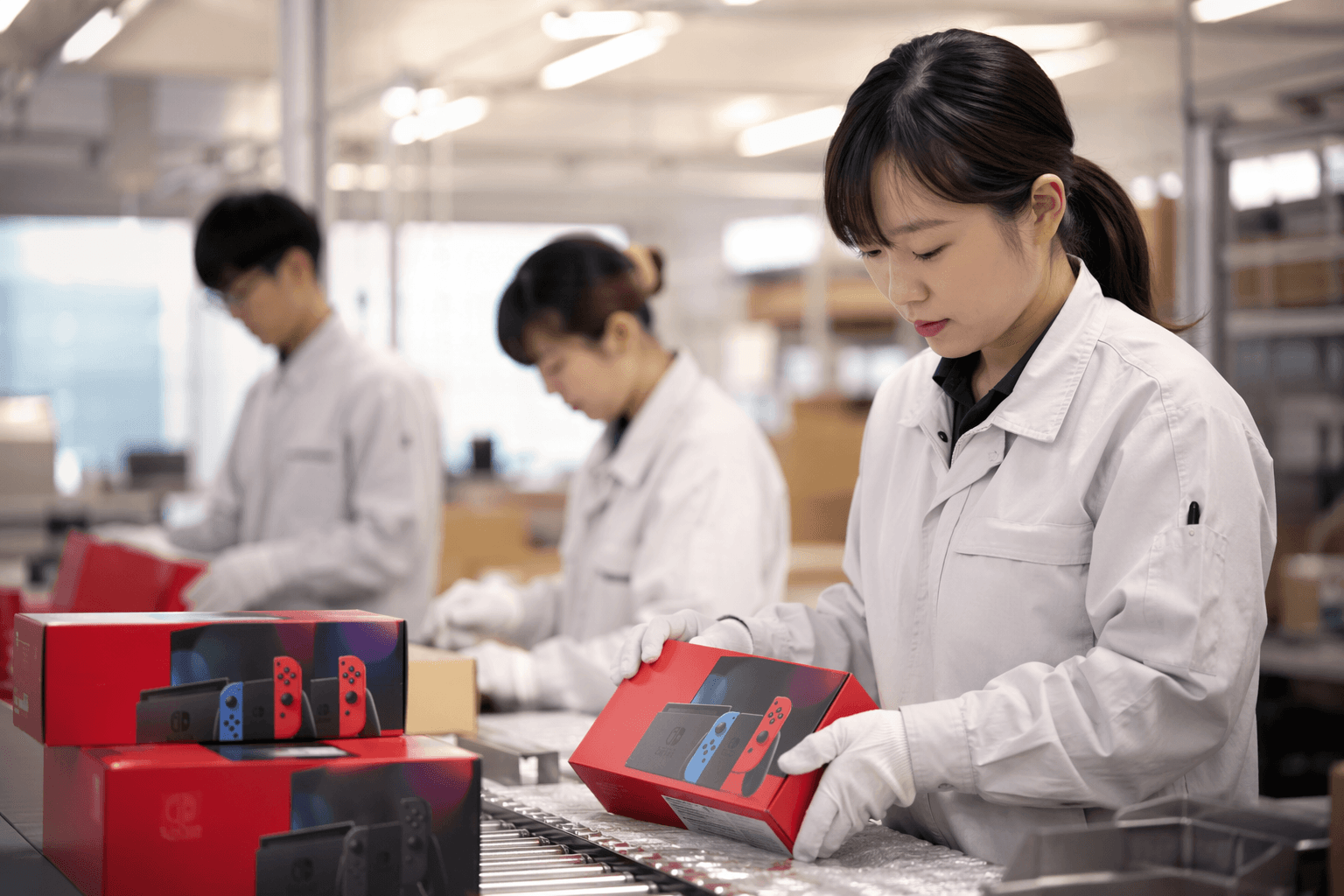
Nintendo’s Manufacturing Engineer role makes one thing plain: at this company, quality control does not stop when the game is finished or the hardware turns on. The job spans product assembly, packaging, quality risk assessment, safety and compliance review, production-part performance evaluation, root cause analysis, corrective action, and validation testing. That is a broad mandate, but it reflects a very specific Nintendo reality: if the box, insert, component, or vendor process is wrong, the customer still experiences it as a Nintendo product failure.
That matters in a quality-first culture because the engineer is not just checking finished goods after the fact. The posting points to a preventive model, one where the role helps define product and assembly documents, reviews partner quality management systems, and recommends design validation testing for new components and packaging materials. In practice, that means manufacturing judgment sits upstream of the customer experience, shaping whether a launch runs smoothly, whether returns spike, and whether the brand keeps its reputation for polish.
How the role turns engineering into process control
What stands out in the posting is how many of the responsibilities happen before a product reaches a shelf. Supporting corrective-action requests is not just about fixing defects that already exist; it is about tracing failures back into the process that allowed them in, then tightening that process before volume ramps. The same logic applies to design validation testing for new components and packaging materials. If a part, insert, or carton does not survive real-world handling, the engineer’s job is to catch that before it becomes a warehouse, retailer, or customer problem.
For hardware teams, this is a reminder that product quality is a manufacturing system, not just a design aspiration. For QA and operations staff, it shows that defect reduction is being approached from two sides at once: test results and process design. That combination is especially important at Nintendo, where the company’s hardware reputation has long depended on execution as much as on ideas.
Why Nintendo of America is the place for this work
Nintendo of America says it partners closely with Nintendo Co., Ltd. to bring Nintendo’s franchises across the Americas through video games, hardware systems, and collaborations. That partnership helps explain why a manufacturing-engineering role sits in the U.S. operation even though Nintendo’s roots are in Kyoto. The company’s mission is to put smiles on the faces of everyone it touches, and it says it has been building that business since 1889, when it began making hanafuda playing cards in Kyoto, Japan.
That history matters because Nintendo is not just a software publisher with a hardware side business. It is a consumer brand whose reputation lives or dies on consistency across markets. A manufacturing engineer in the Americas helps translate global product intent into physical delivery that works locally, whether that means line-side assembly control, packaging compliance, or vendor oversight.
Compliance is part of the quality story
The regulatory layer in Nintendo’s materials gives the role even more weight. Nintendo support pages maintain CPSIA compliance documentation for North American products, and Nintendo UK says Nintendo of Europe and its products comply with applicable European Union directives and regulations tied to environmental protection and consumer health and safety with respect to the manufacture, supply, and use of Nintendo products. That means the job is not only about performance and appearance; it also sits inside a multi-market compliance framework.
For business and operations professionals, that is the real map of the work. Packaging choices can influence safety disclosures, shipping durability, product presentation, and compliance handling at the same time. A bad packaging decision is rarely just a packaging problem. It can become a regulatory problem, a logistics problem, and a customer-trust problem all at once.
Nintendo’s support materials reinforce that broader structure. The company maintains product inserts, health and safety documents, and compliance documents across systems, which shows how much of the customer-facing experience is built around controlled physical information as well as controlled software behavior. The manufacturing engineer sits close to that infrastructure.
The customer-service cost of missing defects
Nintendo’s warranty policy makes the downstream stakes easy to see. Covered hardware defects are repaired or replaced free of charge, and warranty-service replacements may require freight-prepaid and insured shipping. Nintendo also says refurbished replacement parts or products must meet functional new-product specifications. In other words, if a defect escapes manufacturing, the company pays for it again, in service labor, replacement inventory, shipping, and customer friction.
That is why the role’s emphasis on root cause analysis and corrective action matters so much. It is less expensive to improve the process than to move units through warranty service after the fact. It is also why quality control at Nintendo cannot be reduced to a final inspection step. The engineer’s job is to lower the chance that the warranty team has to become the cleanup crew.
Licensed products and the wider brand perimeter
Nintendo’s licensed-product guidance adds another layer to the story. The company says licensed accessories and merchandise are evaluated and licensed by Nintendo, which shows that its quality perimeter extends beyond first-party hardware. That is a meaningful signal for anyone inside the company working on design, QA, or vendor relations: the Nintendo brand is protected not only by what the company builds itself, but also by what it approves.
That broader gatekeeping helps explain why the manufacturing-engineering role cares about packaging and partner quality systems. If the company is going to stand behind an accessory, a component, or a shipment format, the approval process has to be real, not symbolic. The box, the insert, the materials, and the partner’s process all become part of the brand promise.
Why this role feels especially relevant now
Nintendo has already lived through the reputational cost of a visible hardware issue. Its support materials and the long-running public discussion around Joy-Con drift show how a controller-quality problem can become a brand story that reaches far beyond engineering circles. That history gives the Manufacturing Engineer posting extra significance, because it points to the exact functions that help prevent repeat failures: corrective-action requests, partner quality review, and validation of new components and packaging.
For developers, designers, QA testers, and business teams inside Nintendo, the lesson is direct. The company’s quality standard is not only about how a game plays or how a device feels in hand. It is about whether the product survives manufacturing reality, crosses borders cleanly, lands in the customer’s hands intact, and avoids sending the same unit back through the service loop. That is where engineering judgment becomes brand protection, and where Nintendo’s promise is either reinforced or quietly lost.
This article was produced by Prism’s automated news system from verified source data, official records, and press releases, then run through automated quality and moderation checks before publishing. The system is built and supervised by the people who set the standards it runs under. Read our full AI policy.
Know something we missed? Have a correction or additional information?
Submit a Tip