Nintendo posts rare UX engineer role for internal developer tools
Nintendo's NTD posted an Engineer, UX role focused on a shared React component library for developer tools, a sign internal tooling now sits closer to the company's product core.
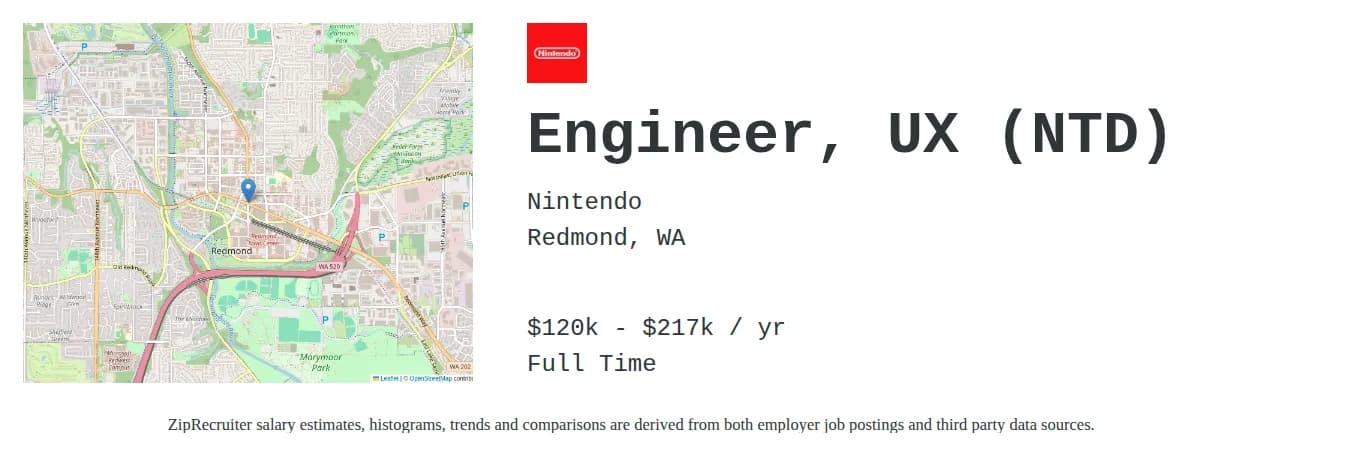
Nintendo is looking for a UX engineer to do more than polish screens. The role sits inside Nintendo Technology Development in Redmond, Washington, and centers on the core development of a shared component library for developer-facing applications, work that affects how software design, coding and testing teams build internal tools.
The posting puts unusual detail around a job category that rarely gets public attention at Nintendo. The engineer would develop the React component library, evangelize it across the organization, and make sure it conforms to Nintendo’s UX style guide. It also calls for the library to follow company guidelines and meet WCAG 2.0 accessibility requirements, which puts the work squarely in the lane of reusable systems, consistency and usability rather than visual flair alone.
For developers and QA staff, that matters. A shared component library can determine whether tools feel coherent from one team to the next, whether features can be shipped without reinventing the same interface pieces, and whether bugs get introduced because every group is building its own version of the same control. The job also signals that Nintendo expects the UX engineer to move across boundaries, with possible collaboration among Nintendo Co., Ltd., subsidiaries, external vendors and partners. That is the kind of role that sits at the intersection of engineering discipline and product governance.

Nintendo Technology Development itself plays a broader role in the company’s hardware and software stack. Nintendo describes NTD as a wholly owned subsidiary based in Redmond that researches and develops technologies powering Nintendo platforms and games, and says the group contributes to systems like Nintendo Switch 2. That makes the UX post especially revealing: the same organization behind platform technology is also investing in the internal design systems that help other teams work faster and with fewer inconsistencies.
The timing also fits Nintendo’s Switch 2 push. Nintendo first showed the system on January 16, 2025, officially announced it on April 2, 2025, and said it would launch on June 5, 2025. The U.S. price was set at $449.99, with the Nintendo Switch 2 + Mario Kart World bundle at $499.99. In that context, a role devoted to developer-facing UX suggests Nintendo is treating internal tools as part of the product pipeline, not a back-office afterthought. For a company built on quality-first execution, that is a telling hiring signal.
This article was produced by Prism’s automated news system from verified source data, official records, and press releases, then run through automated quality and moderation checks before publishing. The system is built and supervised by the people who set the standards it runs under. Read our full AI policy.
Did this article answer your question?
