Nintendo teams urged to treat accessibility as a core discipline
Nintendo’s accessibility work is moving from feature list to production discipline, with Switch 2, storefront tags, and cross-team standards pushing earlier, better decisions.
Accessibility is now part of Nintendo’s quality bar
Nintendo’s strength has always been disciplined execution: tight controls, clean presentation, and products that feel finished. Accessibility belongs in that same lane. The IGDA Game Accessibility Special Interest Group, founded in 2003 and run by volunteers, treats accessibility as a practical craft for making games playable for everyone, not as a marketing line or a checkbox. That framing matters inside a company where polish is a core expectation, because a game can still miss large parts of the audience if the design assumes one way to see, hear, or play.
The broader lesson is simple: accessibility is not a post-launch repair job. It is a development discipline with its own tradeoffs, expertise, and production habits. When teams treat it that way, they do more than avoid barriers. They build games that are easier to understand, easier to test, and easier to support across regions, ages, and play styles.
Why the guidance is practical, not abstract
The Game Accessibility Guidelines put the issue in plain terms: accessibility means avoiding unnecessary barriers. That is a useful standard for Nintendo teams because it pushes the conversation away from sentiment and toward design decisions. If a menu cannot be navigated without precise timing, if text is too small to read comfortably, or if audio cues carry critical information without a visual backup, those are not edge cases. They are barriers that can shut players out.
The same guidance also puts the scale in context. It says 15% of the population is disabled, rising to 20% among casual gamers. It also identifies four of the most commonly complained-about issues: remapping, text size, colorblindness, and subtitle presentation. For developers, designers, QA testers, and localization staff, that is not a niche list. It is a production map. These are the places where accessibility work most often breaks when it is left until the end.
What Nintendo Switch 2 shows about the work
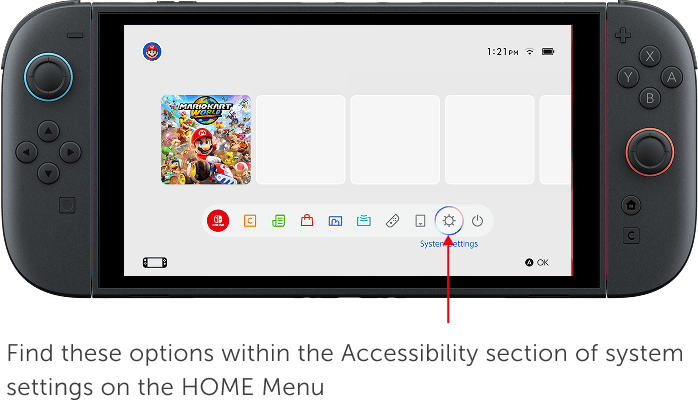
Nintendo’s own Switch 2 accessibility pages make the point that accessibility now sits inside platform design, not beside it. The system includes adjustable text size, bold text, button remapping, zoom, screen color changes, mono audio, text-to-speech, and speech-to-text for GameChat. That spread matters because it spans multiple disciplines at once: UI, controls, audio, communication, and system settings all have to cooperate.
It also shows why accessibility cannot be handed off to a single specialist near the end of the schedule. Text readability is a UI problem. Button remapping is a control-design and QA problem. Mono audio and text-to-speech touch sound design and communication flow. Speech-to-text for GameChat adds another layer, because multiplayer communication has to work for people with different motor, visual, hearing, or cognitive needs. Nintendo support also says some accessibility features are added through system updates, which is another sign that this work is ongoing platform craft rather than a one-time launch decision.
Where teams lose time by bolting it on late
Late-stage accessibility work usually fails in predictable ways. A feature that seems easy to add can expose assumptions buried across the game: fixed-size text, unskippable tutorials, interface icons with no readable backup, or a voice-chat flow that demands perfect timing. By the time those issues surface in QA, fixing them often means reworking UI layouts, retesting localization strings, revisiting audio mixes, and adjusting schedules that were built around the original design.
That is why accessibility belongs upstream. Designers need to think about legibility, control flexibility, and tutorial flow while the structure is still fluid. QA needs test cases for remapping, subtitle clarity, color differentiation, and text scaling before content locks. Localization teams need room to protect readability across languages and screen sizes. Producers need to budget for iteration, because accessibility is not a polish pass. It is part of the content pipeline.

Why this is a business issue as much as a design issue
The market case is broad, and Nintendo knows it. The Entertainment Software Association’s 2025 Essential Facts report says 205.1 million Americans play video games, half are age 35 and up, and the U.S. industry generates $95.8 billion in total economic impact while supporting more than 250,000 jobs. That is a large, varied audience with very different needs, expectations, and abilities. Accessibility is not about shrinking the experience. It is about making sure the experience reaches the audience the business already depends on.
That is especially relevant for Nintendo, whose appeal stretches from longtime franchise loyalists to newer players picking up a Switch family system for the first time. Better accessibility can reduce support friction, lower confusion around onboarding, and keep players inside the experience longer. It can also protect the quality-first brand by making sure the polish is not limited to the players who fit the default control scheme, default font size, or default hearing profile.
A more standardized language is coming to storefronts
Nintendo of America joined the Entertainment Software Association’s Accessible Games Initiative in March 2025 as a founding member, alongside Electronic Arts, Google, Microsoft, and Ubisoft, with Sony Interactive Entertainment also named among the founding companies in ESA materials. The initiative will use standardized accessibility tags on participating storefronts, product pages, and digital catalogs, with tags developed alongside players with disabilities, accessibility advocacy groups, and development teams.
That shift matters for workers because it changes how accessibility is communicated and measured. It gives publishing, storefront, product, and platform teams a shared vocabulary, which should reduce guesswork for players and pressure teams to define features more consistently. For Nintendo’s global operation, this also means accessibility cannot live only inside a single region’s support page. It has to be legible across product marketing, platform surfaces, and release planning.
What a stronger internal process looks like
For Nintendo teams, the best accessibility work starts early and travels across the whole schedule. A practical process would include:
- defining accessibility goals during concept and pre-production, not after content lock
- testing text size, subtitle presentation, and color contrast alongside art and UI reviews
- building remapping and input flexibility into control planning, not as a patch
- checking audio-dependent moments for mono, visual, and text alternatives
- involving QA, localization, UX, and audio early enough to catch avoidable barriers
- treating system updates and platform-level features as part of the long-term support plan
That approach fits Nintendo’s culture better than a last-minute compliance scramble. It respects the company’s emphasis on quality while acknowledging that quality is no longer just visual polish or responsiveness. It also keeps accessibility from becoming a narrow fix owned by one team. The studios and support groups that handle it as a shared discipline will ship cleaner work, and more players will be able to experience it as intended.
Nintendo does not need to choose between charm and inclusion. The more the company builds accessibility into the same careful process that shapes its best games, the more its famous polish will hold up for the full range of people who buy, play, and work on those games.
This article was produced by Prism’s automated news system from verified source data, official records, and press releases, then run through automated quality and moderation checks before publishing. The system is built and supervised by the people who set the standards it runs under. Read our full AI policy.
Did this article answer your question?
