Square Enix shows how fewer, better games can lift profits
Square Enix’s latest numbers show how tighter release selection and heavier oversight can raise margins even as sales fall. For Nintendo, it is a reminder that quality discipline now looks like financial discipline.
Fewer releases, better margins
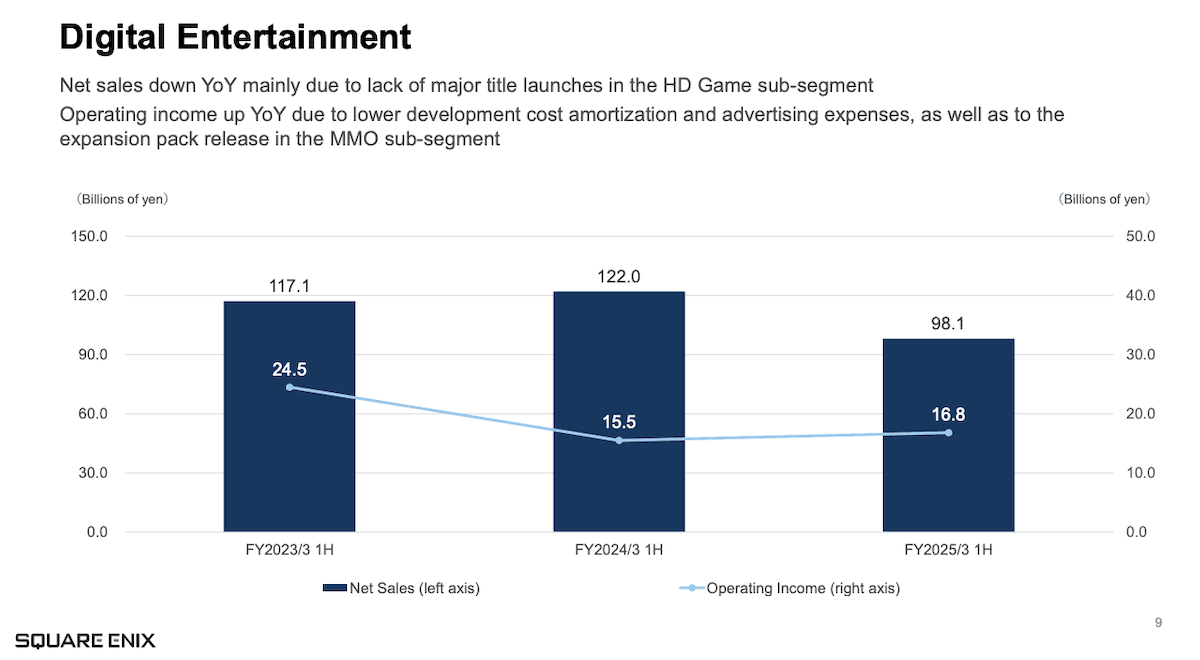
Square Enix’s latest year-end results make a clear management point: in a market crowded with live-service noise and expensive production, a publisher can earn more by concentrating on fewer titles that land harder. Net sales fell to ¥297.6 billion from ¥324.5 billion, but operating income rose 34.9 percent to ¥54.7 billion, lifting operating margin to 18.4 percent from 12.5 percent. That is the core signal for Nintendo teams watching the broader market: the business reward is shifting from sheer output volume to hit concentration and disciplined execution.
The company’s own language reinforces that shift. Square Enix says it is continuing a three-year move from quantity to quality, and its updated medium-term plan puts process, selection, and structural reform at the center of that effort. For developers, producers, and business planners, that is not just a financial note. It is a statement that the cost of missing the mark has become high enough that production culture itself has become a margin issue.
What drove the better profit
Square Enix’s operating result was helped by stronger HD Games performance and better catalogue sales. The company said profit in HD Games increased because of steady sales of new titles and higher sales of catalogue titles, which is a useful reminder that back catalogues are not passive assets. They still need active surfacing, pricing discipline, and the right release cadence to keep generating value.
That matters inside Nintendo because the company’s long-lived franchises already rely on the same logic: legacy only pays if the business keeps it alive. Players may be selective, but they will still spend when a release feels worth it, and older titles can still monetize well when the company does the work to keep them visible. Square Enix’s results show that catalogue value is not a side effect of success. It is part of the plan.
The merchandising segment also saw net sales and operating income increase, driven by royalty income from key IP. That is another sign that a strong franchise portfolio can support earnings beyond launch windows. For staff in brand management, licensing, and franchise planning, the message is straightforward: creative decisions ripple outward into royalty streams, merchandise, and long-tail monetization.
The new operating model behind the numbers
Square Enix is not treating this as a temporary tune-up. Its medium-term plan update says the company is reorganizing development studios in Japan and overseas, rebuilding the pipeline, and reviewing development management to shift from quantity to quality. It also says the company is refining title selection through “selection and concentration,” which is management language for being more selective about what gets greenlit, resourced, and pushed through production.
The company is also adding a company-wide progress-management process for major titles. That detail matters because it shows how badly the industry has been burned by schedule drift, scope creep, and projects that look good in theory but underdeliver in practice. Square Enix is signaling that oversight is no longer a late-stage rescue tool; it is being built into the way the group runs major projects from the start.
It is also forecasting annual cost savings of over ¥3 billion beginning in FY2027 from structural reforms. That means the shift is not only about making better games. It is also about lowering the operating burden that comes with a swollen, hard-to-control development footprint. In practical terms, the company is trying to make the organization itself lighter, more legible, and easier to steer.
Why the weak segments matter
The same results also show where the model breaks down. Square Enix had already warned in its FY2024 materials that weak MMO and smart-device or browser performance could weigh on results, and those risks remain visible in the latest numbers. MMO revenue and smart-device or browser revenue were down, even as the company said games for smart devices and PC browser improved profitability through diversified payment methods and optimized operating costs.
That combination is important because it separates revenue from profit. A segment can still move money without creating acceptable returns, especially if user acquisition, support, or platform economics work against it. For business teams inside Nintendo, the lesson is not that every adjacent revenue stream is failing. It is that each stream has to be judged on its own aging curve, not on optimism or legacy assumption.
The broader takeaway is that weak segments can quietly distort portfolio decisions. If a business keeps supporting a lane that no longer scales well, it can drain resources from the projects that do have long-term value. Square Enix’s numbers suggest that management is trying to stop that drift by tightening the filter at the front end and adding more oversight once projects are underway.

What this means for Nintendo’s own culture
Nintendo has long defended a quality-first reputation, and Square Enix’s results show why that stance still makes commercial sense. A release that feels intentional can still outperform, while overproduced or undercooked work can drag a portfolio down. For Nintendo’s developers, designers, QA testers, and localization teams, that means quality standards are not just about pride in craft. They are also a defense against the financial penalty of shipping work that is not ready.
For production staff, the message is especially pointed: progress controls and scope discipline are not bureaucracy for its own sake. They are a response to the cost of getting a large project wrong. Square Enix’s new progress-management process makes that concrete, because it reflects a broader industry move toward tighter tracking, clearer accountability, and fewer expensive surprises.
For creative roles, there is also something encouraging here. The market still rewards games that feel deliberate rather than bloated. That creates room for more disciplined greenlight decisions, stronger franchise stewardship, and a clearer line between what is promising and what is merely expensive. It also gives Japan HQ and global offices a shared business logic: fewer priorities, better executed, with less room for drift.
The strategic signal beneath the headline
Square Enix’s FY2026 results are not a victory lap. Net sales fell, and the company is openly reorganizing around a thinner, more controlled model. But the profit growth, the higher margin, the catalogue strength, and the planned cost savings all point in the same direction: the industry is learning to value concentration over sprawl.
The company’s latest materials were published together on May 14, 2026, and they read like a management reset rather than a routine earnings update. Major publishers are no longer acting as if more output automatically means more power. They are trying to earn more from fewer releases, and they are building the internal controls to make that strategy stick. For Nintendo, that is not a distant trend. It is the same pressure translated into a different corporate language, and it is only going to intensify.
Know something we missed? Have a correction or additional information?
Submit a Tip