US Patent Office Revokes Nintendo's Summoning Patent in Palworld Case
The US Patent Office rejected all 26 claims in Nintendo's summoning patent as obvious, dealing a significant but not fatal blow to its ongoing Palworld lawsuit against PocketPair.
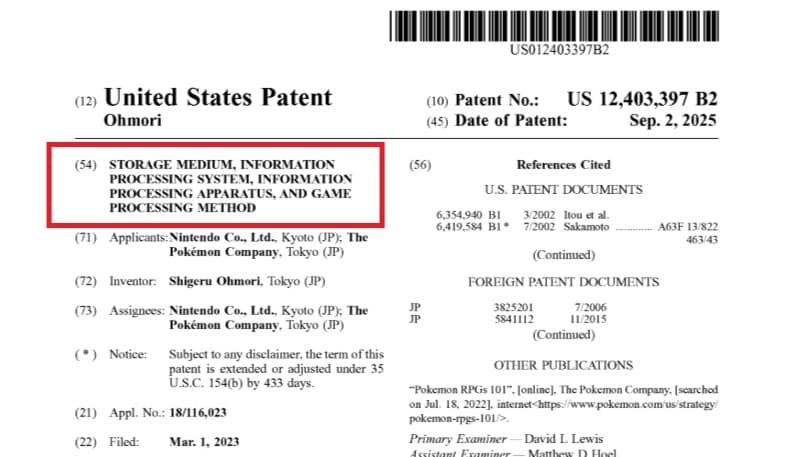
Every single one of them. A U.S. patent examiner rejected all 26 claims in Nintendo's summoning patent as "obvious," striking the most aggressive piece of Nintendo's legal campaign against Palworld developer PocketPair and forcing a hard public reckoning with how far game-mechanic IP can reasonably reach.
The ruling covers patent No. 12,403,397, granted to Nintendo in September 2025 for the mechanic of summoning a "subcharacter" into battle in one of two modes: fully automatic, or under direct player control. Observers quickly noted the description tracked closely with the auto-battling system introduced in Pokémon Scarlet and Violet, though its scope extended broadly enough to threaten series like Persona and Final Fantasy, franchises that have used companion-combat mechanics for decades.
The examiner reached the obviousness finding by stacking four pieces of prior art: Konami's 2002 Yabe patent, which already describes a sub-character fighting alongside a player automatically or manually; Nintendo's own Taura patent from 2020, covering the same core behavior; Nintendo's Motokura patent from 2022; and Bandai Namco's Shimomoto patent from 2020. Combining Taura with either Yabe or Motokura eliminates 18 of the 26 claims outright. Adding Shimomoto removes the remaining eight.
The proceedings that led here were themselves unusual. USPTO Director John A. Squires personally ordered an ex parte reexamination in November 2025, without a petition from any third party. Patent professionals described the move as extraordinary; the last time a USPTO director initiated such a review without outside prompting was 2012. Squires cited "substantial new questions of patentability" from the existing prior art, essentially signaling that the patent may never have been approvable in the first place.
This is a non-final ruling. Nintendo now has two months to respond, with the option to request a further extension. The company has shown no reluctance to press forward in the broader dispute: it changed which specific patents it claimed PocketPair had infringed during the Tokyo District Court proceedings, a tactical adjustment that patent observers read as a sign of legal strain rather than strength.
For developers building creature-collecting or companion-combat games, the practical stakes are significant. If the examiner's rejection stands, the summoning-and-battling claim disappears from Nintendo's U.S. arsenal, meaning any studio designing auto-battling or manual-companion systems is no longer staring down this particular legal threat. PocketPair's U.S. exposure shrinks accordingly. What remains are the Japanese proceedings, where Nintendo and The Pokémon Company filed suit in September 2024 on three separate patents covering creature capture, creature riding, and battle mechanics. Those claims continue at Tokyo District Court with no trial date scheduled.
PocketPair has already altered Palworld in response to Nintendo's litigation, removing or modifying mechanics Nintendo claimed as infringing. Whether those concessions ultimately prove to have been necessary depends on what survives in Tokyo, and on what Nintendo files in Washington over the next eight weeks.
This article was produced by Prism’s automated news system from verified source data, official records, and press releases, then run through automated quality and moderation checks before publishing. The system is built and supervised by the people who set the standards it runs under. Read our full AI policy.
Did this article answer your question?
