Pizza Hut innovation leader shows careers can start in bakery kitchens
Rachel Antalek’s path from a Baltimore bakery to Pizza Hut’s top food-innovation job shows menu careers are built on ops instincts, not just big ideas.

A bakery job can be the first step into menu strategy
Rachel Antalek’s Pizza Hut career is a useful map for anyone who wants to build a future in food innovation without starting in a corporate office. She began in a small bakery in Baltimore, Maryland, and learned early that food could become a career, not just a shift. That matters at Pizza Hut because the brand now puts her at the center of global menu planning: Antalek serves as Global Chief Food Innovation Officer, reports to the Pizza Hut U.S. president, and is responsible for architecting global menu strategy and driving business growth through food innovation.
Her path is also a reminder that food innovation often starts in places that look ordinary from the outside. Before Pizza Hut, she managed Starbucks’ $5 billion global espresso business and founded the front-end innovation lab now known as the Tryer Lab. That background helps explain why her work blends concept design, trend sensing and operational execution. The role is not about dreaming up a fun idea and handing it off. It is about making sure the idea can survive a real restaurant, a real make-line and a real lunch rush.
At Pizza Hut, innovation is an operations job
The clearest lesson from Antalek’s career is that menu innovation is not a marketing function. It is an operating system decision. When Pizza Hut launches a new item, the impact reaches prep flow, ingredient counts, kitchen timing and the way guests read the menu board. That is why a successful innovation leader has to understand how food moves through stores, not just how it looks in a presentation.
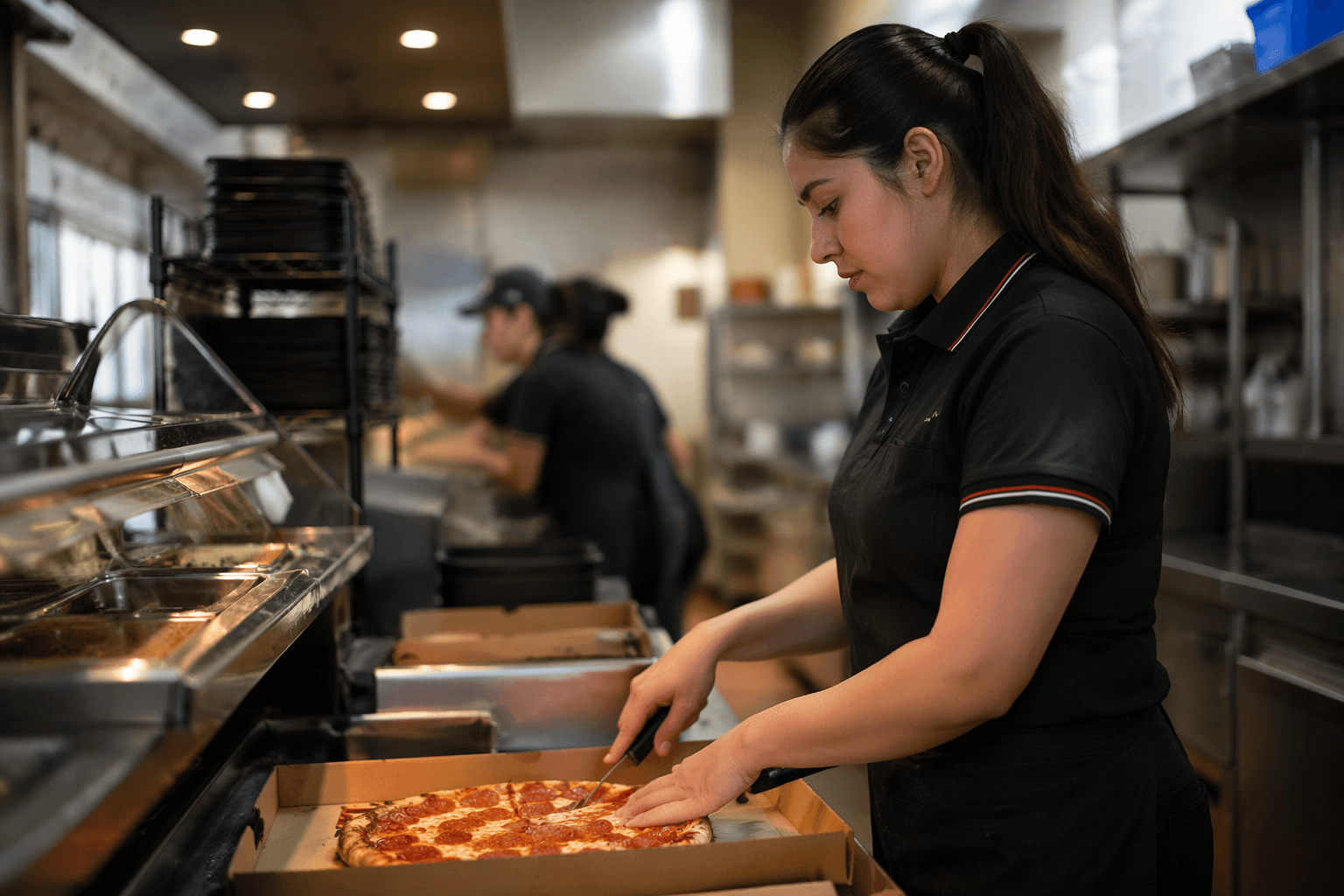
That operational lens is especially important in pizza, where small changes can ripple through the entire shift. A handheld item may simplify one guest occasion but add a new step on the line. A new crust format can help the brand win an order it would otherwise lose, but it also changes how ovens, cut stations and packaging work. For store employees and managers, Antalek’s career says that the people shaping the menu need to understand the pressure points on the floor.
Pizza Hut has always sold more than toppings
Antalek’s work fits into a much older Pizza Hut tradition. The company traces its roots to 1958 in Wichita, Kansas, and has long framed itself as a culinary innovation leader. That history runs through Original Pan Pizza, Original Stuffed Crust and later category moves like Pizza Hut Melts. The brand’s identity has never depended only on adding another topping. It has repeatedly tried to create new crust formats and new eating occasions.
That matters for workers because the company’s best-known innovations usually come from a practical question: what kind of pizza can win a different kind of order? The answer might be a thicker crust for dine-in comfort, a stuffed crust for shareability, or a handheld for customers who want something that eats more like a sandwich. Antalek’s job sits inside that same logic. She is not just building products. She is helping Pizza Hut decide which eating moment it wants to own next.
Trend watching shapes the menu before a test ever hits stores
Pizza Hut’s own 2024 trends report showed how the company turns consumer signals into menu moves. The brand said spicy flavors, layers of flavor and thin crust would remain central, and it called thin crust the No. 1 crust preference in the U.S. It also said demand for sweet-and-spicy pizza would remain high. Pizza Hut then used that playbook to support a nationwide rollout of hot honey pizza and wings starting February 1, 2024.
That kind of trend work is where store-level observation matters. The most valuable innovation teams are watching what guests keep asking for, what finishes fast, what gets customized and what gets left behind. For a crew member on the line or a manager watching ticket flow, those signals are visible every shift. Antalek’s background suggests that the leap from observation to product strategy is exactly how careers in food innovation get built.
Melts show how a launch becomes a business system
Pizza Hut launched Melts in November 2022 as its entry into the handheld category, priced at $6.99 at participating restaurants. The company described them as crispy, cheesy, loaded with toppings and served with a dip. That launch was more than a new menu item. It was a test of whether Pizza Hut could create a format that felt different enough to attract new occasions while still fitting the chain’s kitchen system.
The company kept building on that idea. On May 14, 2024, Pizza Hut introduced the Cheeseburger Melt, a parmesan-crusted thin-crust Melt folded and loaded with beef, applewood-smoked bacon, onions, mozzarella and cheddar, with Burger Sauce on the side. The launch also expanded Melts into four additional varieties, showing that a successful format can become a platform rather than a one-off. By September 2025, Pizza Hut was promoting Melts as a $4.99 Monday offer, which shows how innovation and value pricing can work together in a crowded lunch-and-snack market.
For workers, this is the real lesson: once a concept works, it becomes part of the weekly rhythm. It has to be repeatable, affordable and fast enough to survive busy periods. That is the difference between a brainstorm and a lasting item.
Crafted Flatzz shows the scale of the job now
If Melts showed Pizza Hut could build a handheld platform, Crafted Flatzz showed how far the company wanted to take that approach. Pizza Hut launched Crafted Flatzz on August 20, 2025 and called it the largest simultaneous global launch in its history. The rollout stretched across the U.S., United Kingdom, Taiwan and Egypt through fall 2025 and beyond.
The U.S. version included Nashville Hot Chicken and was positioned as a value-oriented personal pizza for adult lunch and solo occasions. That detail matters because it reveals how Pizza Hut is thinking about the dayparts and customers it wants to win. A personal pizza that works for lunch or one person on the go is a direct answer to changing demand, including the pressure from delivery apps and quick-turn competitors that have trained customers to expect convenience as well as flavor. In that kind of market, innovation has to be easy for guests to understand and easy for crews to execute.
Innovation also depends on supply and sourcing
Pizza Hut has also made clear that new products are tied to sourcing and supply-chain work. In April 2024, the company said it had reached its goal of sourcing 60% of the milk used in its U.S. pizza cheese from participating farms in 2023, two years early. That represented more than 2.35 billion pounds of milk from about 140,000 milking cows.
That scale matters because a food-innovation leader is not only designing recipes. She is coordinating ingredients, suppliers and sustainability goals so the product can actually reach stores. For line employees, that means a launch is only as strong as the supply behind it. For managers, it means the success of a new item depends on whether the system can deliver it reliably during the rush, in the right format and at the right cost.
The career lesson for store crews and junior staff
Antalek’s story is encouraging because it does not start with a polished executive track. It starts with a bakery, moves through an innovation lab and ends at a role that connects global menu strategy with store-level reality. She has also described the hardest part of building disruptive innovation work as getting started, which is a useful reminder that this job often begins in uncertainty, not with a perfect roadmap.
For Pizza Hut workers thinking about a longer path in food service, the message is straightforward: curiosity counts, but so does execution. Watch how guests behave. Notice what slows the line. Learn which ideas can be repeated across shifts and which ones fall apart under pressure. At Pizza Hut, the people who rise into innovation roles are often the ones who can connect trend spotting to real kitchen work. That is how a bakery job can become a blueprint for shaping the next global menu.
This article was produced by Prism’s automated news system from verified source data, official records, and press releases, then run through automated quality and moderation checks before publishing. The system is built and supervised by the people who set the standards it runs under. Read our full AI policy.
Did this article answer your question?