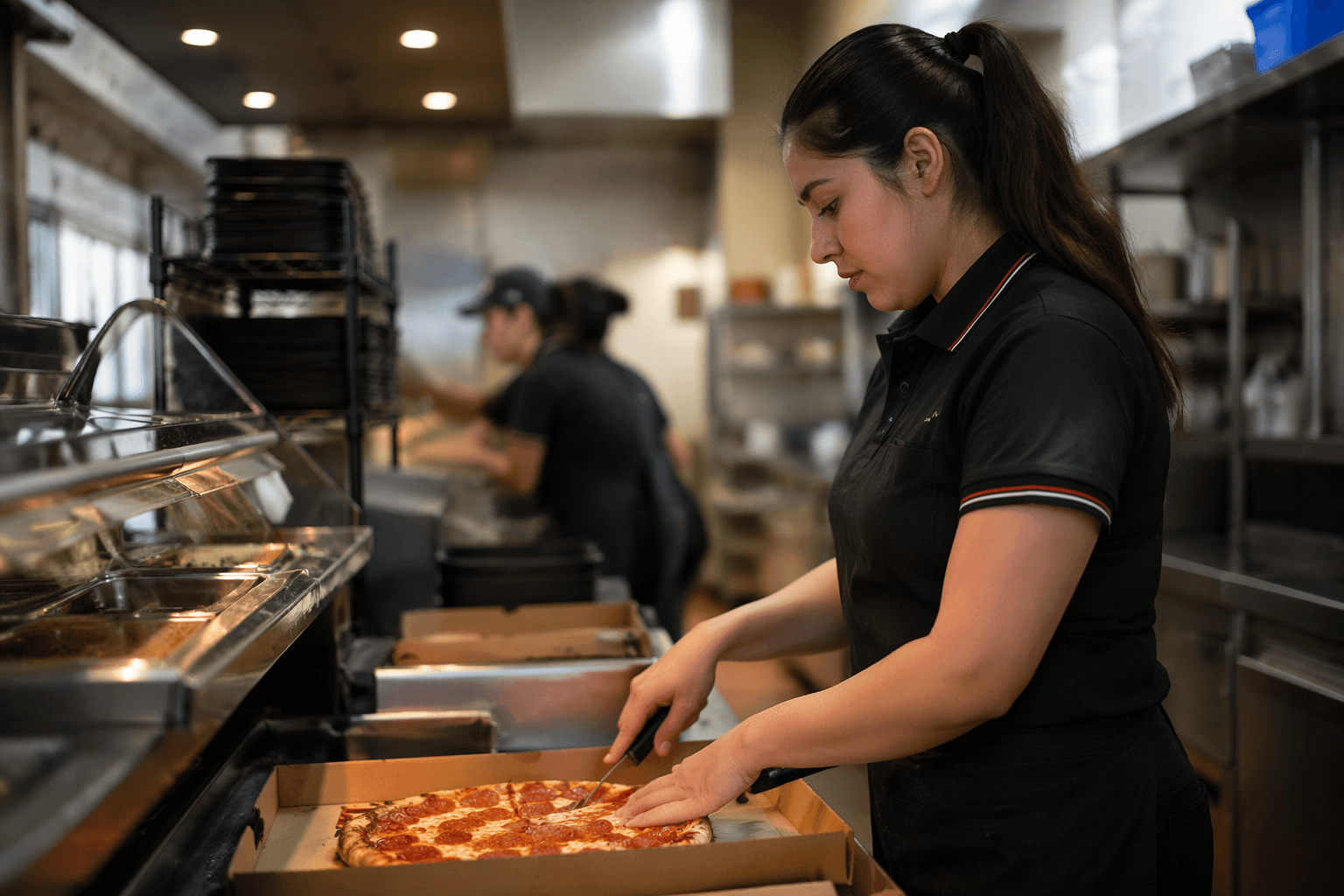
Yum policy spells out human rights, labor standards for Pizza Hut workers
At Pizza Hut, Yum’s policy sets the corporate floor, but the real test is whether your store meets it on pay, safety, scheduling and treatment.

The corporate promise matters most where the store is franchised
With roughly 98% of Yum! Brands restaurants in franchise hands, the company’s human-rights policy is less a headquarters slogan than a checklist for what should still be true inside a local Pizza Hut. Yum says it wants a work environment that respects, protects and supports human rights, and the gap between that promise and daily reality is often widest where a franchise owner controls the schedule, the staffing and the pace on the make line.
That makes the policy worth reading as a worker tool, not just a compliance document. Yum says the standards are meant to apply across the system, including franchisees and suppliers, so the question for crew, drivers and managers is simple: does the store actually live up to the company’s own rules on pay, safety, treatment and retaliation?
What Yum says the floor should be
Yum ties its human-rights policy to the United Nations Guiding Principles on Business and Human Rights and the International Labour Organization Declaration on Fundamental Principles and Rights at Work. In plain English, the company is saying its labor standards are not supposed to be ad hoc or store-by-store improvisation. They are meant to rest on a framework that rejects forced labor, child labor, abuse and coercion.
The policy says Yum does not employ underage children or forced labor, prohibits abuse or coercion, requires compliance with local labor laws and respects the right of employees to form or join a union where law allows. It also says all employees must certify the Global Code of Conduct annually, and Yum says the code applies to the board and all employees of Yum! Brands and its subsidiaries. The company adds that its Worldwide Code of Conduct has been in place since 1997, which matters because this is not a brand-new statement drafted for a moment of scrutiny.
For Pizza Hut workers, the practical takeaway is that the company has already said what it thinks a lawful, acceptable store should look like. You should be able to expect fair treatment, safe working conditions, non-harassment, lawful pay and a workplace where managers cannot lean on pressure, threats or confusion to get around labor standards.
Why franchise structure changes the way problems show up
Yum’s own filings make clear that the system is overwhelmingly franchised. In 2025 filings, the company said about 98% of its more than 60,000 restaurants were owned and operated by franchisees, and its 2024 annual report said the system includes about 1,500 franchisees operating more than 61,000 restaurants in more than 155 countries and territories. Yum also says each year it and its franchisees create thousands of part-time, entry-level restaurant jobs.
That structure is why workers often feel stuck between local management and corporate standards. A line cook who is shorted on hours, a driver dealing with unsafe delivery pressure, or a manager trying to fix a toxic shift may not know whether the issue belongs with the franchise owner, district leadership or the parent company. Yum’s policy does not erase those lines of authority, and it does not replace local law or local handbook rules, but it does give you a map of the standards the whole system is supposed to honor.
Here is the accountability test that matters on the floor: if a store treats the franchise setup as a reason to ignore the basics, that is already in conflict with the company’s own policy. A local operator may control day-to-day labor decisions, but the parent company still says the system should protect workers from coercion, abuse and illegal labor practices.
What that means for scheduling, safety and day-to-day treatment
Yum’s policy does not spell out a shift bid system or a delivery pay formula, so it should not be read as a substitute for local rules. But it does set boundaries around how a schedule or workplace can function. If hours are being cut or reshuffled in ways that violate labor law, punish complaints or create pressure to work off the clock, that is not just a bad store practice. It is the kind of conduct Yum says should be off limits.
The same goes for safety and treatment. A Pizza Hut store that runs with broken equipment, unreasonable rush pressure, harassment, or a culture where workers are afraid to report problems is drifting away from the company’s stated standard of respect and protection. For drivers, that can include pressure to make unsafe runs or absorb problems created by understaffing and gig competition from DoorDash and Uber Eats. For kitchen crews, it can show up in heat, pace, missed breaks and managers who treat labor as disposable because the work is entry-level.
The policy is broad enough to cover supplier expectations too. Yum says its approach extends beyond direct employees to suppliers, vendors, subcontractors and agents. That matters in a Pizza Hut context because labor standards are not only about who wears the branded shirt. They also touch the chain behind the counter, from ingredients and cleaning products to the business relationships that can influence whether a store is properly supplied and staffed.
How to use the reporting channels when the store line is not enough
Yum says employees can use a 24/7 Speak Up Helpline and an online portal to raise concerns, and its governance materials say the helpline is the designated external contact for these issues. The company also says translation services are available to callers, which is important in a system where many workers may be more comfortable explaining a problem in a language other than English.
The company says the helpline can contact the appropriate members of management or the board with concerns it receives, and it also says the Audit Committee has procedures for accounting and auditing issues. That is relevant when a complaint touches payroll, timekeeping or other records where labor problems can overlap with accounting problems. If a local supervisor shrugs off a wage issue or tries to bury a paper trail, Yum says there is a formal route beyond the store.
The useful part for Pizza Hut crews is that this gives you a way to escalate when a shift conversation is not enough. A small scheduling dispute may stay local. But a pattern of wage violations, coercive behavior, safety problems or retaliation is exactly the kind of thing a parent-company reporting channel is meant to catch.
The checklist workers can keep in mind
If the store is following Yum’s own standards, you should be able to point to these basics:
- no child labor or forced labor
- no abuse, intimidation or coercion
- lawful pay and compliance with local labor rules
- a workplace where concerns can be raised without retaliation
- respect for union rights where the law allows
- supplier and vendor relationships that do not depend on cutting human-rights corners
- a way to escalate beyond local management when the problem is bigger than one shift
That is the real value of the policy. It does not guarantee every Pizza Hut will run well, and it does not make franchise ownership disappear. But it does give workers a written standard to measure the store against, and in a system this decentralized, that baseline is often the clearest leverage there is.
This article was produced by Prism’s automated news system from verified source data, official records, and press releases, then run through automated quality and moderation checks before publishing. The system is built and supervised by the people who set the standards it runs under. Read our full AI policy.
Did this article answer your question?