AtomBite's M1 Robot Tackles Takeout Packing's Toughest Last-Meter Challenges
A robot that handled crushed bags and messy receipts in a live kitchen demo could soon replace dedicated packing staff at ghost kitchens and high-volume QSRs.
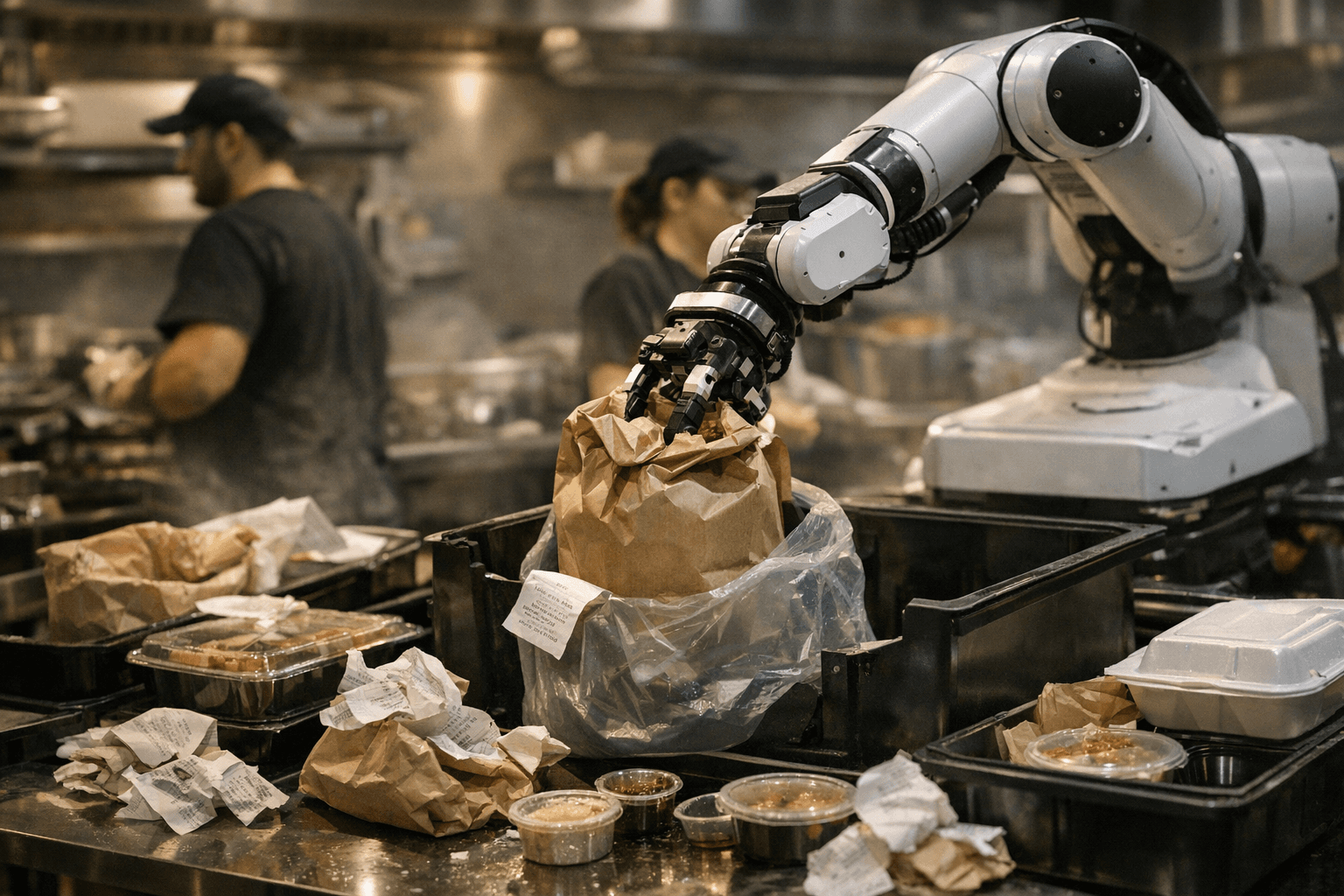
The last-meter packing station, where orders get bagged, labeled, and handed off to drivers, has resisted automation longer than almost any other restaurant task. Crushed bags, off-center containers, mixed-weight items, and sideways receipts make it the kind of organized chaos that rigid, preprogrammed robots consistently fail to handle. AtomBite.AI's M1 robot was put through exactly those scenarios in a live commercial kitchen demo last week, and it packed reliably through all of them.
The technical story isn't the arm. It's a dual-model AI system the company calls the AtomBite Brain, which pairs a small, fast edge model handling real-time motor control with a larger foundation model that reasons through cluttered or unexpected scenes. That architecture is what separates the M1 from earlier automation attempts: instead of failing when something is deformable or out of place, the robot adapts. Restaurant Magazine's hands-on review, which documented the April 1 demo, identified the software as the genuine differentiator, not the hardware.
Other kitchen automation targets structured, repeatable tasks. Robotic fry stations work because the inputs are consistent. Packing doesn't offer that consistency, which is why the last-meter problem has stayed stubbornly human until now.
AtomBite is selling the M1 on a Robot-as-a-Service subscription at an OPEX target in the low thousands per month, with a payback window the company estimates at four to six months in some test deployments. Those numbers would be attractive to ghost kitchens, campus dining operations, and high-volume quick-service restaurants where delivery volume is high and a wrong bag means a one-star review.
The review pushed back on the headline economics. Integration costs for robotics deployments routinely run higher than the subscription figure suggests: floor reconfiguration, network infrastructure, staff safety training, and maintenance all carry real costs that don't appear in an OPEX pitch. Operators were advised to model realistic volumes and error rates before assuming a short ROI window.
For expeditors and packers currently staffing those stations, the near-term scenario is role reshaping rather than mass displacement. A machine absorbing repetitive packing during a Friday surge may shift a worker toward quality control or multi-station coverage rather than eliminating the position outright. But the longer-term math is harder to ignore: as automation reduces the headcount needed at peak packing windows, employers who don't build in retraining commitments and pay protections will leave workers absorbing the downside of a productivity gain they don't share in. Whether those terms get negotiated, written into contracts, or left unaddressed entirely is the more consequential question the M1 raises for anyone working behind a packing station.
This article was produced by Prism’s automated news system from verified source data, official records, and press releases, then run through automated quality and moderation checks before publishing. The system is built and supervised by the people who set the standards it runs under. Read our full AI policy.
Did this article answer your question?