Labor Department outlines WARN notice rules for restaurant closures
When a restaurant closes, WARN notice, unemployment claims, and pay records can determine how badly workers are hit. The Labor Department says the real protection starts before the lights go out.
When the dining room goes dark, the paperwork starts
A restaurant closure can hit like a rush cut in reverse: one day the kitchen is staffed, the next the shifts are gone and the payroll question becomes urgent. The U.S. Department of Labor says the WARN Act is meant to give workers advance notice in qualified plant closings and mass layoffs, and in restaurants that can mean the difference between scrambling for rent and having time to line up the next job.
That notice matters because closures in food service are often messy. A franchisee may start trimming weaker locations, or a brand may fold underperforming stores into a smaller footprint. When that happens, the people affected are not just hourly servers and line cooks. Managers, supervisors, and salaried staff can all be swept up if the law applies.
Who gets WARN notice, and when
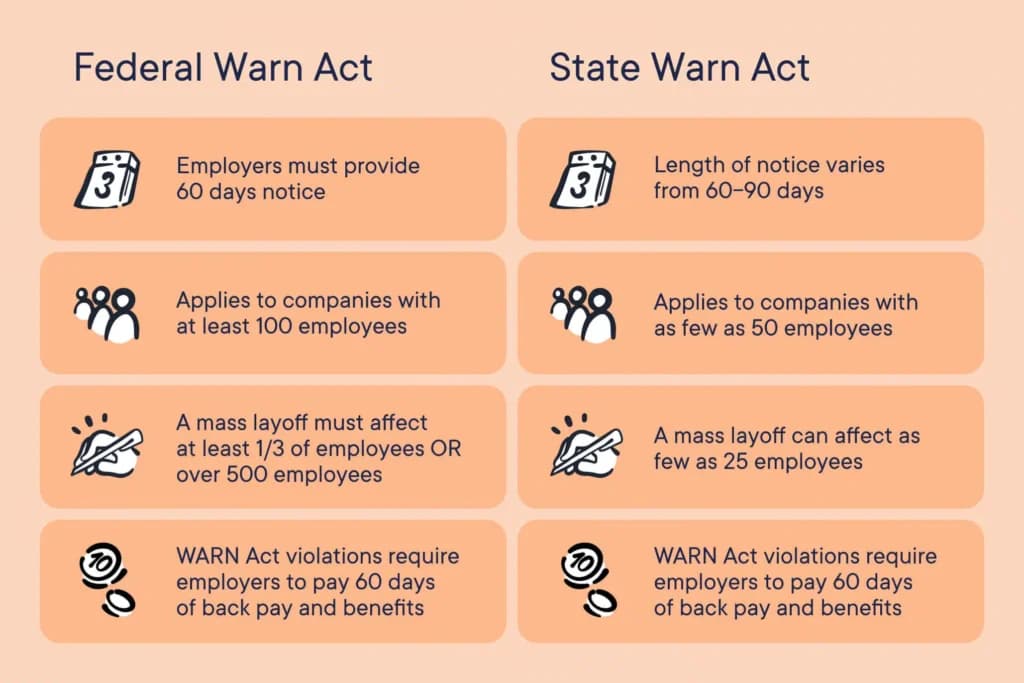
The Labor Department says WARN generally applies to employers with 100 or more employees, with some exclusions for workers who have been employed less than six months in the last 12 months and those averaging fewer than 20 hours a week. It generally requires at least 60 calendar days of advance written notice before a plant closing or mass layoff affecting 50 or more employees at a single site of employment.
That threshold is the first thing workers should understand, because restaurant payrolls are often spread across multiple units, departments, and job types. A shutdown can look small from the front of house, but if enough workers at one site are affected, WARN can be triggered. The law is designed to give employees time to arrange a new job or retraining, not to leave them learning about a shutdown from an empty prep table.
The notice itself has to go to more than workers. The department says it must also be sent to employees’ representatives, the local chief elected official, and the state dislocated worker unit. In practice, that means a closure can trigger public and local government attention quickly, which is one reason employers sometimes try to keep the situation quiet until the last minute.
Why restaurant workers should keep a paper trail immediately
The biggest mistake workers make in a closing restaurant is waiting for management to explain everything. Once a location starts thinning out, save schedules, keep pay stubs, note the last day worked, and preserve any messages about cuts, shutdowns, or transfer offers. If the building is already emptying out, assume you may need those records to prove when you worked, what you were owed, and what you were told.
Final pay is only part of the picture. Workers should track unpaid wages, earned but unpaid tips, and any state rules on unused vacation or PTO. If management offers a transfer, a different position, or severance, get it in writing. In a closure, the paper trail often decides whether the exit is orderly or whether workers spend weeks trying to reconstruct basic facts from memory.
Unemployment should be the first administrative move
The Labor Department says laid-off workers should file for unemployment in the state where they worked and contact the state unemployment insurance program as soon as possible. That advice matters in restaurants because hours can fall before the official closure date, especially when management begins cutting labor while still denying that a shutdown is coming.
For tipped workers, that early filing can be especially important. A server or bartender can lose income long before the final day on the schedule, and a reduced section or a shorter dinner shift can slash weekly pay without warning. If hours are collapsing, file early and keep records of the schedule cuts.
Tips, minimum wage, and overtime do not disappear in a closure
Restaurant shutdowns can expose wage problems that were already there. Under the Fair Labor Standards Act tip-credit rules, the employer has to make sure a tipped worker receives enough tips plus direct wages to equal at least minimum wage and overtime compensation required by federal law. The Labor Department also says restaurant and fast food businesses with annual gross sales of at least $500,000 are subject to the FLSA.
That matters because a closing restaurant may leave workers chasing final wages, tip money, and overtime all at once. If the house had been shorting the floor, the shutdown does not erase the debt. It can make the accounting harder, especially if the books are being moved to a parent company or a new operator. Workers should compare pay stubs, tip records, and schedules to see whether the employer actually met its obligations before the doors shut.
State law can add another layer of protection
Federal law is not the only game here. The Labor Department says some state and local scheduling laws require reporting pay or predictive scheduling penalties when shifts are canceled or reduced without required notice. State labor laws may also provide additional rights and protections.
In restaurant work, that can be a real issue when a general manager starts hacking the schedule before a formal closure is announced. A host, prep cook, or server may lose multiple shifts before the final layoff notice arrives, and those canceled hours can trigger local penalties or reporting pay in some places. The right move is to keep every posted schedule, every text about shift cancellations, and every message announcing reduced hours.
Rapid Response teams are supposed to help workers land on their feet
The Labor Department says workers who are laid off can get help through state dislocated worker units and Rapid Response teams. Those teams gather information about workers’ skills and career interests and connect them with services that can help them return to work. For restaurant staff, that can mean retraining, job search support, and other transition help that is often more useful than a vague promise to “stay in touch.”
The department also says workers may get time to make arrangements for a new job or retraining during the WARN notice period, and employers may choose to give paid time off to look for another job. In a well-run closure, that time is used to apply elsewhere, line up references, and collect records before the final paycheck hits. In a poorly run closure, workers are left to sort out the damage after the staff room has already been cleared.
Where employers most often fall short
The gap between corporate messaging and reality usually shows up in three places. First, employers delay notice until the last possible moment, then act as if a shutdown was unforeseeable. Second, they fail to document final wages, tips, or unused leave clearly, which pushes the burden onto workers. Third, they forget that a closure is not just a business decision but a legal event that can trigger federal notice rules, state wage claims, and unemployment deadlines all at once.
That is why WARN compliance is not just a management problem. It is a worker-protection issue tied to the basics of restaurant life: wages, schedules, tips, and the ability to make rent after a shift disappears. And because WARN is enforced through private lawsuits in federal court, not by the Labor Department itself, workers cannot assume someone else will fix the problem for them.
Restaurant closures have stayed a live issue, with industry reporting in 2024 and 2025 showing chains shutting hundreds of locations or announcing thousands of layoffs. That pattern makes the lesson plain: when a restaurant starts closing in pieces, the safest move is to treat every schedule change, every pay stub, and every notice as evidence. In this business, the paper trail is often the only thing standing between a chaotic shutdown and a clean exit.
This article was produced by Prism’s automated news system from verified source data, official records, and press releases, then run through automated quality and moderation checks before publishing. The system is built and supervised by the people who set the standards it runs under. Read our full AI policy.
Know something we missed? Have a correction or additional information?
Submit a Tip