Starbucks and McDonald’s keep battling for restaurant workers online
Starbucks and McDonald’s are courting workers with very different pitches, and the fine print shows whether a chain is competing on pay, speed, flexibility or advancement.
The new front door to restaurant jobs
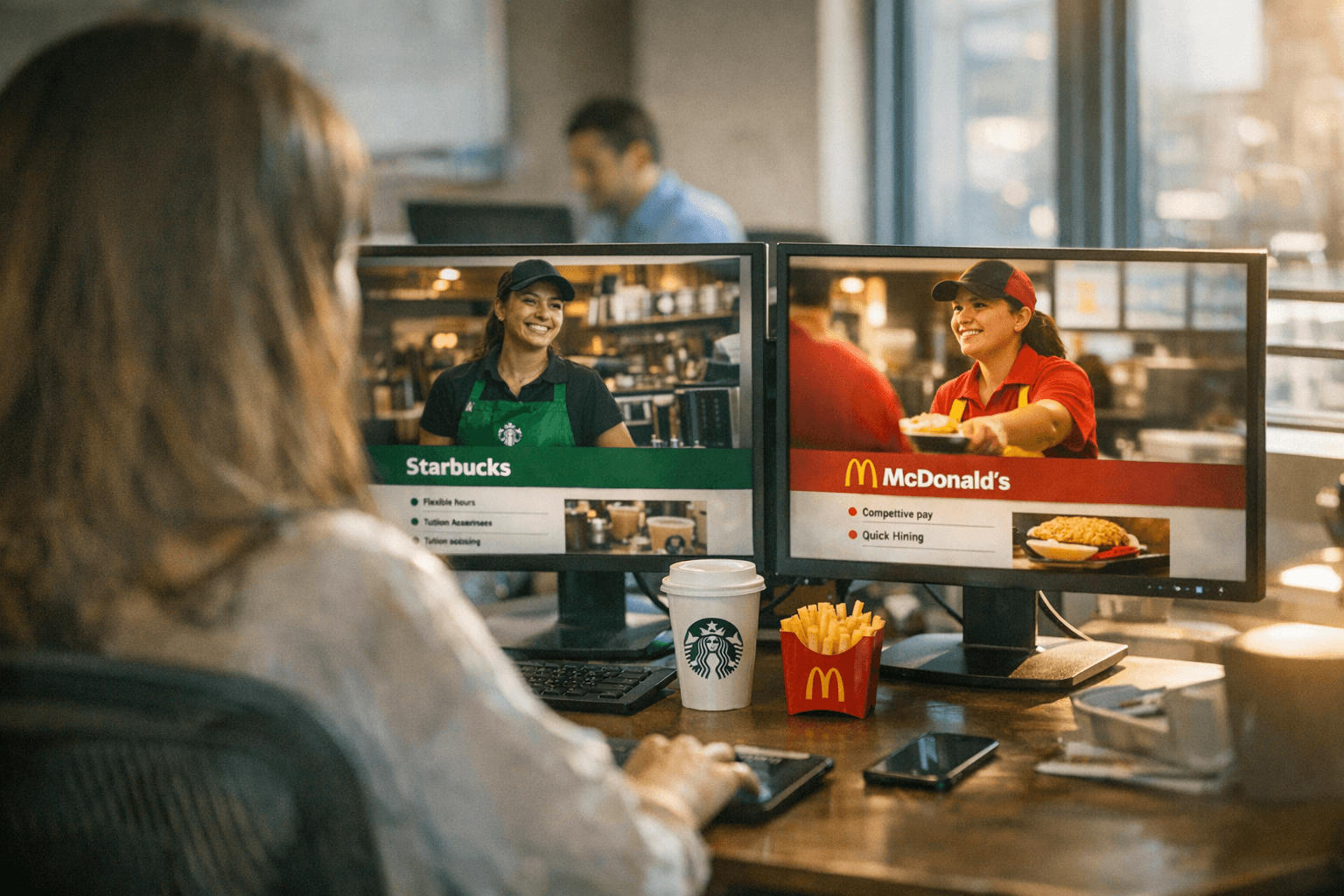
The fight for restaurant workers now starts before the apron goes on. Starbucks is leading with health coverage, education and paid leave, while McDonald’s is leaning on fast interviews, flexible schedules and tuition help, a split that shows how much the labor battle has moved online.
That matters because these are not small employers testing a new hiring trick. Starbucks ended fiscal 2025 with 40,990 stores worldwide and roughly 381,000 employees, while McDonald’s reported 43,477 restaurants worldwide at the end of 2024, with about 95% franchised. When companies that large polish their careers pages, they are not just posting jobs. They are telling workers what kind of labor they are trying hardest to buy.
What Starbucks is really selling
Starbucks’ recruiting message is built around staying power. Its benefits pages highlight medical, dental and vision coverage, life insurance, short- and long-term disability, stock and savings programs, college and education benefits, paid parental leave, backup care, commuter benefits, discounts and matching grants. The company also promotes free drinks and coffee, Spotify Premium, discounts and a company match for eligible nonprofits, all of which turn the job pitch into a broader lifestyle package.
That is paired with a message about growth. Starbucks says its people are one of its most valuable assets and stresses learning opportunities that can develop skills and move careers forward. For workers, that is a signal that the company is trying to make the job look like a path, not just a shift.
The size of the operation gives that pitch more weight. Starbucks said about 223,000 of its employees were in the U.S., and about 6% of U.S. company-operated stores were represented by unions. It also closed 627 stores in fiscal 2025 as part of its “Back to Starbucks” restructuring plan, with those closures concentrated in North America. In other words, the company is still big enough to lose stores, shift work and reorganize labor, yet still has to recruit at scale.
What McDonald’s is really selling
McDonald’s is leaning into speed and flexibility. Its U.S. careers page says restaurants are hiring across all levels, from crew team members through management, which signals that the company wants applicants who can see a ladder, not just a clock-in time. The recruiting portal also features Olivia, a virtual assistant that can help people search for jobs, answer questions and, for some qualified candidates, schedule interviews in minutes.
That is a different kind of promise than Starbucks’ benefits-heavy pitch. McDonald’s is saying the application itself should be easy, the schedule should be manageable, and the path from applicant to interview should not drag on long enough for workers to lose interest. For a worker juggling school, childcare or a second job, speed can matter just as much as hourly pay.
The company also packages the role with flexible scheduling, free meals and discounts, paid time away, employee rewards, tuition assistance up to $3,000 per year, world-class training and the chance to earn a degree for free through eligible tuition coverage. That combination tells job seekers McDonald’s is trying to compete on both the short term, through schedule control and meals, and the long term, through education and training.
Why the labor market keeps forcing this fight
The restaurant labor market is still tight enough that major chains need to advertise what makes them different. The National Restaurant Association projected 200,000 new restaurant-industry jobs in 2025, and said restaurant and foodservice workforce growth continued even as staffing in full-service restaurants remained below pre-pandemic readings.
The latest labor pulse shows how uneven that recovery still is. In March 2026, eating and drinking places added 21,500 jobs on a seasonally adjusted basis after losing 26,200 in February. Employment in eating and drinking places was 76,800 jobs above the February 2020 peak, but full-service restaurant employment was still 207,000 jobs below pre-pandemic levels as of February 2026. Quickservice, fast casual and coffee and snack segments were above pre-pandemic staffing.
That mix explains why the careers pages look the way they do. Chains still need a steady flow of applicants to replace turnover, cover seasonal spikes and fill openings fast. They are not only competing on hourly wages. They are competing on whether a job feels stable, whether the schedule is predictable, whether the training is useful and whether the employer makes moving up seem realistic.
How to read a recruiting page like a worker
A careers page can tell you what an employer is most worried about losing. If the first thing you see is a long list of benefits, the company is trying to hold onto people who might otherwise leave after a few shifts. If the first thing you see is a quick path to an interview, the company is trying to reduce friction and fill openings fast. If tuition and training are front and center, the chain is selling a ladder.
Look for these signals:
- A heavy benefits list usually means the company is trying to appeal to workers who compare total compensation, not just base pay.
- Fast application tools, like Olivia at McDonald’s, usually mean the employer is chasing volume and wants to close the gap between interest and interview.
- Frequent references to learning, growth and advancement usually mean the company knows turnover is expensive and wants people to stay longer.
- Flexible scheduling language matters most when workers are balancing school, childcare, split shifts or a second job.
- Tuition assistance is often the clearest clue that a chain wants to keep workers beyond entry level and move them toward management.
For restaurant workers coming from tipped dining rooms, that distinction matters. In full-service restaurants, paycheck math can swing with tip pools, section assignments, wage laws and the quality of the floor. In quickservice and coffee chains, the pitch is more straightforward: base pay, benefits, hours and advancement. That can make a chain job feel more predictable, but only if the schedule actually holds and the training turns into real promotion.
What this means on the floor
The online recruiting battle is really about burnout, turnover and control. A polished careers page is a sign that a chain knows it has to fight for people before a shift ever starts. Starbucks is trying to win with breadth, from health benefits to parental leave to education. McDonald’s is trying to win with speed, flexibility and a clear path from crew to management.
For workers, the useful move is to read the recruiting language as a promise test. The more a company leads with tuition, training and advancement, the more it is asking for long-term loyalty. The more it leads with instant scheduling and flexible shifts, the more it is trying to fill labor gaps quickly. In a restaurant industry still adding jobs but still short in key segments, that difference is the real competition.
This article was produced by Prism’s automated news system from verified source data, official records, and press releases, then run through automated quality and moderation checks before publishing. The system is built and supervised by the people who set the standards it runs under. Read our full AI policy.
Did this article answer your question?