NLRB outlines Starbucks workers’ rights to organize and discuss pay
Starbucks workers can discuss pay, hours, staffing, and safety, and the NLRB says acting together can be protected even without a union.

The NLRB’s employee-rights rules give Starbucks workers a plain-language floor to stand on when pay, hours, staffing, or safety become a store issue. At a company where organizing pressure, management pushback, and contract talks have all played out in public, the key question is often simple: what can you say together, what can you do alone on behalf of others, and what should you document?
What the law protects in plain English
The National Labor Relations Board says employees covered by the National Labor Relations Act have the right to join together to improve wages and working conditions, to try to form a union where none exists, to assist a union, and to refuse to do any of those things. That means the legal protection is not limited to union members. It also covers protected concerted activity, which includes two or more employees acting together for mutual aid or protection over terms and conditions of employment.
That protection can sometimes extend to a single worker too. The NLRB says a lone employee may still be protected when acting on the authority of other employees, bringing group complaints to management, trying to get coworkers to act together, or preparing for group action. In a Starbucks store, that distinction matters because a conversation about labor is not automatically a protected act, but a conversation about pay, hours, safety, or staffing often may be.
Why Starbucks workers should care
For baristas, shift supervisors, and even managers trying to understand where the law draws the line, the practical issue is whether a workplace complaint is individual grumbling or collective action about working conditions. A barista comparing wages with a coworker is not the same thing as a campaign, but the NLRB makes clear that employees can discuss pay with each other and can bring group complaints to management.
That matters in a Starbucks environment where pay raises, tip changes, and scheduling decisions affect the whole floor. When stores are short-staffed or schedules get sliced, workers do not need a formal union committee to have a legally relevant conversation. The broader point is that the law protects workers when they act together about the conditions of the job, even before a contract exists.
Who is covered, and why job title is not the whole story
The NLRB says most private-sector employees are covered by the NLRA, but supervisors are excluded. At Starbucks, that detail is not theoretical. NLRB case materials have repeatedly listed baristas and shift supervisors in bargaining units while excluding store managers, assistant store managers, clerical employees, guards, professional employees, and supervisors as defined by the Act.
That means the title on your schedule is not always the whole answer. Whether someone is legally a supervisor can depend on actual authority, not just day-to-day responsibility. For a Starbucks worker trying to figure out whether a conversation, complaint, or organizing step is protected, the better question is usually whether the person is acting as part of the crew over shared working conditions or exercising management power over others.
What you can say, do, and document
If you work at Starbucks and want to stay on solid ground, the safest approach is to think in terms of shared workplace concerns and keep a record of the facts.
- You can talk with coworkers about pay, hours, staffing, safety, tips, and scheduling problems.
- You can raise group complaints to management, especially when the issue affects several workers or the whole store.
- You can ask coworkers to join a conversation, compare experiences, or act together on a problem.
- You can document what happened, including dates, shift times, who was present, what was said, and any texts or schedule changes tied to the issue.
- You can keep your notes focused on workplace terms and conditions, not personal insults or side fights that blur the issue.
The misconception many workers carry is that “protected” means anything goes. It does not. The NLRB’s guidance is narrower than that, but still broad enough to cover the kinds of conversations Starbucks workers have every day when the store is understaffed, the closing shift gets squeezed, or tips and pay changes hit morale.
The Starbucks labor fight gives these rights real weight
These rights were written into the original 1935 National Labor Relations Act, but Starbucks has become one of the clearest modern examples of how they play out on the floor. In June 2021, an NLRB administrative law judge found that Starbucks unlawfully retaliated against two Philadelphia baristas who had been organizing their store and a citywide campaign. That case made plain that organizing activity is not an abstract labor-law topic; it can have consequences inside one specific café.
The conflict intensified in Buffalo, where Starbucks workers began organizing in 2021. By April 22, 2022, the NLRB was already seeking federal-court injunctions in three Starbucks cases involving alleged retaliation against members of a union organizing committee. For workers in stores still weighing whether to speak up, that history shows why knowing the legal baseline matters before a manager asks pointed questions or a schedule suddenly changes after a conversation about organizing.
Where the company and union stand now
Starbucks and Workers United announced on February 27, 2024, that they had found a constructive path forward on organizing and collective bargaining. Starbucks later said the sides made significant progress in bargaining in Atlanta on April 25, 2024. The company also announced in February 2024 that unionized cafés would get credit-card tipping, a benefit that had already been available in nonunion stores.
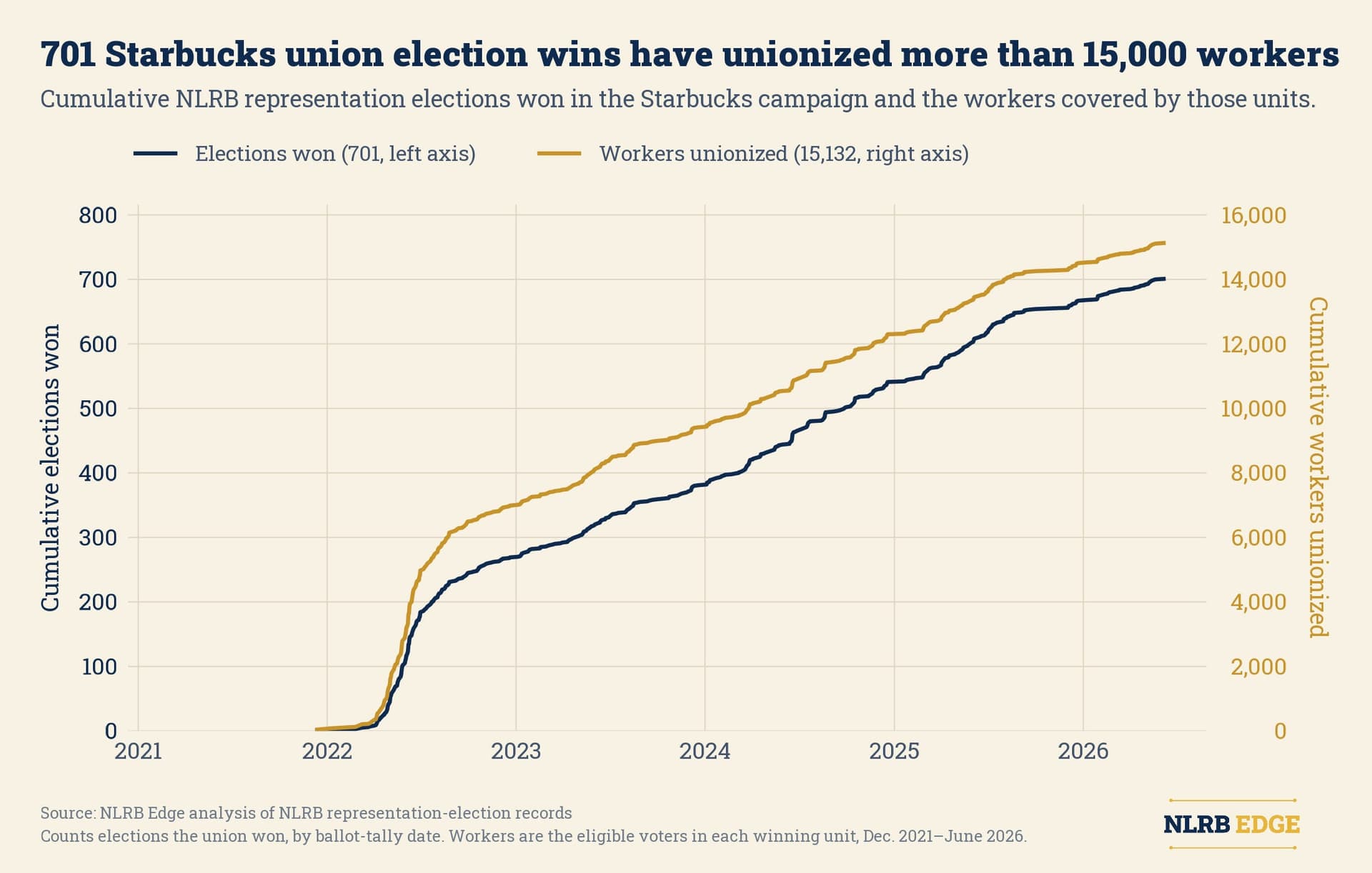
Still, the underlying fight did not disappear. Starbucks Workers United has said it has organized more than 550 active stores and about 11,000 baristas, and the union said baristas won their union election at the 500th Starbucks store in late 2024. Reuters reported in December 2024 that a strike over pay, staffing, and scheduling spread to more than 300 stores and involved more than 5,000 workers. By late 2025, the union said more than 700 unresolved unfair labor practice charges remained in dispute.
What this means at store level
For baristas, the core lesson is that the law gives real protection to collective workplace talk, especially when it is about wages, hours, staffing, safety, and other terms and conditions of employment. For shift supervisors, the question can be more complicated because the Act excludes supervisors, but Starbucks bargaining units have often included shift supervisors, which shows why actual duties matter as much as the title on the badge.
For store managers and assistant store managers, the line is different. They are typically excluded from bargaining units, which makes it even more important to understand when a discussion is about employee rights and when it is part of management authority. In a company as union-active as Starbucks, that difference shapes everything from how complaints are handled to how workers document retaliation claims.
The bottom line is straightforward: if workers are acting together about working conditions, the NLRB may protect that conduct. In a Starbucks store, that is not just labor-law theory. It is the rulebook that can determine whether a conversation about pay or hours stays ordinary, becomes organizing, or turns into a protected workplace act.
This article was produced by Prism’s automated news system from verified source data, official records, and press releases, then run through automated quality and moderation checks before publishing. The system is built and supervised by the people who set the standards it runs under. Read our full AI policy.
Did this article answer your question?