CFPB Issues Earned Wage Access Rule, What Taco Bell HR Needs to Know
The CFPB's December 2025 earned wage access rule cleared a path for employer-integrated EWA programs, but Taco Bell HR still faces a state-by-state compliance puzzle.
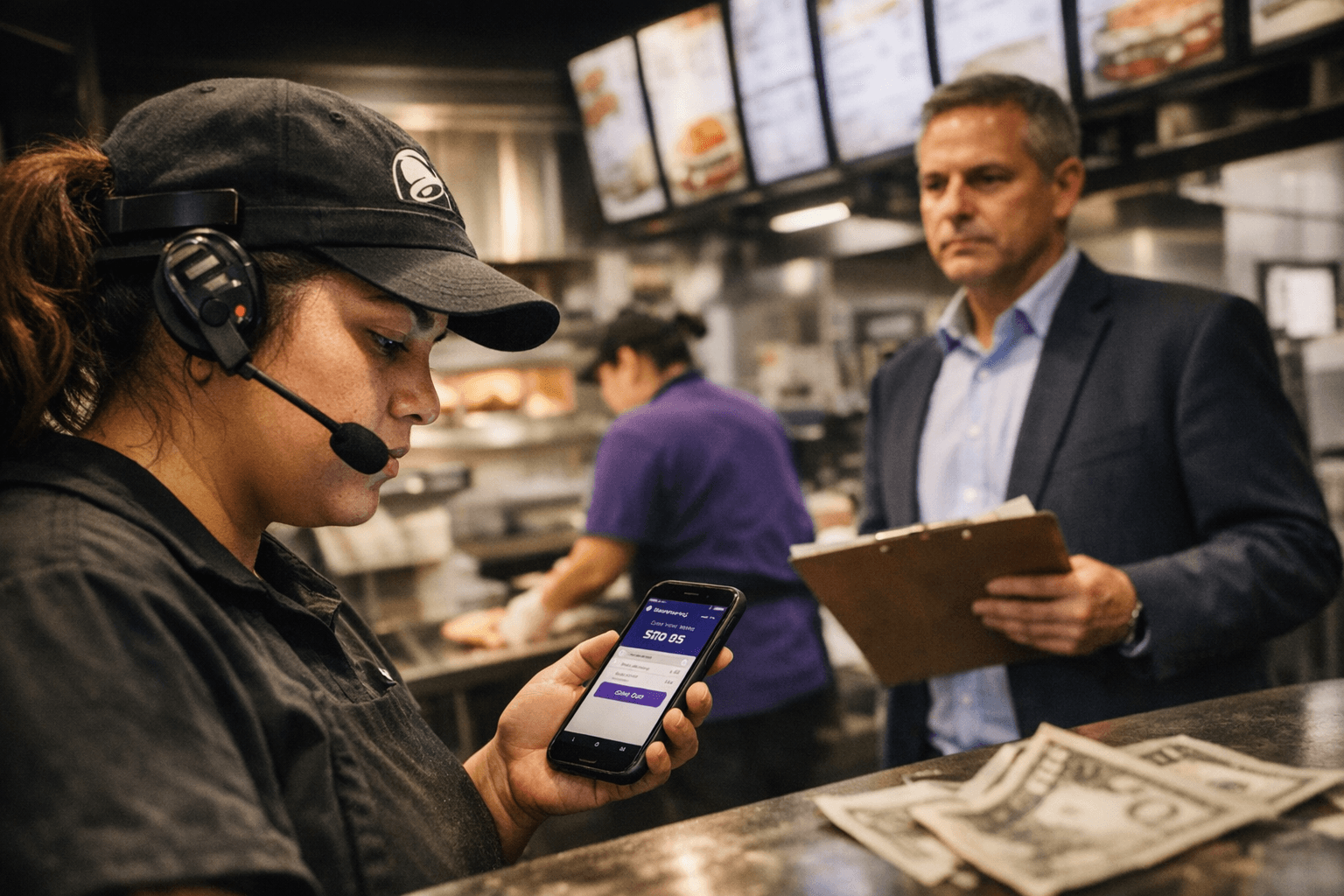
The federal government finally drew a line around earned wage access, and it landed squarely in favor of employers who run payroll-integrated programs. The Consumer Financial Protection Bureau's December 2025 interpretive rule clarified that certain employer-integrated EWA programs do not qualify as credit under the Truth in Lending Act or Regulation Z, pulling back a 2024 proposed rule that had threatened to treat most EWA products the same as payday lending. For Taco Bell HR and payroll teams, that shift matters enormously: it means a well-structured EWA benefit can be offered without triggering the disclosure requirements, APR calculations, and compliance burdens that come with consumer credit regulation.
What Changed and Why It Took So Long
Earned wage access, the ability for workers to draw on wages they've already earned before a scheduled payday, had existed in a regulatory gray zone for years. Employers, vendors, and workers all understood the basic concept, but the legal classification of these transactions remained unsettled. The CFPB's 2024 proposed interpretive rule threatened to collapse that distinction by treating EWA fees and expedite charges as finance charges under TILA and Regulation Z, effectively placing EWA providers under the same regulatory framework as lenders.
The December 2025 action reversed course. The agency withdrew the 2024 proposal and issued guidance the agency itself said "resolves regulatory uncertainty" for the rapidly growing EWA market. The regulatory form of the December 2025 action is described variously across coverage as an interpretive rule, an advisory opinion, and a ruling; the substantive outcome is consistent regardless of the label. Employer-integrated programs that meet specific mechanics are outside the TILA/Regulation Z credit framework. Everything else may not be.
What the CFPB Actually Requires
The CFPB's guidance centers on what it calls "Covered EWA" programs. Meeting that standard requires more than good intentions from a vendor. As the guidance makes explicit: "The CFPB requires Covered EWA programs to verify wages through payroll data, settle through payroll deduction, and operate on a non-recourse basis with no credit checks or credit reporting. A free delivery option must also be available to employees."
Each of those elements carries weight. Wage verification through payroll data means the vendor must connect to actual payroll records, not rely on employee estimates or bank transaction histories. Payroll-based settlement means repayment happens through payroll deduction when the next paycheck runs, not through a separate ACH pull or a debit card authorization. Non-recourse operation means the employer or vendor cannot pursue legal action against a worker if the payroll deduction doesn't fully cover the EWA advance. And the requirement for a free delivery option means workers must have a path to access their earned wages without paying an expedite fee, even if a faster-delivery option costs extra.
On the fee question, the guidance adds important clarity: optional expedite fees and voluntary tips are explicitly not considered finance charges. That distinction protects both employers and vendors from inadvertently triggering TILA disclosures simply because workers opt for faster access or choose to tip the platform.
Why Payroll Integration Is the Central Compliance Question
Taco Bell operates thousands of locations with varying payroll systems, and the CFPB's framework makes payroll integration the hinge point of the entire compliance analysis. "Payroll integration is essential because it satisfies two core Covered EWA requirements: wage verification and payroll-based settlement. Employer-integrated models that meet these criteria are the most clearly aligned with the CFPB's guidance."
A vendor that bypasses employer payroll systems, relying instead on direct deposit pattern analysis or employee self-reported hours, doesn't satisfy the wage-verification requirement. Similarly, a vendor that recovers advances through a direct bank debit rather than a payroll deduction doesn't satisfy the settlement requirement. Both gaps can push a product outside the Covered EWA definition and back into territory the CFPB's guidance explicitly did not address. The agency was clear that "products outside these bounds were not addressed by the opinion," meaning they could remain subject to TILA, Regulation Z, or state lending laws.
For HR and finance teams vetting vendors, the practical implication is that technical integration depth is a compliance issue, not just an operational preference.
The State Patchwork That Doesn't Go Away
Federal clarity on TILA and Regulation Z does not resolve the state-level complexity that Taco Bell HR faces across its footprint. According to Thomson Reuters analysis, employers and providers "face a growing patchwork of state laws" as EWA rules continue to evolve.
The breakdown matters for any operator with locations in multiple states:
- Nevada, Missouri, Wisconsin, South Carolina, and Kansas have adopted licensing or registration regimes for EWA providers.
- California has gone further, classifying EWA transactions as loans under its state lending laws, a classification with significant compliance implications for any vendor operating in the state.
- Arkansas, Indiana, Maryland, and Utah have passed newer statutes imposing consumer protections, including mandatory no-cost options for workers, fee transparency requirements, and explicit bans on credit checks and late fees.
- Pending legislation in New York, Texas, and Georgia signals that additional states will likely add requirements before these frameworks stabilize.
Effective dates for these various state laws range from mid-2024 through early 2026, meaning some rules that were not yet in force when a vendor contract was signed may now apply. Any EWA program deployed across Taco Bell's multi-state workforce requires a state-by-state legal review, not a single federal compliance checkbox.
Industry Reaction: Praise With Caveats
Ian P. Moloney, Chief Policy Officer at the American Fintech Council (AFC), described the CFPB's action as "a constructive first step" that brings much-needed clarity. "Responsible EWA services provide workers access to the wages they're entitled to when they need it most," he said. The AFC's measured optimism reflects an industry that spent years navigating uncertainty; the December 2025 guidance provides a federal foundation, but the architecture around it, particularly at the state level, remains under construction.
A Practical Vendor Checklist for Taco Bell HR
Before rolling out or renewing an EWA program, Taco Bell HR and legal teams should be able to answer yes to each of the following:
- Does the vendor verify wages using employer payroll data directly, not employee estimates or bank records?
- Does the program settle through payroll deduction, with repayment processed when payroll runs?
- Is the program non-recourse, meaning no legal action against employees if payroll deductions fall short?
- Does the program prohibit credit checks, credit reporting, and credit risk underwriting on workers?
- Is a free delivery option available to all employees, not just those who pay an expedite fee?
- Are expedite fees and tips structured as optional and not classified as finance charges?
- Has legal counsel reviewed the program against state laws in every state where Taco Bell locations will offer it, including California's loan classification and licensing requirements in Nevada, Missouri, Wisconsin, South Carolina, and Kansas?
That last point deserves emphasis. The CFPB's December 2025 guidance provides, as Instant Financial put it, "a consistent federal reference point for legal and compliance review" for employers weighing EWA. What it does not do is preempt state law. A program that clears every federal hurdle can still run into a state licensing requirement or a California loan-classification issue.
The earned wage access market is growing, and the December 2025 rule means that a thoughtfully designed, payroll-integrated EWA benefit can now be offered with substantially more regulatory confidence at the federal level. But the companies that will benefit most from that clarity are the ones that also did the state-level homework.
Know something we missed? Have a correction or additional information?
Submit a Tip