Taco Bell hiring guide highlights age rules, pay and worker perks
Taco Bell is still leaning on a youth-heavy hiring funnel, but age rules, pay, and perks depend heavily on the store you walk into. The real question is whether the job is a foothold, or just a fast-food stop.

What Taco Bell is hiring for
Taco Bell is still recruiting across the restaurant ladder, from team members and cashiers to managers and other store roles. That matters because the brand is not just filling one-off shifts, it is trying to keep a steady pipeline moving in stores that depend on fast onboarding and flexible coverage.
The company’s hiring pitch is broad on purpose. It is designed to catch first-time workers, people looking for a second job, and employees who want a route beyond crew work. Taco Bell also positions the job as more than a short-term gig, tying hiring to training, education support, and advancement.
How old you have to be to apply
The minimum age question is not as simple as a single national number. Taco Bell’s careers FAQ says the hiring age can vary by location, and applicants should check their local Taco Bell for the minimum age requirements. For minors, that means the first conversation should not be with the application form, but with the specific store.
Federal child labor law sets the floor at 14 for nonagricultural jobs, but it also limits the hours workers under 16 can work and bars workers under 18 from hazardous jobs. State rules can be stricter, which is why Taco Bell and the U.S. Department of Labor both point applicants back to local requirements and state labor departments. If you are under 18, the practical step is to confirm whether your state requires a work permit or age certification before you ever accept a shift.
That age flexibility helps explain Taco Bell’s appeal in youth-heavy labor markets. It also means store managers need to be precise, because a candidate who looks hireable on paper may still run into hour limits or paperwork rules once a schedule is built.
What the job promises on pay and perks
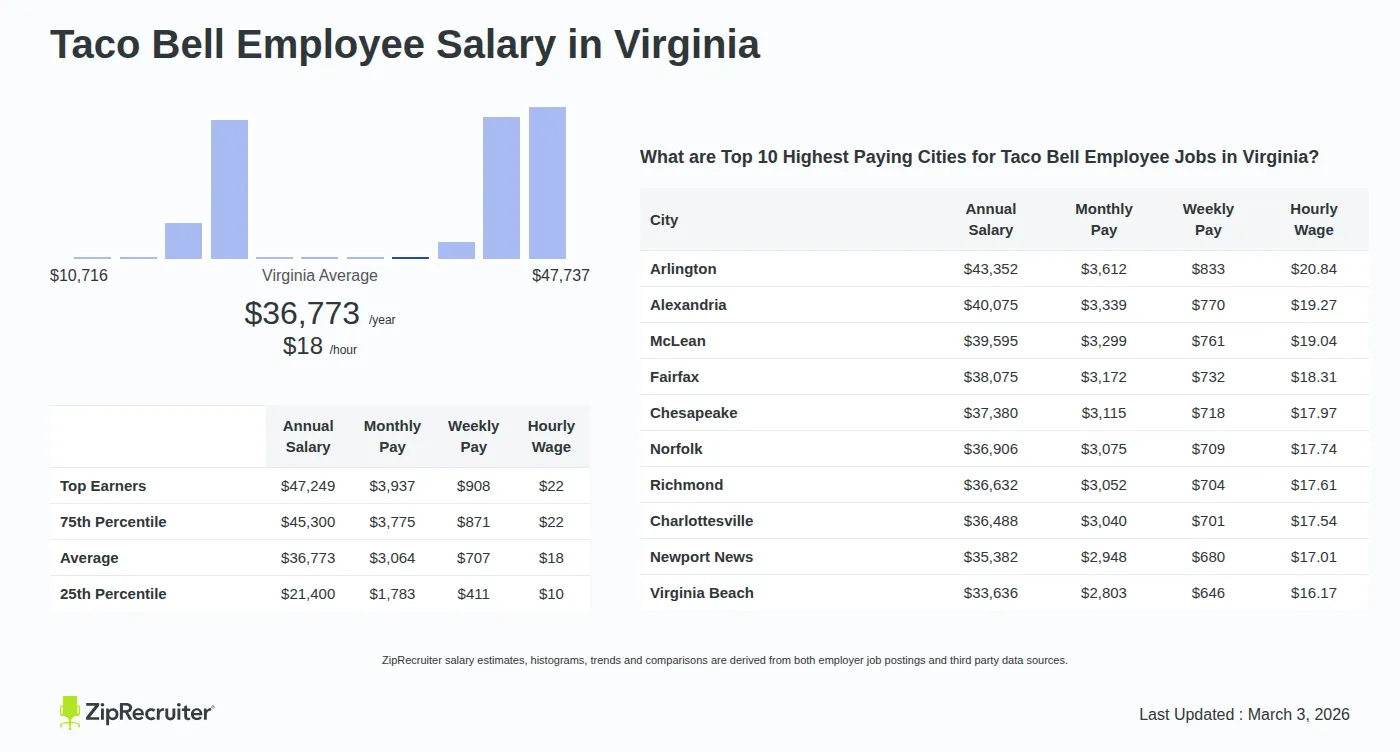
Taco Bell describes its pay as competitive, but the bigger story is the benefits menu it uses to sell the job. Many owners and operators may offer education assistance, health insurance, free meals, employee assistance, paid time off, and retirement savings options. Taco Bell is careful to say those benefits vary by employing organization, which is the fine print workers need to read closely.
At the corporate level, the perks are more specific. Taco Bell’s headquarters benefits page says comprehensive medical, dental and vision coverage starts on Day 1. It also says Yum! Brands offers a 401(k) with a 6% matching contribution and immediate vesting, which is a real draw for workers who want something more stable than a weekly paycheck.
That split between corporate perks and store-level variation is a recurring theme in fast food, and Taco Bell is no exception. The brand can market a strong benefits package, but the actual experience often depends on whether the store is company-run or franchised, and how well the operator executes the basics.
Why the franchise split matters
Taco Bell says positions are available at both corporate-owned and franchised locations, and it also says franchisees and licensees are independent business owners responsible for their own employment practices. That distinction is not a footnote. It is the reason one Taco Bell may advertise generous scheduling flexibility and stronger benefits, while another may feel much tighter on hours, staffing, or support.
For workers, that means two stores under the same brand can feel like different employers. For managers, it means hiring and retention problems often cannot be fixed by branding alone. A polished career page may get people in the door, but the day-to-day rules on breaks, schedules, training, and promotions are what decide whether they stay.
The first real step up from crew
For workers who want more than entry-level shifts, Taco Bell’s own materials point to a path upward. The restaurant careers page says the brand offers career growth opportunities, training and development, and what it calls a “fun atmosphere, friendly teams, great perks.” That is the language of a company trying to make a restaurant job feel like a stepping-stone instead of a dead end.
The clearest formal advance track in the material is Taco Bell Business School, a six-week program for restaurant leaders. The company says the program is meant to help leaders move toward franchise ownership, which puts a rare ambition marker on a fast-food job. In other words, the first step up from crew is not just more responsibility on the line, it is a system that can lead into management, leadership, and in some cases ownership.
That matters inside stores because the best Taco Bell operators need more than bodies on the clock. They need people who can close, train, run shifts, and eventually manage operations when turnover hits. The chain’s hiring message is really a staffing strategy dressed up as a career ladder.
Education, scholarships, and the long game
Taco Bell pushes education as part of that ladder. Its homepage points applicants to the Live Más Scholarship and the GED Certification Program, and the Taco Bell Foundation says it continues to award Live Más Scholarships to students and team members. That is a big signal to younger workers who may be balancing school, work, and the pressure to keep moving.
These programs also help explain why Taco Bell leans so hard into the language of opportunity. A company that hires a lot of students and young adults has to offer more than an hourly wage if it wants to keep them. Education support is part retention tool, part brand promise, and part answer to a labor market that gives workers more choices than it used to.
Why Taco Bell keeps leaning young
One number says a lot about the labor pool Taco Bell is recruiting from. The U.S. Bureau of Labor Statistics said 21.1 million people ages 16 to 24 were employed in July 2025, and 25 percent of them worked in leisure and hospitality, the largest share across industries. That is the labor market Taco Bell is fishing in: young, flexible, and often looking for a first or second job.
That also tells you something about the pressure inside the stores. A hiring page may promise access and advancement, but the operating reality is built around filling basic coverage gaps, managing peak-hour chaos, and keeping enough trained people on hand to survive a rush. The better the management, the more that promise becomes a real path. The worse the management, the more it looks like another quick stop on the way to somewhere else.
For crew members, the smartest move is to treat the application as the beginning of a detailed conversation, not the end of one. Ask the store exactly what the minimum age is, whether it is corporate or franchised, what benefits actually apply, and how the schedule will work. In Taco Bell, the difference between a decent job and a frustrating one is often hidden in the local details.
This article was produced by Prism’s automated news system from verified source data, official records, and press releases, then run through automated quality and moderation checks before publishing. The system is built and supervised by the people who set the standards it runs under. Read our full AI policy.
Did this article answer your question?