Taco Bell workers weigh AI tools as workflow changes, not robot replacements
The real change at Taco Bell is workflow: voice AI can speed drive-thrus, but crews still handle exceptions, recovery and the rush.
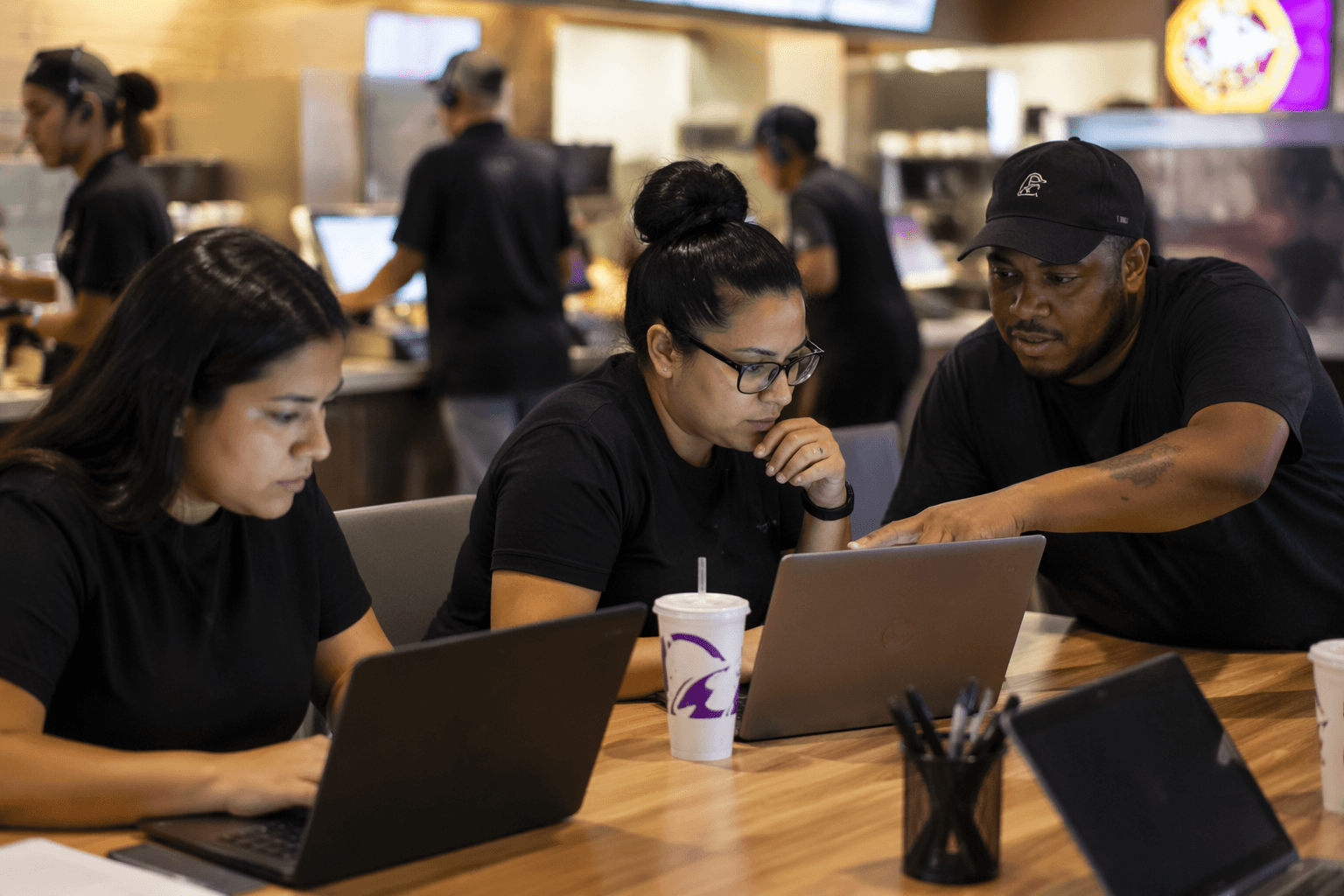
On July 31, 2024, Yum said Taco Bell’s voice AI was active in more than 100 U.S. drive-thrus across 13 states, with hundreds of stores targeted by the end of 2024. The biggest shift is not a robot taking over the line. It is a reordering of who does what when the drive-thru backs up, the headset crackles, and an order comes in wrong. Byte by Yum and Taco Bell’s voice AI move some ordering work off the crew and into software, while leaving the human job intact where it matters most: fixing mistakes, keeping the pace up, and protecting the guest experience.
Byte by Yum is the operating layer behind the AI story
Yum! Brands formally introduced Byte by Yum! on February 6, 2025 as a SaaS AI-driven restaurant technology platform for KFC, Taco Bell, Pizza Hut, and Habit Burger & Grill. The package is broader than drive-thru ordering. It covers online and mobile ordering, point of sale, kitchen and delivery optimization, menu management, inventory and labor management, and tools for team members.
The Taco Bell voice AI is not arriving as a one-off gadget. Yum said 25,000 restaurants globally already use at least one Byte by Yum product, and the U.S. system using Byte elements handles more than 300 million digital transactions a year. In its 2024 annual report, Yum also said Taco Bell U.S., KFC U.S. and Pizza Hut U.S. were already operating on the company’s Byte digital ordering platform. For a crew member on the floor, that means the drive-thru experiment sits inside a larger stack that can touch ordering, labor planning, and the screens the team is already using.
Voice AI is moving some work, not removing the need for people
Yum had spent more than two years fine-tuning and testing the system before the wider rollout. The technology is being tuned for a messy, high-pressure job rather than a clean demo.
The pilot grew from five California locations to 30 restaurants before the broader rollout. That is still a small slice of the chain, which had nearly 7,700 U.S. locations at the end of 2023, but it is large enough to matter to store operations. When a test moves from a handful of stores to more than 100 drive-thrus, the impact stops being theoretical. It starts affecting how many orders the crew hears, how often they have to step in, and how quickly they can recover when the system misses something.
The goal is to improve order accuracy, reduce wait times, and create a consistent, friendly experience. Dane Mathews, Taco Bell’s chief digital and technology officer, said voice AI is meant to improve both team member and consumer experiences. It is also meant to ease team member workloads and free them for front-of-house hospitality. In plain terms, some of the repetitive ordering friction moves from the headset to the screen, and that can open up time for prep, guest interaction, and fixing orders that go sideways.
What changes on a Taco Bell shift
For crew members, the most important change is not that the machine talks. It is that the machine takes a first pass at the order flow. If it works well, the line moves faster and the front counter or drive-thru lane is less overloaded. If it gets a combo wrong, misunderstands a modification, or simply cannot keep up with a noisy carload, a person still has to catch it, explain it, and keep the guest from feeling stuck in a loop.
That makes the shift manager’s job more complicated. Instead of only managing labor, tickets, and service speed, managers can end up troubleshooting the technology in real time. The best operators will treat AI like one more station on the floor: useful when it is working, noisy when it is not, and only as strong as the training and leadership behind it. That is the practical test in a Taco Bell rush, when every extra second at the speaker can spill into the rest of the line.
Yum said Taco Bell and its franchisees helped shape the rollout. Execution will not look identical in every store. Yum also linked voice AI to digital menu boards, the proprietary Poseidon POS system, and Taco Bell Rewards. The connected system can speed decisions, surface options, and create new points where the crew may need to intervene.
Why Taco Bell moved fast
The chain’s rollout was aggressive compared with some rivals. McDonald’s ended its IBM-powered automated order-taker trial in June 2024 after mixed results, while Taco Bell pressed ahead. Wendy’s and White Castle have been slowly implementing voice AI, but Taco Bell’s deployment moved faster and wider than most competitors. The technology is no longer a curiosity sitting in a single market. It is becoming part of how one of the biggest fast-food systems in the country thinks about service.
Drive-thrus are a high-volume bottleneck, restaurant labor is expensive, and the chain wants speed without simply cutting the cashier out of the equation. That is also why the rollout keeps coming back to support, not replacement. Taco Bell was founded in 1962 by Glen Bell in Downey, California, and sold its first franchise in 1964.
This article was produced by Prism’s automated news system from verified source data, official records, and press releases, then run through automated quality and moderation checks before publishing. The system is built and supervised by the people who set the standards it runs under. Read our full AI policy.
Did this article answer your question?