Tipped wage rules matter for Taco Bell franchise payroll teams
A federal tip-credit rule can change a paycheck by dollars an hour, but state laws often override it. Taco Bell payroll teams need to check every location.

Why the federal baseline is only the starting point
A tipped-wage rule can look irrelevant on a Taco Bell pay sheet until a franchisee runs more than one kind of restaurant or crosses state lines. The federal baseline is simple on paper: $7.25 an hour minimum wage, a $5.12 maximum tip credit, and a $2.13 cash wage for eligible tipped employees. The problem is that many states and localities set higher standards, and some require the full state minimum wage before tips are counted at all.
That gap matters because payroll mistakes do not start with a lawsuit, they start with a shift schedule, a transfer, or a manager assuming the federal rule is the only one that counts. For Taco Bell franchise teams, especially operators who also run other food-service brands, the real challenge is matching the right wage rule to the right restaurant, state, and job classification every time the schedule changes.
Who counts as a tipped employee, and why that definition matters
Under Department of Labor guidance, a tipped employee is generally someone who customarily and regularly receives more than $30 a month in tips. That is a narrow category, and it is not the same thing as any worker who sometimes gets a gratuity or works near a tipped job. If an employer claims a tip credit, the worker’s direct wages plus tips must equal at least the federal minimum wage for the workweek.
That weekly test is where many disputes begin. A crew member may only see the hourly cash wage on a pay stub, but the employer has to make sure the math works across the full workweek, not just one busy lunch rush or one slow afternoon. Congress added the tip-credit provision to the Fair Labor Standards Act in 1966, and the current $2.13 federal cash wage dates to 1996, when the federal minimum wage was $4.25 an hour. The number is old, but the compliance obligation is current, and employers must keep records for tipped employees.
Why this still matters at Taco Bell, where most jobs are hourly
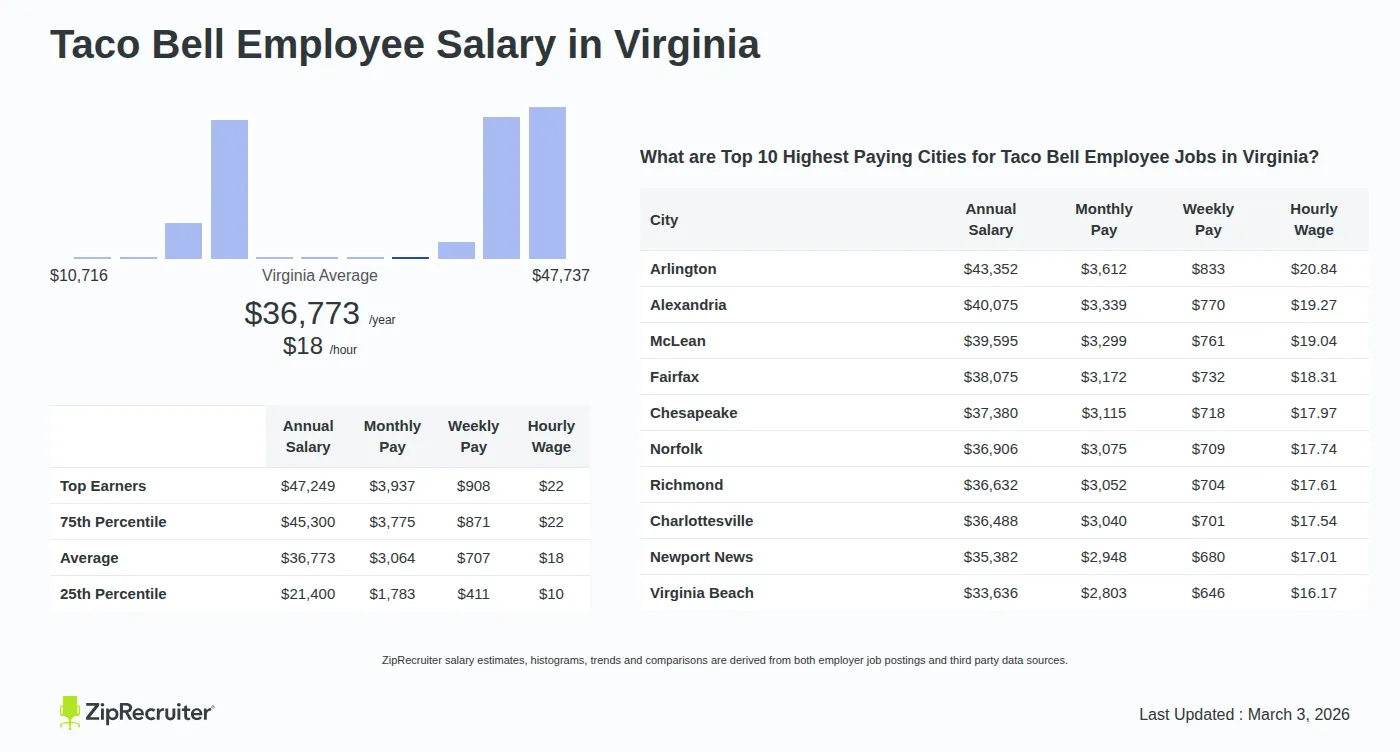
Most Taco Bell roles are not traditional tipped positions, which is exactly why payroll teams can overlook the rule. Taco Bell career postings show many restaurant jobs paid hourly rather than through tips, including a Team Member posting with a base range of $14.70 to $18.50 an hour. A California franchise posting listed Team Member pay at $20.00 to $21.10 an hour. That is a reminder that the chain’s labor model is built around hourly wages, not tip-credit math.
Still, the federal rule matters as a comparison point, especially for franchise operators. Taco Bell says franchisees are independent business owners who set their own wage and benefit programs, which means pay practices can vary from store to store and state to state even under the same brand. If a franchisee also operates a second concept with tipped staff, the payroll team may need to administer more than one wage system under one roof. The federal tipped-wage rule becomes the floor, not the whole map.
Where managers most often get into trouble
The first problem is scheduling. A manager may move workers between restaurants, concepts, or states without checking whether the local rule allows a tip credit at all. That is risky because some jurisdictions require a higher cash wage, and others require the full minimum wage before tips. A schedule that looks fine in one state can be noncompliant in the next, even if the job title is the same.
The second problem is the tip-credit calculation itself. Employers have to be sure the employee gets enough tips from customers and enough direct wages in the workweek to reach the legal minimum. If the math does not work, the employer has to make up the difference. That means payroll cannot wait until the end of the month, and it cannot rely on a manager’s rough estimate after a busy weekend.
The third problem is communication. Workers need to know whether their location can legally use a tip credit, what wage rule applies, and how the company is tracking the numbers. If the pay model changes because a worker transfers to another state, a franchise opens a different concept, or a local rule overrides the federal baseline, that change has to be explained clearly. Confusion usually starts when the hourly rate on the stub does not match what the worker expected to earn after tips.
The recordkeeping and training details that keep payroll clean
The Department of Labor says records for tipped employees must be kept, and that is not a formality. Good records are what let a franchisee prove that the cash wage, tips, and workweek totals satisfied the law. For multi-state operators, records also help separate one state’s rules from another’s when the same payroll system handles several locations.
Manager training should focus on a few practical controls:
- Confirm whether the restaurant is in a state or city that allows a tip credit, and whether the cash wage has to be higher than the federal $2.13.
- Check the workweek total, not just the shift total, so tips and direct wages are measured against the correct minimum wage.
- Flag transfers between brands, locations, or states before the schedule is finalized.
- Keep pay stubs, tip records, and wage notices organized so crew members can review them if there is a dispute.
That is especially important in mixed-portfolio franchise groups, where one payroll team may handle hourly Taco Bell crew pay alongside tipped roles in another concept. The accounting burden grows fast when wages, taxes, tip credits, and minimum-wage shortfalls all have to be tracked at once.
Why the industry keeps debating the rule
The National Restaurant Association argues that the tip-credit system lets tipped restaurant workers earn more than minimum wage and says many operators and tipped employees want to preserve it. The same group also says restaurant payroll accounting is complicated because operators have to calculate wages, taxes, tip credits, and minimum-wage shortfalls. Both points are true at once: the system can raise pay for some workers, and it can also create a lot of compliance pressure for managers.
For Taco Bell franchise payroll teams, the lesson is straightforward. The federal number is only the baseline, state and local rules can be stricter, and the real paycheck is shaped by how carefully managers handle scheduling, wage calculations, and worker communication. In a business built on thin margins and fast shifts, the cleanest payroll is the one that never assumes one rule fits every store.
This article was produced by Prism’s automated news system from verified source data, official records, and press releases, then run through automated quality and moderation checks before publishing. The system is built and supervised by the people who set the standards it runs under. Read our full AI policy.
Did this article answer your question?