EEOC guidance clarifies when Trader Joe's workplace harassment becomes illegal
A bad shift is not always illegal, but repeated abuse tied to race, sex, disability, religion or another protected trait can trigger EEOC action fast.
Where the legal line really sits
A rude coworker is not automatically a federal case. The EEOC’s harassment guidance draws the line where ordinary retail friction ends and discriminatory abuse begins: the conduct has to be tied to a protected characteristic, and it has to be severe or frequent enough that a reasonable person would find it abusive, while the worker actually experiences it that way.
That distinction matters in a Trader Joe’s store, where the pace is fast, the aisles are tight, and tempers can flare over stocking, samples, schedules, or coverage at the register. A bad attitude, a clash over closing duties, or a personality conflict can be exhausting, but federal law does not cover every ugly interaction. What it does cover is conduct rooted in race, color, religion, national origin, sex, pregnancy, sexual orientation, transgender status, disability, age 40 or older, or genetic information.
What crosses the line in a grocery setting
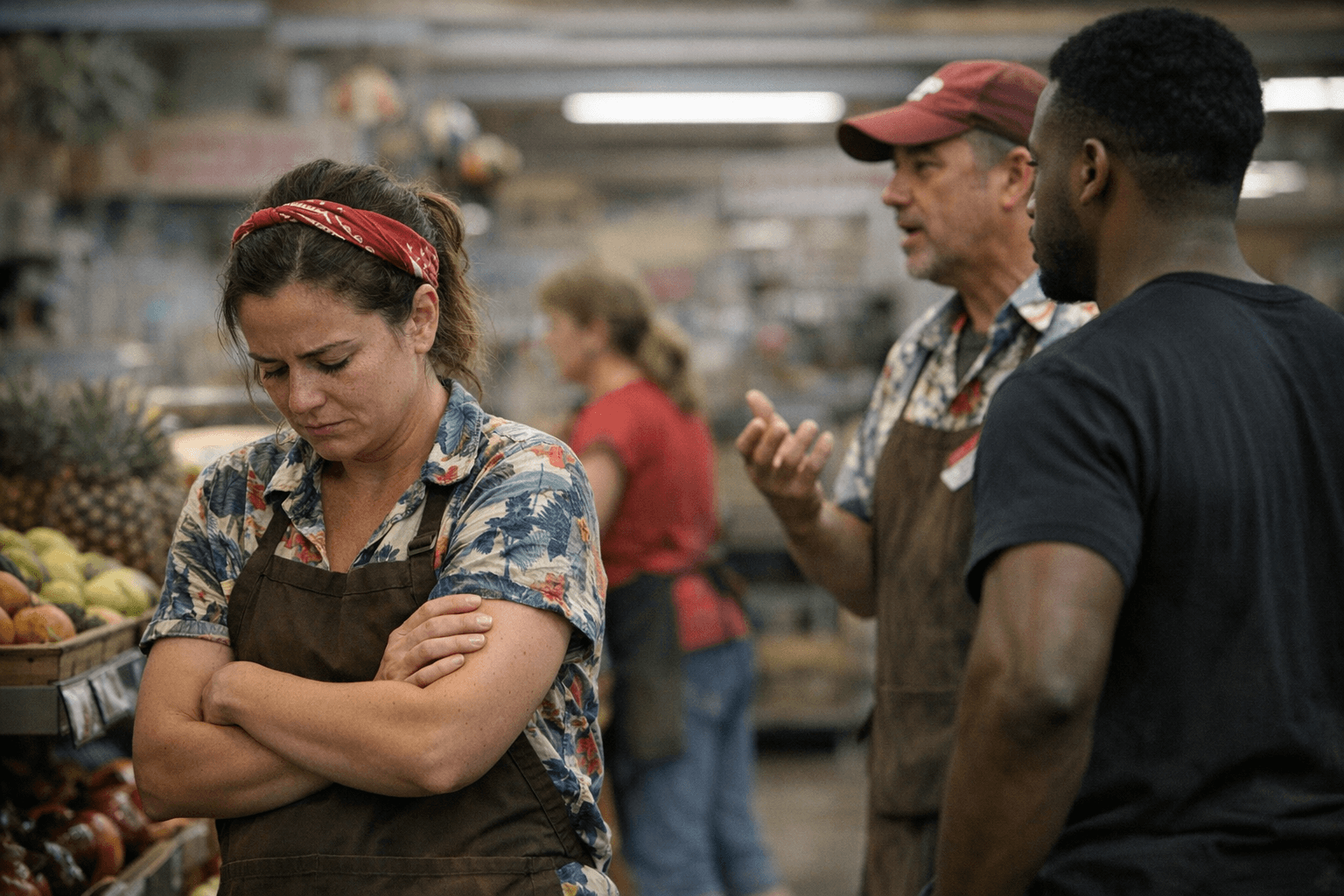
In a store environment, the EEOC’s examples translate easily. Slurs, racist cartoons, sexually demeaning images, mocking a coworker’s accent, ridiculing disability-based limitations, or threatening someone because of religious beliefs or attire can all be part of an unlawful hostile work environment. A joke that lands badly is not the same thing as conduct that repeatedly targets who someone is.
That is the practical test for crew members and managers alike: ask whether the behavior is just unpleasant, or whether it is discriminatory. A supervisor who keeps nitpicking a worker’s accent after complaints is not simply being difficult. A coworker who posts offensive images in a back room, or who makes sex-based comments in front of the team, is not just creating tension. In a busy store, the noise and stress can make everything feel louder, but the law still focuses on whether protected traits are driving the abuse.
The EEOC also makes clear that personality conflicts, disagreements, or general incompatibility are not covered by federal equal employment opportunity laws unless they are tied to a protected characteristic. That boundary is important for Trader Joe’s, where the culture often prizes friendliness and teamwork. The law does not require anyone to endure repeated abusive conduct just because it happens in a store that likes to think of itself as upbeat.
When harassment becomes a legal problem
Not every hostile comment is the same, and the EEOC’s guidance flags two especially serious situations. First, harassment can violate federal law if it is severe or frequent enough to create a hostile work environment. Second, harassment can also become unlawful when it leads to a tangible employment action, such as demotion, lost hours, lost pay, or firing.
That second point matters in retail because pay and scheduling are so central to daily life. If a complaint is followed by a cut in hours, a bad assignment, or discipline that looks retaliatory, the issue may be more than a bad interaction. For a crew member trying to make rent, lost hours are not a small consequence. They can be the difference between a rough week and a crisis.
Managers should understand the flip side as well: once the company knows about possible harassment, prompt correction and protection from further harm become part of the job. Waiting, minimizing, or treating repeated abuse as a personality dispute can leave the company exposed and leave workers unprotected.
How to document it before it gets worse
The safest move is to write things down while they are fresh. Keep a record of the date, time, place, who was involved, what was said or shown, and who else heard or saw it. Save texts, schedule changes, emails, photos of offensive images, and any written complaints you made. If the conduct affects your hours, pay, or assignment, note that too.

A practical paper trail often includes:
- the exact words used, if you can remember them
- the names of witnesses, including customers if they heard the exchange
- where it happened, such as the break room, stockroom, checkout lane, or parking lot
- how you reported it and to whom
- whether the conduct stopped, continued, or led to a shift change, discipline, or lost hours
That record helps in two ways. It gives the company a chance to fix the problem, and it creates a timeline if the behavior escalates. In a store where a worker may see the same people every day, memories blur quickly. Notes do not.
When to escalate inside, and when to go outside
Start inside when the issue is early, isolated, or not yet severe, especially if you want the store to correct it quickly. Report through the employer’s channels, and if possible, put the complaint in writing so there is a clear record of what you raised and when. If you work in a store with a union presence, loop in your representative as well when the issue overlaps with scheduling, discipline, or retaliation.
If the conduct continues after management knows, if it becomes more severe, or if you lose hours, pay, or your job after speaking up, it is time to think beyond the store. The EEOC says most laws it enforces require a charge before a lawsuit can be filed, and the filing deadlines are strict. Its Public Portal is the intake path for people who believe they have faced discrimination by a private employer, a state or local government, a union, or an employment agency.
That external route is not just theory. In fiscal year 2024, the EEOC said it filed 110 lawsuits challenging unlawful employment discrimination, and its FY 2024 to 2028 Strategic Enforcement Plan prioritizes systemic harassment. The agency is still treating harassment as a major workplace issue, not a minor HR complaint that can be buried and forgotten.
Why Trader Joe’s workers keep watching this closely
Trader Joe’s has a reputation for above-market pay and a crew culture that many employees are proud of, but the labor record around the chain shows that good branding does not settle workplace questions. The National Labor Relations Board has open Trader Joe’s-related cases filed in Philadelphia on January 17, 2025, and in Henderson, Nevada on December 30, 2024. Other cases filed in Minneapolis on February 26, 2025, and Oakland on May 20, 2025, were later closed by withdrawal.
Chicago remains one of the clearest reminders that worker sentiment can split right down the middle. At Trader Joe’s East on 3745 N. Lincoln Avenue, an election case ended 70 votes for the union and 70 against, with 154 eligible voters. Block Club Chicago reported that North Center workers pushed to form a union to protect pay, benefits, and the store’s progressive atmosphere. That language matters because it shows what employees think they are defending, not just what the company says it stands for.
Fast Company also reported that a former Trader Joe’s employee in suburban Boston said she complained in mid-2020 about a male colleague she believed was sexually harassing women, and that about a dozen employees later signed a letter asking for more transparency about harassment complaint findings. The company said its process for resolving workplace abuse allegations was robust. The gap between those two positions is exactly why workers need to know the legal line.
At Trader Joe’s, the lesson is simple: friendliness is not a substitute for compliance. If the conduct is tied to a protected trait, it can become unlawful quickly. If it is not, it may still be a bad management problem, a union issue, or a culture problem that deserves escalation before it hardens into something worse.
This article was produced by Prism’s automated news system from verified source data, official records, and press releases, then run through automated quality and moderation checks before publishing. The system is built and supervised by the people who set the standards it runs under. Read our full AI policy.
Did this article answer your question?