Madison Students Claim Monroe Street Trader Joe's as a Campus Cultural Hub
A Badger Herald feature crowns Monroe Street Trader Joe's as Madison's unlikely campus rite of passage, where broke undergrads and faculty share approximately three aisles and wilting flowers.

The bus ride takes long enough that you start doubting your own geography. Then, as a Badger Herald feature put it, "you crane your travel-weary neck up Monroe Street. There she blows, Monroe Street Trader Joe's."
That opening, published in the student newspaper's March 11, 2026 long-form feature, captures something that students and residents of Madison, Wisconsin have apparently understood for years: the Monroe Street Trader Joe's is not just a grocery store. It is, by the feature's telling, a cultural fixture and a rite of passage, the kind of place that confers local identity simply by being survived.
A store that earns its mythology
The piece, written in first-person and running as a long-form feature in The Badger Herald, the University of Wisconsin–Madison's independent student publication, leans hard into the store's inconvenience as part of its appeal. The location sits on Monroe Street, far enough from central campus that the commute itself becomes part of the story. "Far away from everything, unless you live in the apartments directly attached to it," the feature notes, the journey by bus registers as a minor expedition before a single item lands in a basket.
That distance, rather than undermining the store's status, seems to amplify it. The trek is framed not as a deterrent but as a threshold experience, the kind of slightly absurd commitment that transforms a mundane errand into something worth writing about.
Who actually shops there
What the feature captures with particular sharpness is the social cross-section that Monroe Street Trader Joe's assembles under one (compact) roof. The store, described in the piece as spanning "approximately three aisles," draws "primly dressed graduate students, locally residing faculty, and the 'I've got bats flying out of my wallet' broke-level undergrads alike." That phrase, which reads like something overheard in a Trader Joe's checkout line and immediately committed to memory, does real descriptive work: it maps the economic and social range of a UW–Madison community that does not always share the same spaces.
Graduate students grinding through dissertations, professors who have planted themselves in the neighborhood for decades, and undergraduates running on dining hall skepticism and a tight budget all converge in those three aisles. The store becomes, by this reading, a rare equalizer in a university town where status and stage of academic life tend to sort people into different orbits.
The cashier, the flowers, and the knighting
No detail in the feature landed with more ceremony than this one: "One of the over-friendly cashiers will knight you with an already-wilting bouquet of flowers and you can allow yourself to luxuriate in the sense of community it bestows upon you."
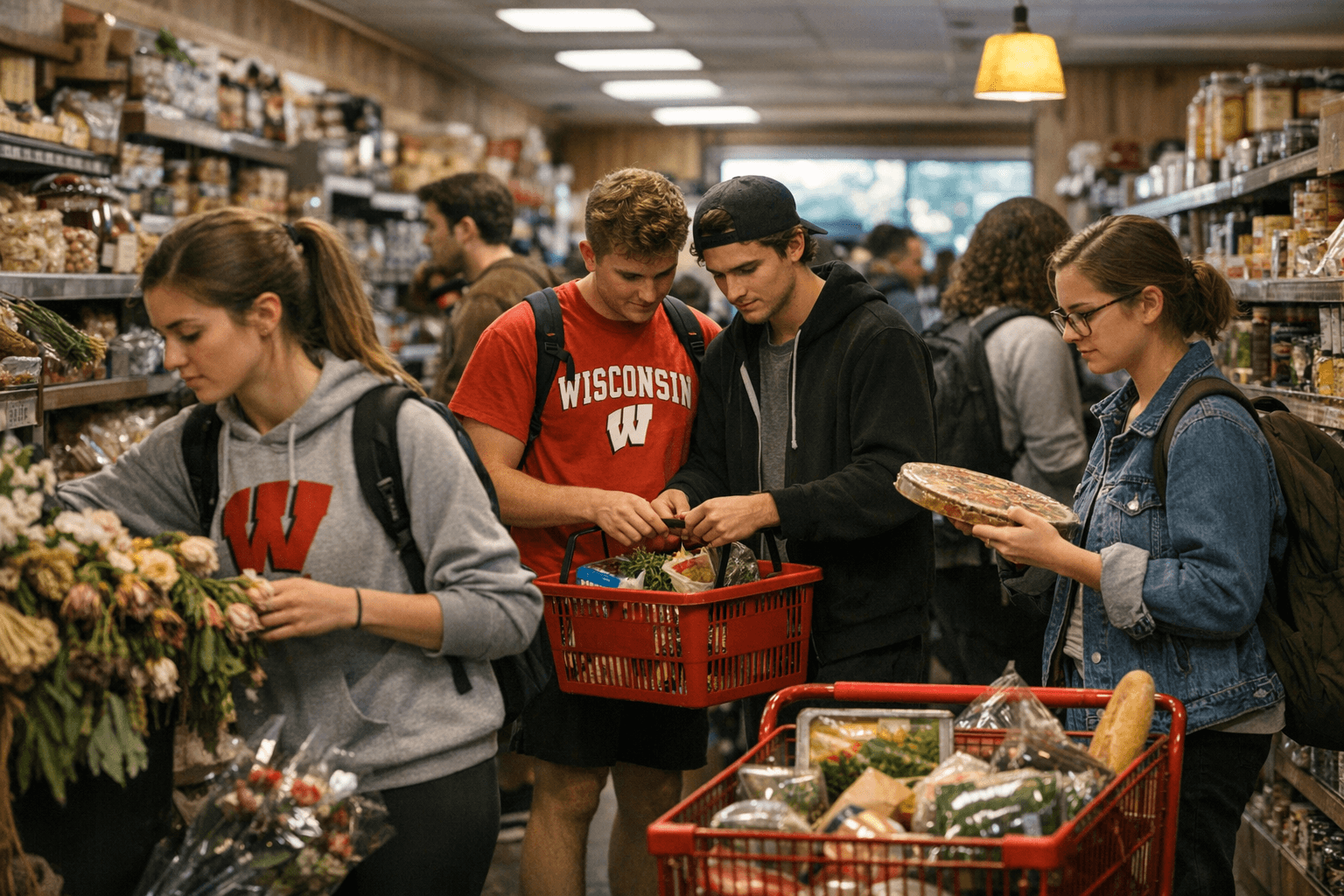
The image is absurd and warm in equal measure. A slightly past-its-prime bouquet, extended by a cashier described as "over-friendly" in that specifically Trader Joe's way that long-time customers recognize immediately, becomes the symbolic capstone of the visit. The feature does not present this as a documented store policy or a verified recurring ritual; it reads as the author's first-person account of an encounter that crystallized something true about the store's atmosphere. Whether every customer gets knighted is beside the point. The fact that it happened once, and felt representative enough to anchor a feature, says something real about the staff culture the store has cultivated.
Trader Joe's locations have always traded on a particular brand of staffed warmth, the Hawaiian shirts, the enthusiastic product knowledge, the sense that the person ringing up your frozen mandarin orange chicken is genuinely pleased to see you. The Monroe Street location, at least in this account, carries that culture authentically rather than as performance.
Becoming a true Madisonian
The feature's closing argument is not subtle, and it does not need to be. "Rest assured that after you have made this adventure through its approximately three aisles, you will have crossed over into becoming a true Madisonian." The store is positioned as an initiation, a place where the transition from newcomer to local gets quietly ratified by the experience of showing up, navigating the tight space, and leaving with something in a paper bag.
This kind of civic mythology tends to attach itself to unexpected places. Not the famous buildings or the landmark bars, but the slightly inconvenient grocery store that takes commitment to reach and repays it with community. For UW–Madison students arriving in Madison from elsewhere, the Monroe Street Trader Joe's appears to function as one of those anchoring experiences, small in scale but disproportionate in meaning.
Why a student paper is telling this story
The Badger Herald covering a grocery store in first-person long form is itself notable. Student journalism typically tracks institutional decisions, campus politics, and athletic results. The same March 11, 2026 issue that carried this feature also covered student government candidates Bobby Gronert and Ellen Zhang at an SVU Q&A and the naming of John Zumbrunnen, who has held academic and leadership positions at UW for nearly 18 years, as the university's new provost. Serious institutional news, handled alongside a lyrical tribute to a three-aisle grocery store.
The choice to publish the Trader Joe's feature in that context reflects something genuine about student journalism at its best: the understanding that campus life is not only policy and administration, but also the accumulation of ordinary rituals that give a place its texture. A grocery store that brings together broke undergrads and faculty, that requires a bus ride long enough to question your bearings, that sends you home with a wilting flower and a feeling of belonging, is worth documenting.
The Monroe Street Trader Joe's did not earn its cultural status through marketing or corporate positioning. It earned it by being exactly what it is: small, inconvenient, staffed by people who seem genuinely glad you made the trip, and located just far enough away that getting there feels like an act of intention. The Badger Herald simply wrote it down.
Know something we missed? Have a correction or additional information?
Submit a Tip