OSHA warns Trader Joe's crews about slips, trips and falls
OSHA’s warning is a reminder that the biggest grocery-store injuries often start with the smallest floor hazards. At Trader Joe’s, wet aisles, tight stock moves, and cluttered backrooms can turn a normal shift into missed time.
Why this warning matters on a Trader Joe’s floor
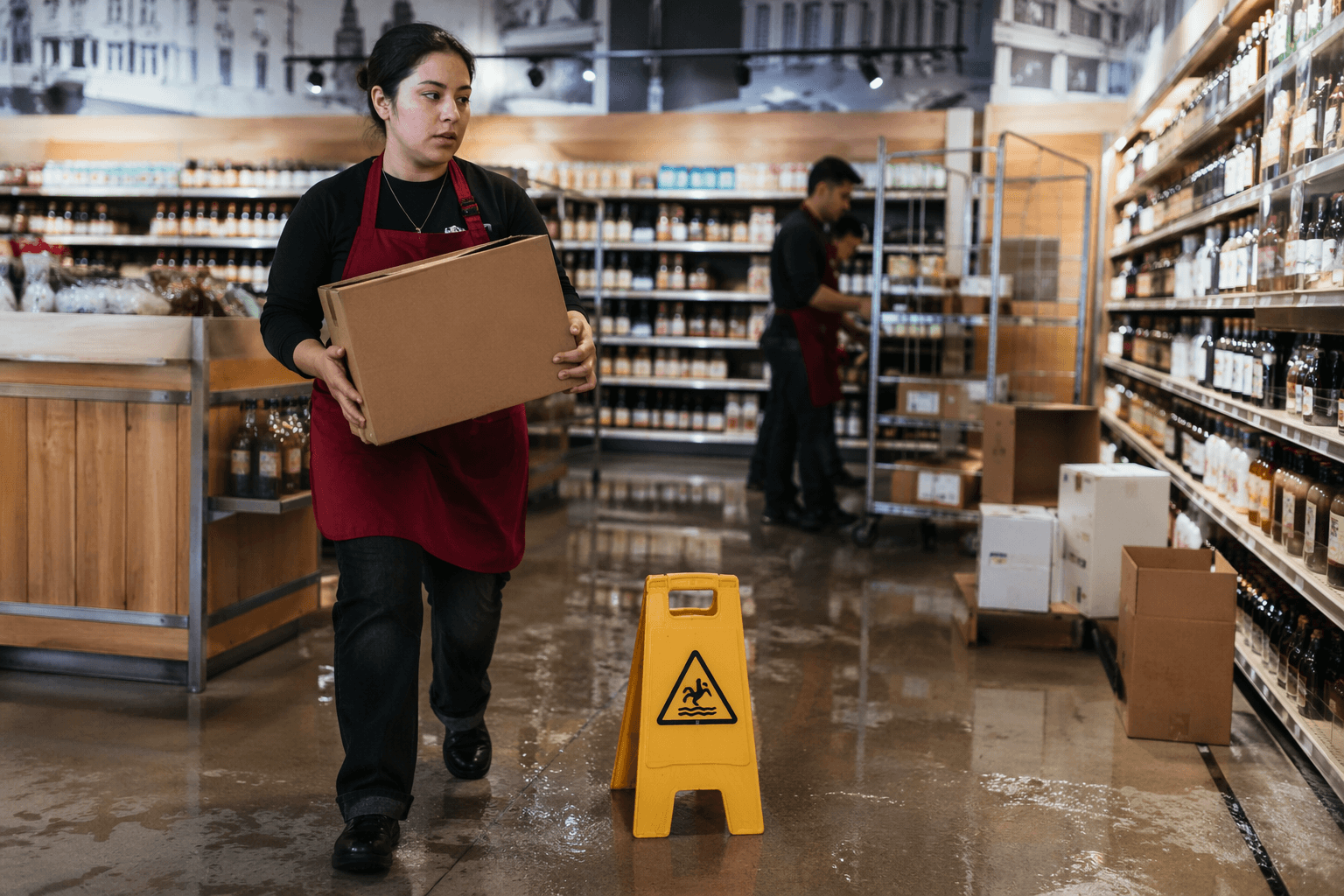
A wet patch in produce or a cardboard pile in the backroom can do more than slow a shift. At Trader Joe’s, slips, trips and falls are the kind of routine hazard that can turn into injuries, missed time, and a chain reaction of delayed stocking, disrupted aisles, and frustrated crews.
That is why OSHA’s guidance lands differently in grocery work than it would in an office or a warehouse with wide lanes and predictable traffic. Trader Joe’s stores run on speed, tight spacing, and constant movement, which means the everyday exposure points are easy to identify: produce mist, freezer condensation, wet entrances, narrow aisles, stock carts, and the quick box handling that keeps the shelves full.
The floor risks are built into the job
OSHA’s basic rule is straightforward: walking and working surfaces have to be kept free of hazards like clutter, protruding objects, and wet conditions. In practice, that covers the messiest parts of grocery work, from a spill in front of the juice case to a stray box flaps in the backroom to a cart left in the wrong place when shoppers are moving through.
The agency’s breakdown of the problem is equally plain. Slips usually come from wet surfaces, spills, or weather hazards like ice and snow. Trips happen when a foot hits an object. Falls happen when a worker gets too far off balance. Those definitions matter because they map directly onto what crew members actually deal with during a shift, especially when the store is busy and people start moving faster than the floor conditions allow.
NIOSH makes the broader point even more clearly: employees in wholesale and retail trade establishments suffer high rates of slip, trip, and fall injuries. This is not a rare or dramatic hazard, and it is not limited to one store or one district. It is one of the most common ways grocery work turns into an injury claim or a lost-workday case.
Trader Joe’s has already been tested on safety enforcement
The company’s recent OSHA history gives this issue extra weight. In April 2024, OSHA said Trader Joe’s Co. was facing nearly $217,000 in proposed penalties, with a total of $216,902, after a December 2023 inspection at the Greenwood Village, Colorado, store. OSHA said the inspection found unsafe forklift operations, a lack of training for forklift operators, and boxes blocking or making electrical equipment inaccessible.
That case mattered beyond the specific hazards cited. OSHA said Trader Joe’s had 15 business days from receipt of the citation and penalties to comply, request an informal conference with the agency’s area director, or contest the findings before the Occupational Safety and Health Review Commission. The company was identified as being headquartered in Monrovia, California, and the release noted that Trader Joe’s has eight locations in Colorado and 568 stores across the country.
The paper trail shows that enforcement problems do not always stay isolated. OSHA records show Trader Joe’s East, Inc. was previously cited in a matter affirmed as a final order on March 20, 2020. Records also show a March 4, 2024 citation with an initial penalty of $126,764 and a current penalty of $85,000, later marked as a formal settlement on October 9, 2024. OSHA also notes a prior inspection issued on May 29, 2020 under 1910.157(c)(1). For workers, the takeaway is simple: if a hazard is recurring in the records, it is probably recurring on the floor unless managers build habits that actually stick.
The Tennessee case shows how one spill can become a bigger legal problem
The safety risk is not just theoretical, and it is not just about worker injuries. In Melissa Binns v. Trader Joe’s East, Inc., the Tennessee Supreme Court said a plaintiff could pursue direct negligence claims alongside premises-liability claims. The court’s opinion, issued on April 8, 2024, involved an alleged slip and fall at a Nashville store on December 17, 2018.
According to the court’s summary, employee Natalie Thompson was stocking shelves when a package of tofu fell and released a clear liquid onto the floor. Binns slipped on that liquid while shopping and alleged negligent training, negligent supervision, premises liability, and vicarious liability. The court said those theories could proceed concurrently, a reminder that one spill can expose not only the store’s floor discipline but also its training and supervision practices.
The case caption also underscores how much turns on routine floor work. Judge Amanda Jane McClendon handled the trial court side of the case, Sean W. Martin represented Trader Joe’s East, Inc., and Donald Capparella represented Melissa Binns. For managers, that is a blunt lesson: the small decisions around stocking, spill response, and aisle clearance can become the center of a lawsuit long after the shift is over.
What crews and managers should be doing every day
The best prevention is boring, which is exactly why it works. OSHA says employers should train workers to recognize and avoid unsafe conditions and show new employees the specific hazard spots in the workplace. OSHA also recommends discussing the right choice of shoe, because footwear is part of the equation when floors get slick or crowded.
A practical Trader Joe’s version of that looks like this:
- Wipe spills immediately and mark the area clearly until the floor is dry.
- Keep stock carts and box breaks out of narrow traffic lanes.
- Cut down on backroom clutter, especially near electrical panels and active receiving areas.
- Point out the recurring danger zones during onboarding, not just in a general safety meeting.
- Treat produce mist, freezer condensation, and wet entrances as expected hazards, not surprises.
- Slow down when the floor is busy, because most slips happen when speed outruns attention.
That is the real workplace payoff here. Fewer slips and trips mean fewer injuries, fewer missed shifts, fewer claims, and fewer interruptions to the fast, tidy, curated rhythm that Trader Joe’s depends on. In a company where crew culture is part of the brand, floor safety is not background noise. It is one of the clearest tests of whether the operation is actually as solid as it looks from the aisle.
This article was produced by Prism’s automated news system from verified source data, official records, and press releases, then run through automated quality and moderation checks before publishing. The system is built and supervised by the people who set the standards it runs under. Read our full AI policy.
Know something we missed? Have a correction or additional information?
Submit a Tip