Trader Joe's Openings Linked to Home Prices Rising 6% Faster Nearby
A study of 32,000 grocery openings found homes near Trader Joe's rise 6% faster than the national average — while Walmart openings see prices underperform by 4%.
When analyst Aziz Sunderji tracked 32,000 grocery store openings, one finding stood out: neighborhoods where Trader Joe's set up shop saw home prices rise 6% faster than the national average. Walmart openings ran the opposite direction, with prices underperforming the national average by 4%.
The pattern holds across multiple independent analyses. Zillow found that two years after a Trader Joe's opened, the median home within a mile had appreciated 10 percentage points more than homes in the broader city over the previous year. Before the opening, those same homes had been appreciating at roughly the same rate as the rest of the city. The store's arrival, Zillow's data suggested, was the inflection point.
Zillow Group Chief Economist Stan Humphries described the dynamic as something close to a feedback loop. "Like Starbucks, the stores have become an amenity in their own right — a signal to the home-buying public that the neighborhood they're located in is desirable, perhaps up-and-coming, and definitely improving," he said. "Like a self-fulfilling prophecy, the stores may actually drive home prices. Even if they open in neighborhoods where home prices have lagged those in the wider city, they start to outperform the city overall once the stores arrive."
The long-run numbers tell a similar story. Between 1997 and 2014, homes within a mile of either Trader Joe's or Whole Foods were consistently worth more than the median U.S. home. By the end of 2014, they were worth more than twice as much as the median home elsewhere in the country.
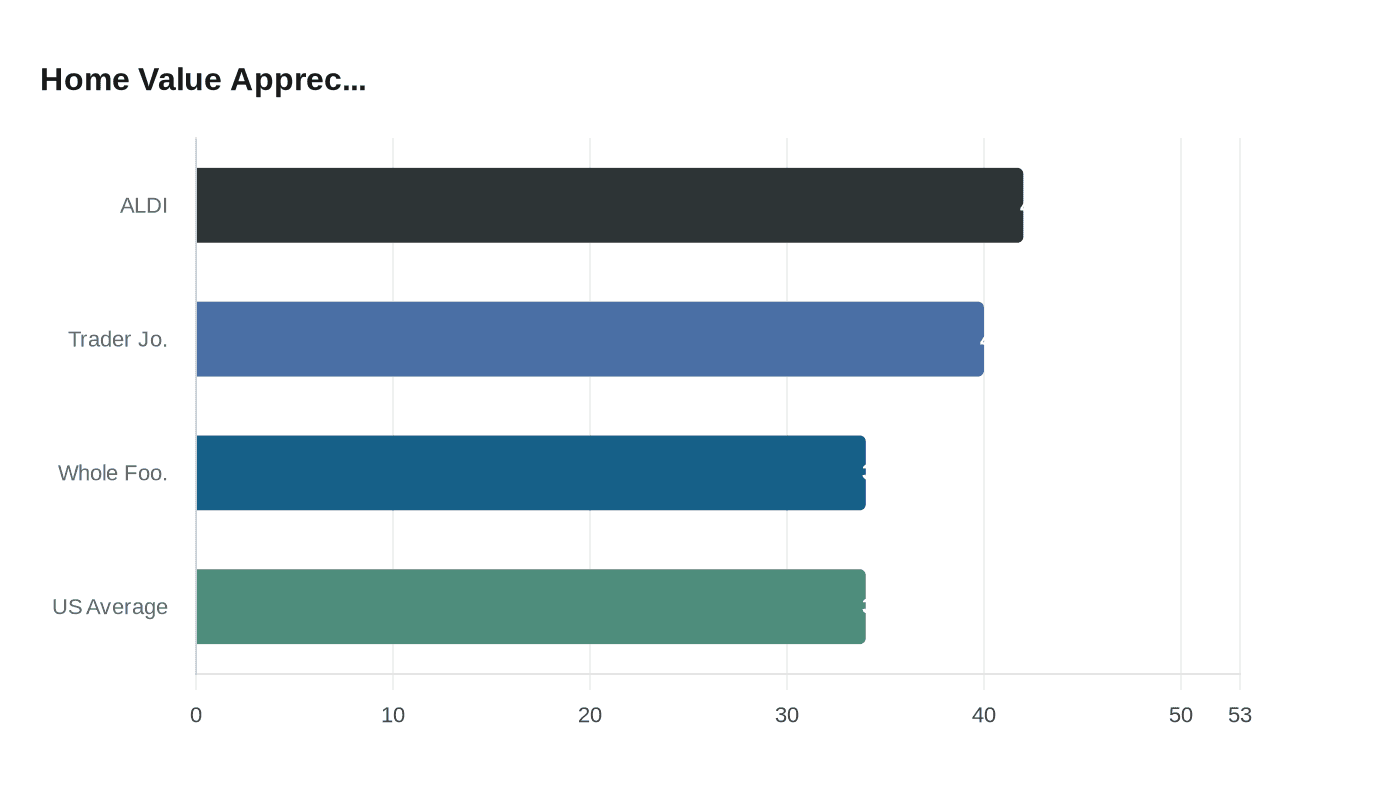
A RealtyTrac analysis sharpened the comparison against Trader Joe's closest competitor for the "premium-but-approachable" positioning. Homes near Trader Joe's had increased in value by 40% since purchase, compared to 34% for homes near a Whole Foods — which also happened to match the 34% average appreciation for all U.S. homes. Trader Joe's neighborhoods carried a higher average price ($592,339 versus $561,840 for Whole Foods areas) and significantly higher property taxes: $8,536 per year near Trader Joe's versus $5,382 near Whole Foods, against a national average of $3,239. Homebuilders, RealtyTrac concluded, could charge more for new construction near a Trader Joe's than near a Whole Foods.
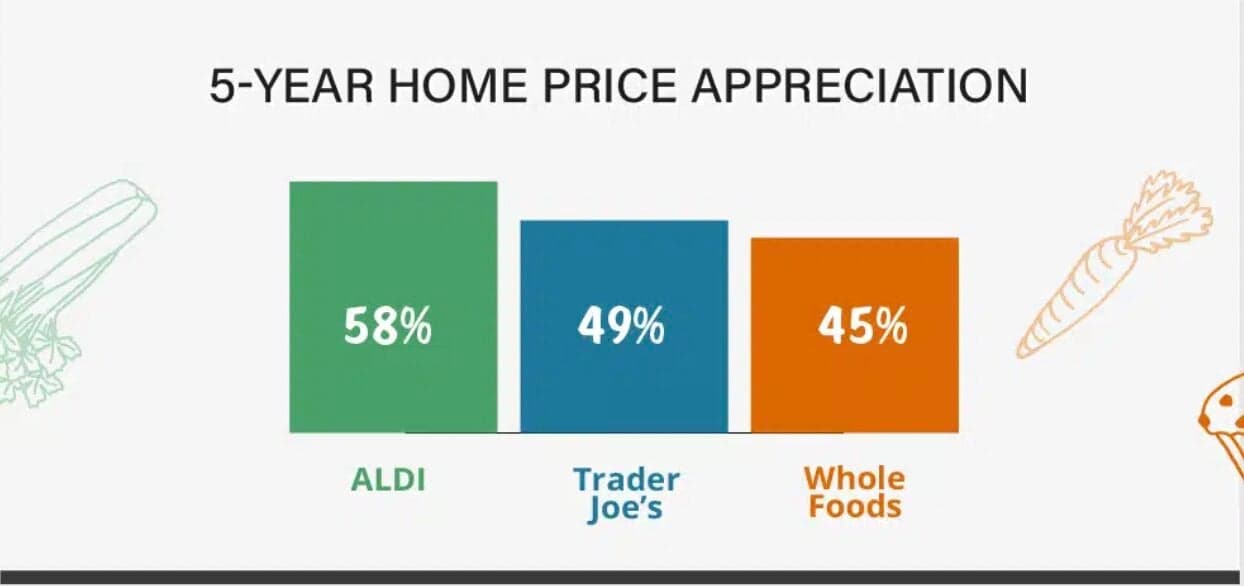
ATTOM Data Solutions introduced a counterintuitive wrinkle when comparing three grocery chains directly. Over a five-year period, ALDI-adjacent homes led with 42% appreciation, beating Trader Joe's neighborhoods at 33% and Whole Foods at 31%. On house-flipping returns, ALDI neighborhoods were even more dramatic: a 62% average gross flipping ROI versus 35% for Whole Foods and 31% for Trader Joe's, well above the 52% average across all zip codes with these stores nationally. ATTOM described ALDI neighborhoods as "an investor's cornucopia." The distinction matters: ALDI areas appear to offer more upside room for investors precisely because they start from lower price bases, while Trader Joe's neighborhoods tend to arrive already elevated.
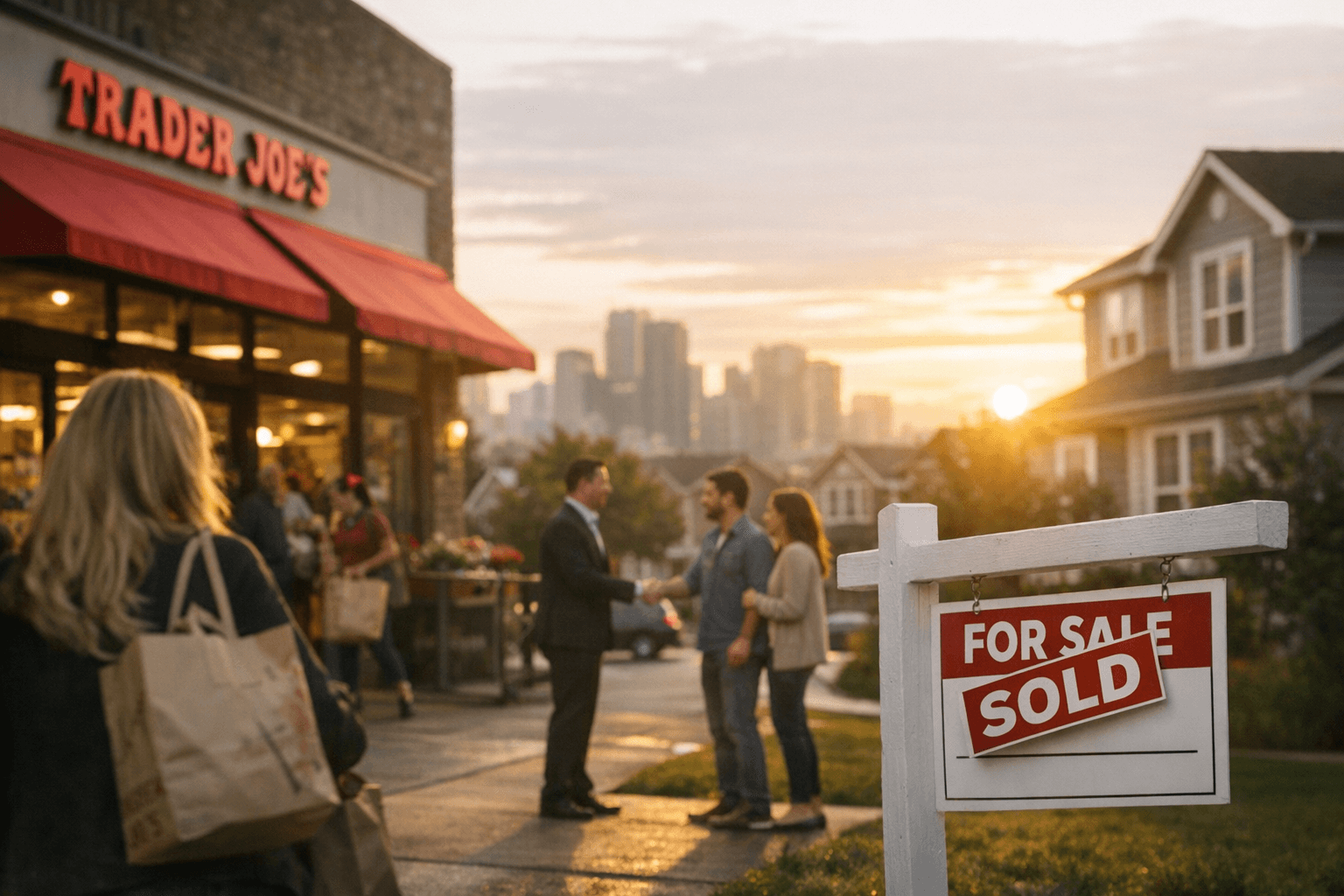
That elevation is partly by design. A 2018 episode of the "Freakonomics" podcast cited data showing Trader Joe's tends to open in counties where average household income sits roughly $10,000 above the median. A 2020 study of Southern California found the chain concentrated in upper-middle-class neighborhoods rather than middle- or lower-income ones. Attom Data Solutions separately found the average price of homes in the same zip code as a Trader Joe's was nearing $1 million, and a Real Estate Consulting report found a street-level Trader Joe's could raise rental rates by an average of 5.8%.
Critics have attached a specific name to the phenomenon. Apartment Therapy coined the term "Trader Joe's Effect," and the gentrification concerns it captures are not purely theoretical. In 2014, a predominantly Black neighborhood in Portland, Oregon, rejected plans for a Trader Joe's location over fears that the store would accelerate displacement of lower-income residents.
The Idaho Business Review noted a local version of this calculus when reporting the ATTOM findings. Trader Joe's opened its first Idaho location in 2014 at 300 S Capitol Blvd in downtown Boise, and a second store was rumored for Meridian, described at the time as one of the nation's fastest-growing communities. The same dynamics playing out in national datasets were, by that point, already visible at the neighborhood level in markets where the chain was still relatively new.
Whether a Trader Joe's causes appreciation or simply anticipates it remains the core methodological question none of these studies fully resolves. Humphries' framing — stores as signals that become self-fulfilling — is probably the most honest accounting of what the data can and cannot prove.
Know something we missed? Have a correction or additional information?
Submit a Tip