UPS Teamsters toolkit explains heat-safety rights in plain English
UPS’s heat toolkit turns Article 18 into a field manual: ask for water, take a cool-zone break, document problems, and grieve violations.

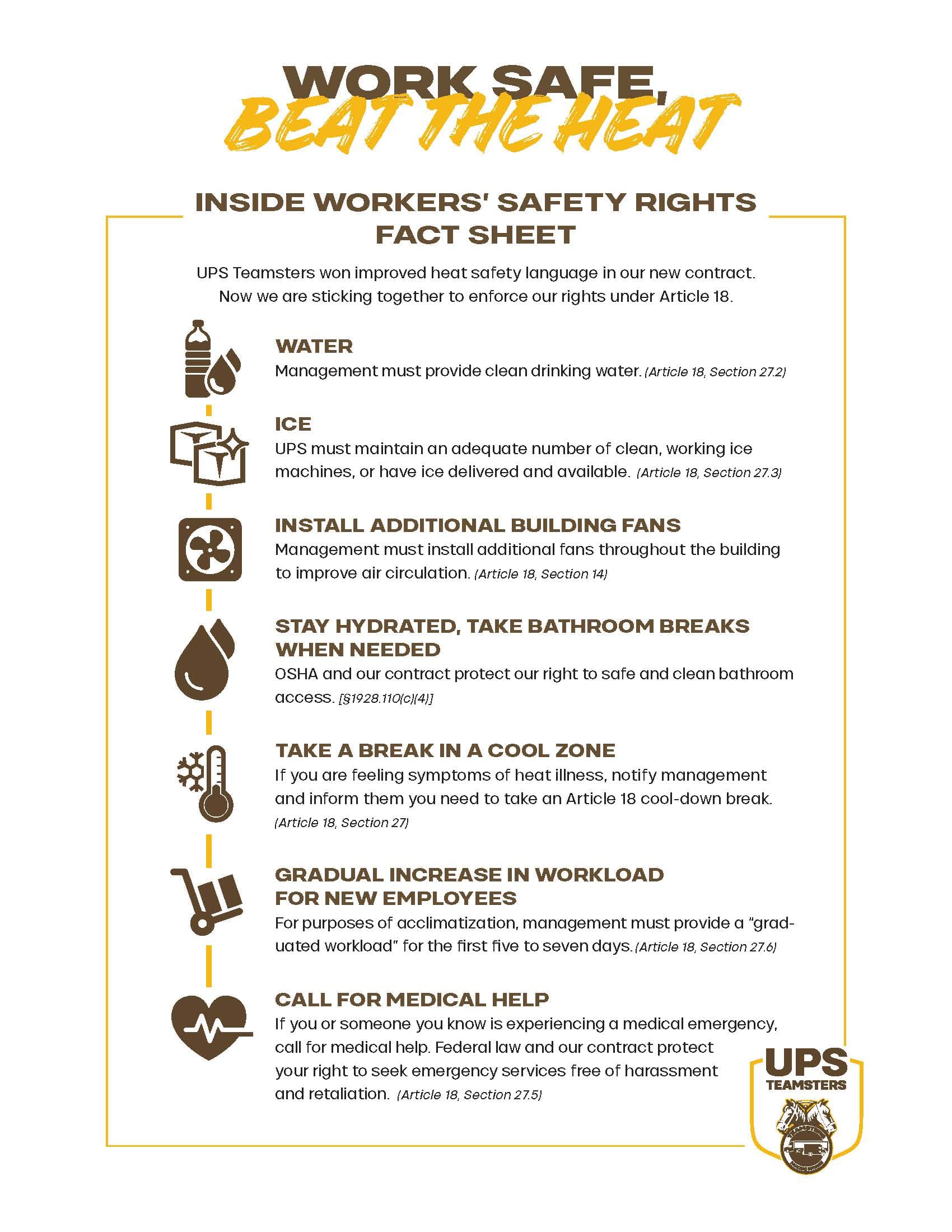
Wallet cards, a webinar, and building audit materials are at the center of UPS Teamsters United’s heat-safety toolkit for the 2023-2028 contract. It turns the 2023-2028 UPS contract into a same-day script for package handlers, drivers, mechanics, and inside workers who are trying to get through a hot shift without getting sidelined by heat illness.
What the toolkit puts in your hands
UPS Teamsters United built the toolkit around Article 18 rights and paired the plain-English guidance with materials workers can actually use on the clock. That package includes wallet cards, a webinar, building audit materials, social graphics, and reminders about contract-enforcement trainings, which makes it useful both for stewards and for anyone who needs a quick refresher before a summer route or a long inside shift.
The materials are written for the realities of UPS work, where heat can build fast in a package car, on a dock, or in a building with poor airflow.
What to do the moment you feel overheated
When you feel overheated, notify management right away, using a DIAD message if you are a driver or another direct notice if you are inside. Then ask for an Article 18 cool-zone break, take your regular breaks and meal period, and do not wait for the problem to get worse before saying something.
A practical sequence looks like this:
1. Send a DIAD message or otherwise tell management you are overheated.
2. Ask for an Article 18 cool-zone break.
3. Take your scheduled breaks, including meals, instead of trying to power through.
4. If the situation becomes a medical emergency, call for medical help.
5. Document that you asked for the break or medical assistance and note any response you got.
If a supervisor brushes off the request, the worker has a record that the right was asserted and the company had notice. In a UPS building, that can make the difference between a quick correction and a grievance.
What UPS is supposed to provide
Management must provide every driver with a one-gallon water bottle and clean drinking water each day. It must maintain an adequate number of clean, working ice machines, or have ice delivered and available.
Every package car must have two working fans. In its June 13, 2023 agreement with the Teamsters, UPS said package cars would get a cab fan retrofitted within 30 days of contract ratification, and that a second fan would be installed in vehicles without air conditioning by June 1, 2024. The company also said new small package delivery vehicles would have air conditioning starting January 1, 2024.
Management must install 18,000 additional building fans during the life of the contract for inside workers. That applies to hub employees, preloaders, sorters, and mechanics working in buildings where heat can stack up well before a driver ever leaves the lot.
- One-gallon water bottle and clean drinking water every day.
- Working ice machines, or ice delivered and available.
- Two working fans in every package car.
- Air conditioning in new small package vehicles purchased after January 1, 2024.
- 18,000 additional building fans for inside workers over the life of the contract.
Why this is an enforcement fight, not just a safety reminder
The Teamsters made heat safety a central demand during bargaining for the five-year contract covering more than 340,000 unionized UPS employees. That campaign reflected years of worker complaints about hot package cars and overheated buildings, and it helped push UPS to agree publicly to new heat measures in June 2023. The union later kept pressing because winning language on paper is one thing and getting it followed on routes and in hubs is another.
That is why the toolkit is tied to grievances, steward trainings, and local enforcement campaigns. The toolkit helps workers and stewards force compliance when a fan is broken, ice is missing, water is not provided, or a supervisor discourages a cool-zone break. Retaliation for using those rights is not supposed to be part of the equation.
How workers can use the toolkit in real time
For stewards, the toolkit gives something fast to hand out in the parking lot, at a safety meeting, or during a shift change. For experienced workers, it is a reminder that the contract language can be turned into an immediate script: ask for water, ask for ice, ask for the cool-zone break, and document what happened. For newer hires, including part-timers trying to move up or drivers learning the rhythm of a route, it is a short path from heat exposure to contract enforcement.
This article was produced by Prism’s automated news system from verified source data, official records, and press releases, then run through automated quality and moderation checks before publishing. The system is built and supervised by the people who set the standards it runs under. Read our full AI policy.
Did this article answer your question?