Gatik expands driverless Walmart deliveries across multiple states
Gatik’s Walmart route grew from a Bentonville pilot into a multi-state driverless freight network, with public-road deliveries now spanning five markets.

Gatik’s driverless box trucks have moved beyond a single Bentonville test route and into a broader middle-mile role for Walmart, with the company now saying its freight-only vehicles are commercially deployed across Texas, Arkansas, Arizona, Nebraska and Ontario. For store and supply chain workers, the change is less about sales floor automation and more about how freight gets from one Walmart location to another, and who has to absorb the disruption if a load arrives late, damaged or off schedule.
Walmart first announced a pilot with Gatik on July 25, 2019, saying it was testing autonomous vehicles for customer delivery and for moving goods between locations. By December 2020, Walmart said Gatik’s multi-temperature Autonomous Box Trucks would operate driverless in Arkansas. On November 8, 2021, the companies said the trucks were running daily without a safety driver on a Bentonville route between a dark store and a Neighborhood Market.
Gatik has since pushed the program into larger commercial use. In January 2026, the company said it had reached $600 million in contracted revenue and had become the first U.S. company to operate fully driverless trucks at scale for commercial deliveries. It said those trucks were making daily public-road deliveries for Fortune 50 retailers. In June 2026, Gatik announced a multi-year strategic partnership with PepsiCo that it described as the largest commercial autonomous freight deployment to date. Gatik said it was already running driverless trucks for PepsiCo across Texas, Arizona and Arkansas and serving about 250 retail locations, including Walmart and Dollar General stores.
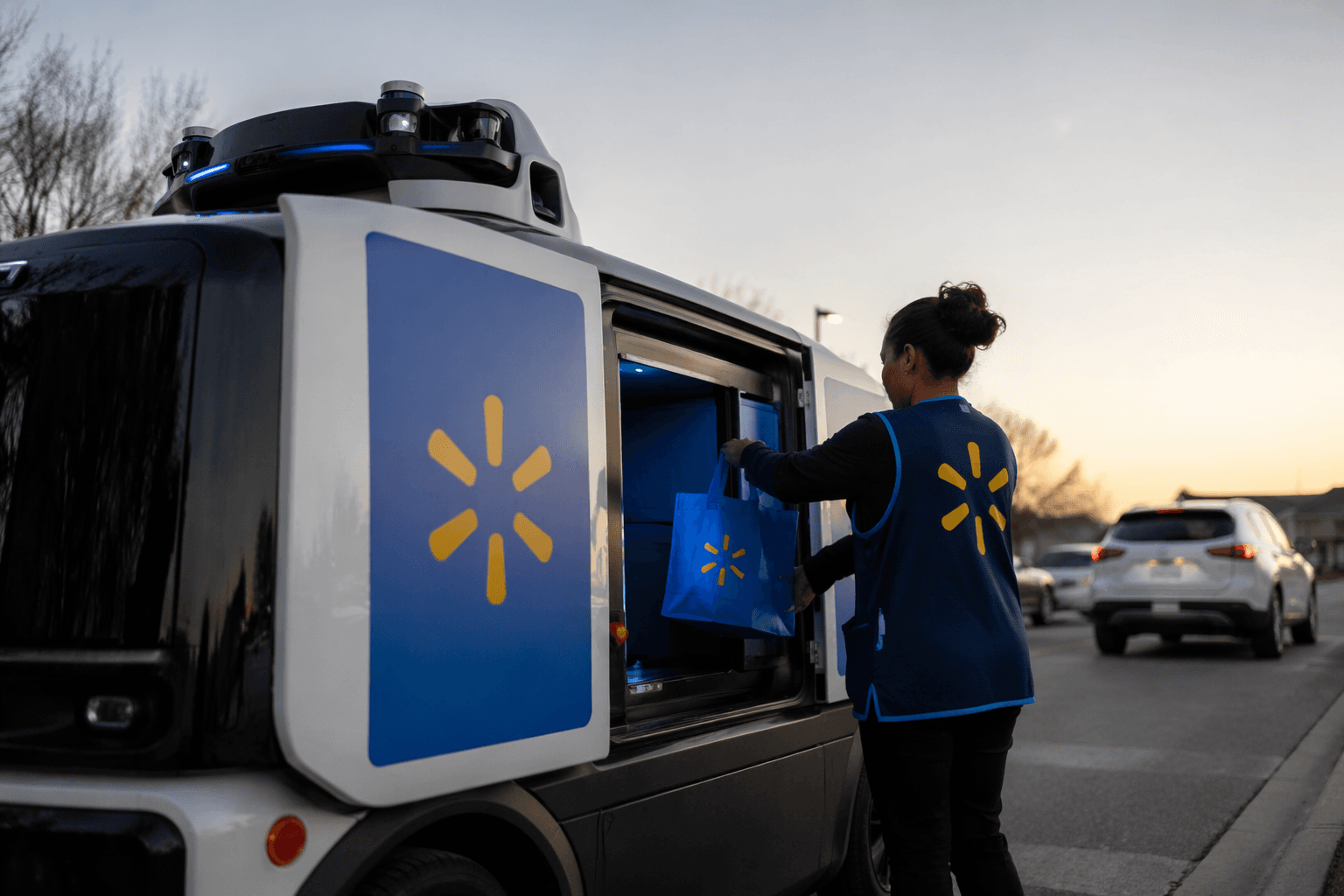
The trucks themselves are medium-duty 26- and 30-foot box trucks built with Isuzu Motors and equipped with cameras, radar and lidar. Gatik has also leaned hard on safety, saying it created a safety advisory council in 2025 and subjected its safety case to independent third-party assessment. That matters in a business where the American Trucking Associations said trucks moved 11.27 billion tons of freight in 2024 and trucking employed 3.58 million professional drivers. A 2017 Government Accountability Office report put the number of U.S. heavy and tractor-trailer drivers at nearly 1.9 million, a reminder of how much labor sits behind every load that reaches a store.
Walmart has said the pilot fits its efforts to test new capabilities that improve convenience and shape retail’s future. For associates, the practical effect is narrower and more immediate: middle-mile freight can move without a person in the cab, but the receiving dock, inventory checks and scheduling problems do not disappear. They simply shift to the people already responsible for keeping the store supplied.
This article was produced by Prism’s automated news system from verified source data, official records, and press releases, then run through automated quality and moderation checks before publishing. The system is built and supervised by the people who set the standards it runs under. Read our full AI policy.
Did this article answer your question?