Walmart education benefits can help hourly associates build careers
Walmart’s education benefit matters most when it helps hourly workers move into team lead, department manager, and assistant manager roles. The smartest move is choosing training that fits the next job, not just collecting credentials.
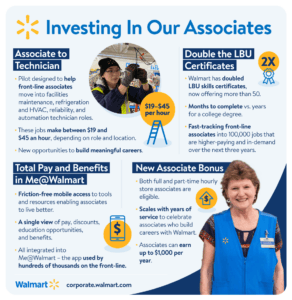
Education as a career ladder, not a side perk
Walmart’s education support is most useful when it helps an hourly associate move from doing the job well to understanding how the store runs. That is the real career-ladder story here: education can help turn a reliable shift worker into someone ready for team lead, department manager, or assistant manager responsibilities.
The benefit is broader than many people assume. It is not just about degrees. Certificates, short programs, skill-building, and confidence all matter, especially in retail, where advancement depends on a mix of people skills and operational judgment. An associate who learns scheduling basics, inventory flow, customer service, conflict handling, and simple data discipline becomes more competitive for the jobs that sit above the hourly floor.
Which kinds of programs fit store leadership paths
The strongest education choices are the ones tied to a specific next step inside the store. A business class can make it easier to talk about budgets and the numbers behind daily decisions. A supply chain credential can help an associate build credibility in backroom or replenishment work, where understanding product movement and timing matters. Communication training can be especially useful for anyone aiming at a coach or lead role, where clear direction and calm conflict handling matter as much as task completion.
That is why the best programs are practical, not abstract. A course that helps an associate understand how a schedule is built, how inventory gets replenished, or how a department stays on process can show immediate value on the floor. Education works best when it strengthens the exact habits Walmart managers look for: consistency, judgment, and the ability to keep a team moving.
Why flexibility matters for working adults
For hourly associates, the biggest test is not whether education exists, but whether it fits around retail life. Store schedules, family time, transportation, and changing shifts all affect whether a program is realistic. If a class is too rigid, too time-consuming, or too disconnected from the workday, it will not do much to improve promotion odds.
The value rises sharply when a program is flexible enough for working adults and practical enough to apply immediately on the job. That combination matters because retail careers are built in real time. Associates need training they can use between shifts, not a credential that sits on a resume without changing how they operate in the store.
Where hourly associates usually get stuck
A common trap is treating education as a general resume booster instead of a promotion strategy. A worker can finish coursework and still stay invisible if the program does not connect to store leadership responsibilities. That is especially true in retail, where managers are often looking for people who already show they can think beyond their own task list.
Another place people get stuck is failing to translate learning into language managers understand. It is one thing to say a class was completed. It is more useful to explain how that class changed the way an associate handles schedules, resolves conflict, or thinks about inventory flow. The leap from hourly work to leadership often depends on showing that shift in mindset.

There is also a practical limit: education alone does not guarantee promotion. Walmart’s ladder still runs through performance, reliability, and the ability to handle operational pressure. Training can improve the odds, but it has to be paired with strong attendance, solid execution, and a willingness to take on broader responsibility.
What associates should do now if they want education to help them move up
The smartest approach is to start with the job you want next, not the course catalog. If the goal is team lead, look for learning that builds people-management and operational skills. If the target is department manager, focus on inventory, scheduling, and the basics of running a section of the store. If assistant manager is the long-term goal, choose programs that sharpen business judgment, communication, and comfort with numbers.
A practical path looks like this:
1. Pick the next role you want, not just a general interest area.
2. Match education to the skills that role demands in a store.
3. Choose flexible training that fits around your schedule and family obligations.
4. Use what you learn right away on the floor, in reviews, and in interviews.
5. Talk about your work differently, as someone who understands how the store operates.
That last step matters more than people think. Education can give associates the language to speak more confidently in reviews and interviews. It can help them explain how they solve problems, not just how they complete tasks. In Walmart’s culture, that difference can be the line between being seen as dependable and being seen as promotable.
What managers should take from this
Managers should not think of education as a perk reserved for the especially ambitious. It is also a retention tool. Workers who can see a future are usually more likely to stay, keep learning, and apply themselves. That matters in a business where turnover is expensive and operational consistency is hard to maintain.
A store that encourages education with a clear connection to advancement is more likely to keep associates engaged. The point is not simply to help people earn credentials. The point is to build a pipeline of workers who understand scheduling, inventory, customer service, and the day-to-day rhythm of retail well enough to step into leadership when the store needs it.
The associates who benefit most will be the ones who treat education as a bridge. They will choose programs that fit their shifts, strengthen the skills Walmart actually promotes for, and help them speak the language of store leadership. That is how education stops being a benefit on paper and starts becoming a real rung on the ladder.
This article was produced by Prism’s automated news system from verified source data, official records, and press releases, then run through automated quality and moderation checks before publishing. The system is built and supervised by the people who set the standards it runs under. Read our full AI policy.
Did this article answer your question?