Walmart Stays Open Easter Sunday as Competitors Choose to Close
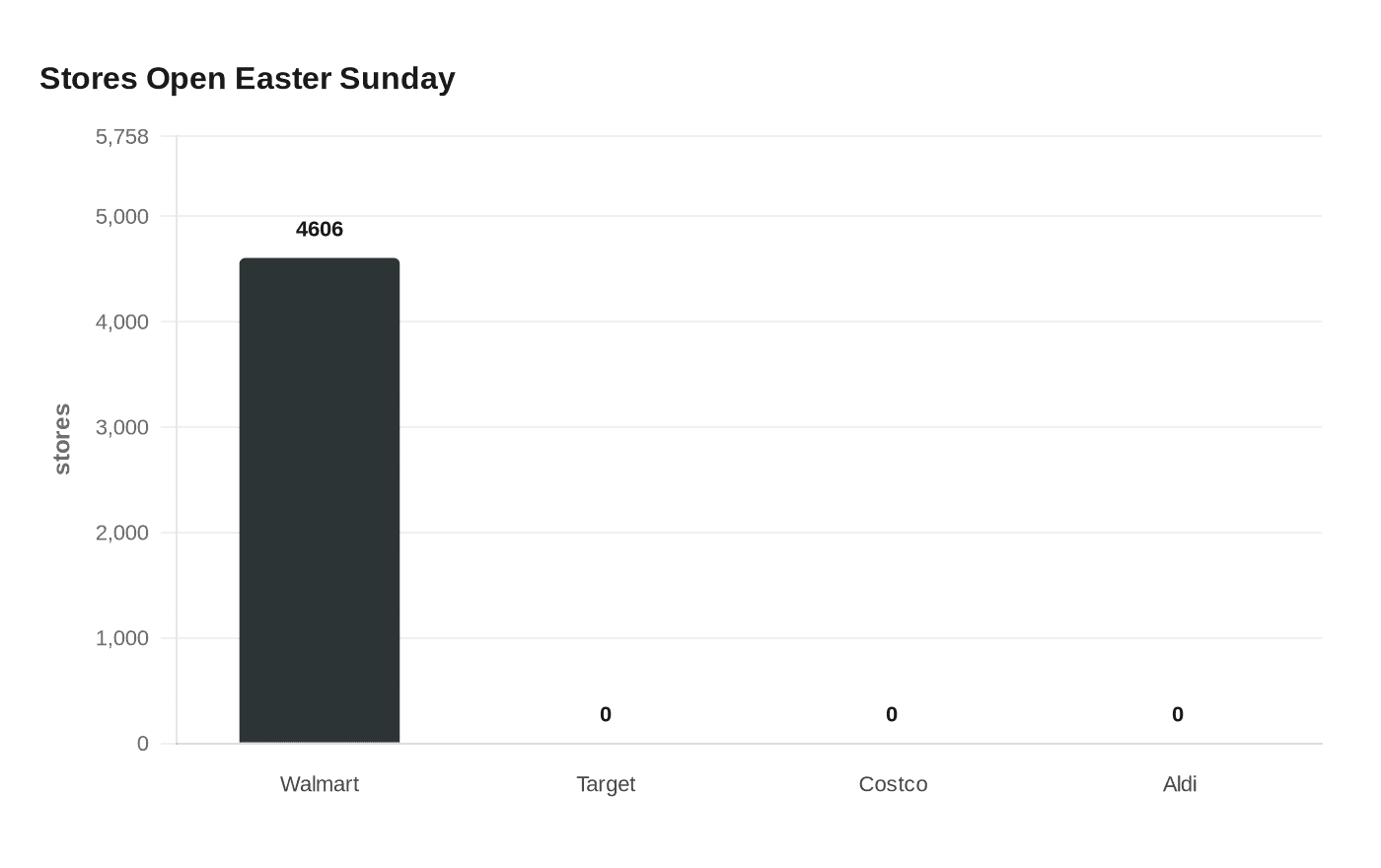
Walmart's 4,606 U.S. stores ran 6 a.m. to 11 p.m. on Easter while Target, Costco, and Aldi all closed; here's what associates need to know about pay, PPTO, and scheduling rights.

Before you clock in on Easter Sunday, there is one question worth asking your manager directly: is this shift paying regular straight-time wages, or does it qualify for a holiday premium? The answer is not automatic, and at Walmart, the distinction between those two scenarios can add up fast across a seven- or eight-hour shift.
Walmart kept all 4,606 of its U.S. stores open on Easter Sunday, April 5, operating on a schedule of roughly 6 a.m. to 11 p.m., though individual locations vary. That decision set Walmart apart from several of its largest retail peers. Target closed all of its stores for the holiday. Costco and Aldi did the same. For associates, the comparison is not just a trivia point; it reflects a corporate posture that keeps workers on the floor while employees at those competing chains spent the day at home.
The first practical step for anyone scheduled this weekend is straightforward: open the Me@Walmart app and confirm your shift details in writing. If there is any discrepancy between what the app shows and what you were verbally told, get clarification from your department manager before the shift starts, not after. Miscommunications about Easter scheduling are common precisely because hours across departments like the deli, pharmacy, and vision center do not always match front-end retail hours. A pharmacy that closes early means a shorter shift for pharmacy techs even if the rest of the store runs its full schedule.
On the pay question, the honest answer is that Walmart's holiday pay structure for hourly associates is not uniform. The company has shifted its approach to paid time off in recent years, moving toward a consolidated PTO bucket system rather than automatic holiday premiums for all workers. Whether Easter qualifies as a covered holiday at your specific store, and whether that triggers any wage uplift, depends on your role and location. The clearest path to an answer is a direct conversation with your manager or a review of your posted pay schedule before your shift begins. If a premium applies, it should appear in your pay stub within one pay period after the holiday. If it is not there, that is the time to flag it with payroll.
For associates who were scheduled on Easter but could not or chose not to work, Protected Paid Time Off is the mechanism that matters most. PPTO accrues at approximately 30 hours per year for hourly associates, with a maximum usable balance of 48 hours. Critically, PPTO does not require manager approval. An associate can apply available PPTO hours to cover an absence without asking permission, and when PPTO is applied, it excuses any attendance occurrence that would otherwise be generated. An unexcused absence on a holiday weekend can trigger an attendance point under Walmart's system, but the same absence covered by PPTO does not. Associates who knew in advance they would not be working Easter should have submitted PPTO through Me@Walmart ahead of the shift, not after. Retroactive requests are more complicated and are not guaranteed to clear a point once it has been recorded.
The operational reality of Easter at a Walmart store adds another layer. Holiday Sundays that coincide with a major grocery occasion tend to drive heavy last-minute traffic in perishables, bakery, and prepared foods. Deli and bakery associates in particular often face the sharpest volume spikes in the hours before midday. Managers who did not adjust staffing plans to account for that surge may find themselves pulling associates from other departments, creating coverage gaps elsewhere and extending shift lengths without advance notice. If a manager asks an associate to stay beyond a scheduled end time on a holiday, the updated hours should be reflected in the timekeeping system before the associate leaves.
The broader pattern is one Walmart's workforce has encountered consistently across major holidays. While Target, Costco, and Aldi leaned into full closures as a staffing benefit and a goodwill signal toward their workers, Walmart has continued to prioritize availability for its roughly 270 million weekly customer visits. That is a defensible business decision, but it places the scheduling burden squarely on the hourly associates working across all 4,606 stores. The workers who showed up Easter morning to stock shelves, run registers, and fill prescriptions did not make that call; corporate did.
For associates who worked Easter and have follow-up questions about pay, the process is the same as any other pay discrepancy: check your pay stub in Me@Walmart when the period closes, compare actual hours and rate against what you expected, and if there is a gap, report it to your personnel coordinator or store manager promptly. Payroll corrections have deadlines, and waiting too long after a holiday shift to flag a missing premium makes resolution significantly harder.
This article was produced by Prism’s automated news system from verified source data, official records, and press releases, then run through automated quality and moderation checks before publishing. The system is built and supervised by the people who set the standards it runs under. Read our full AI policy.
Did this article answer your question?