Whole Foods simplifies health plan provider searches for employees
Whole Foods is steering employees toward a curated provider search, so the first health-plan decision is where you go, not what the bill says later. Preferred and Expanded Network choices affect both access and cost.

For Whole Foods Market team members, the hardest part of health coverage is often not the deductible or the copay. It is figuring out which doctor, clinic, hospital, pharmacy, or specialist actually counts as in-network before an appointment turns into a surprise bill.
The Whole Health Plan’s newest materials are built around that problem. Instead of burying employees in jargon, the plan points them to a curated provider search, a clearer network map, and a Benefits Service Center when the answer is not obvious. That is the real usability test for any workplace health plan: whether someone can use it without becoming a benefits expert first.

A curated network, not a guessing game
The core of the plan is the Preferred Network, which Whole Foods describes as a curated network of recognized local providers, clinics, and hospitals. Members use the group ID WFM when they are navigating that network, a small detail that matters because it is part of the actual path to care, not just an HR footnote.
That structure gives employees a practical first choice. If a nearby primary care office, urgent care clinic, or local hospital is in the Preferred Network, the plan is meant to work with less friction. If it is not, the next step is not to assume coverage and hope for the best. It is to check the broader network options before the visit happens.
Whole Foods also maintains an Expanded Network through Aetna Signature Administrators, with administration handled by WebTPA. That national fallback matters for a workforce that moves around, travels, or has family members whose care needs do not fit neatly into one city or one metro area. The company is signaling that it wants coverage to follow employees beyond the immediate neighborhood around their store.
What the provider search actually covers
The provider-search tools are not limited to one type of care. Whole Foods says members can search for in-network primary care providers, hospitals, pharmacies, dental care, vision care, and more. That breadth is the point. Health insurance only feels usable when the same search process can help with a routine checkup, a prescription refill, a dentist visit, or a specialist referral.
For a team member, that means the decision path is simpler than it has been in many employer plans: look up the provider, confirm the network, and then schedule. The plan is designed so that employees do not have to wait for a claim denial or a confusing explanation of benefits to learn that a doctor was outside the network.
That also changes the conversation on the sales floor and in the back of house. A team leader helping an associate think through a provider choice is not just talking about convenience. The difference between a nearby doctor in the Preferred Network and a farther one in the Expanded Network can change both access and cost.
Cost follows the network you choose
The financial difference between the two networks is not cosmetic. Whole Foods says the Expanded Network comes with a significantly higher deductible and out-of-pocket maximum than the Preferred Network. That means the network decision can shape how much someone pays long before they reach a big medical event.
The company’s benefits site also says in-network preventive services are covered at no cost, including age-recommended screenings and vaccinations. That is important in practice because preventive care is one of the few parts of the health system that can actually feel straightforward when the network rules are clear.
The lesson for employees is simple: do not treat the network search as optional. If the plan documents say one thing and a website summary says another, Whole Foods says the plan documents and policies control. That is the fine print that matters when someone is trying to decide between a local provider and a less familiar one in the national network.
Help is part of the benefit
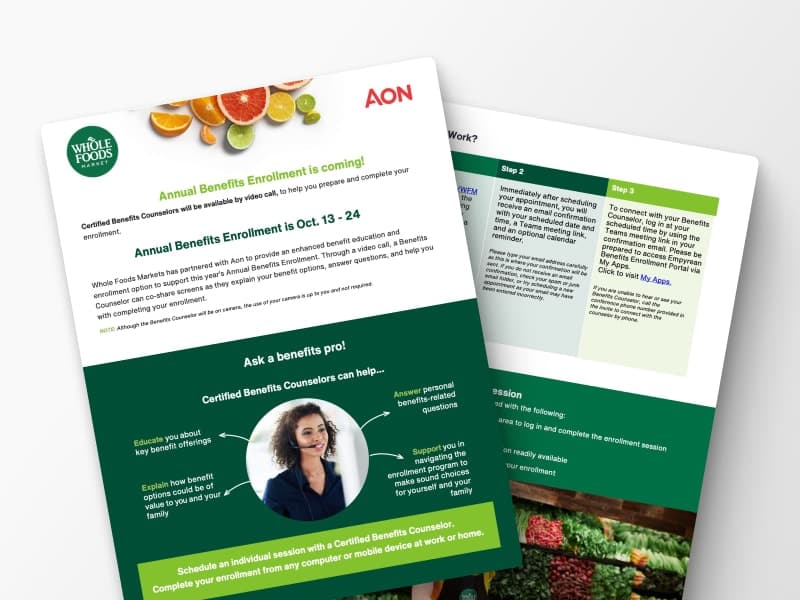
Whole Foods is not pretending employees should decipher all of this alone. The benefits materials point team members to the Whole Foods Market Benefits Service Center at 888-681-2249, with support available from 7 a.m. to 7 p.m. CT. The company also directs employees to annual enrollment resources, which matters because benefits often become clearer only when someone has a real decision to make.
Annual enrollment elections generally take effect Jan. 1 of the following year, and the Whole Foods Market benefits overview is effective Jan. 1, 2026. That timing matters because it turns the provider search into something employees need to use before they make a choice, not after a claim hits their inbox.
The broader medical materials show the same logic. Whole Foods says Prime Therapeutics provides in-network prescription drug coverage through its national pharmacy network, and MDLive offers virtual care by phone or video for minor medical conditions and behavioral health needs. Those pieces make the plan feel less like a single insurance card and more like a connected system for routine care, prescriptions, and quick access when in-person care is not necessary.
A network strategy that has been building for years
This is not a brand-new experiment. Whole Health Plan was first piloted in 2016 in the Austin, Texas, and Los Angeles catchment areas, which shows the network strategy has been developed over time rather than dropped in all at once. That long runway helps explain why the current version is so focused on navigation.
The broader message from Whole Foods is hard to miss: the benefit is supposed to be usable, not merely available. A national retailer with a spread-out workforce needs a plan that can handle local care, traveling employees, and changing household needs without turning every appointment into a scavenger hunt. The company is betting that a curated local network, a national fallback, and a clearer provider search will matter just as much as the headline coverage itself.
This article was produced by Prism’s automated news system from verified source data, official records, and press releases, then run through automated quality and moderation checks before publishing. The system is built and supervised by the people who set the standards it runs under. Read our full AI policy.
Did this article answer your question?