Ann Lowe, the couture bride behind American wedding history
Ann Lowe proves that custom bridal fashion changes more than the fit. Her Jackie Kennedy gown shows how handwork, proportion, and meaning turn a dress into history.
Ann Lowe makes the strongest case for custom bridal fashion because her gowns did what mass-market wedding dressing never quite can: they shaped a body, carried a social code, and looked as if ceremony itself had been stitched into the seams. Her work for Jacqueline Bouvier Kennedy’s 1953 wedding remains the clearest proof, but the larger story is even richer. Lowe built couture that was personal in the most exacting sense, and the museum record around her shows why bespoke bridalwear still matters when the dress has to do more than simply fit.
The couture bride behind American wedding history
The Metropolitan Museum of Art lists Ann Lowe as ca. 1898 to 1981, and that span tells you how much of 20th-century American style she touched. She was born in Clayton, Alabama, around 1898, reared in Montgomery, and later made her career in New York, where the fashion world’s highest tiers were still guarded by money, race, and access. The National Museum of African American History and Culture identifies her as one of America’s most significant designers, and the Fashion Institute of Technology places her squarely in the history of American fashion, not at its margins.
That context matters because bridal fashion is never just about the garment. It is about who gets to be seen, who gets remembered, and who gets credit for making the image possible. Lowe’s name belongs in that conversation because she designed the kind of wedding dressing that announces a bride before she even speaks: precise, hand-finished, and so controlled in silhouette that the result feels inevitable.
Why custom changes the final look
Custom bridal fashion earns its keep in the details that most cameras only suggest. Fit is the first revelation. A couture gown can follow the collarbone, flatten where it should, release where it must, and keep its line through a long ceremony, photographs, and a room full of bodies and light. That kind of adjustment cannot be faked with a standard size, even a luxurious one.
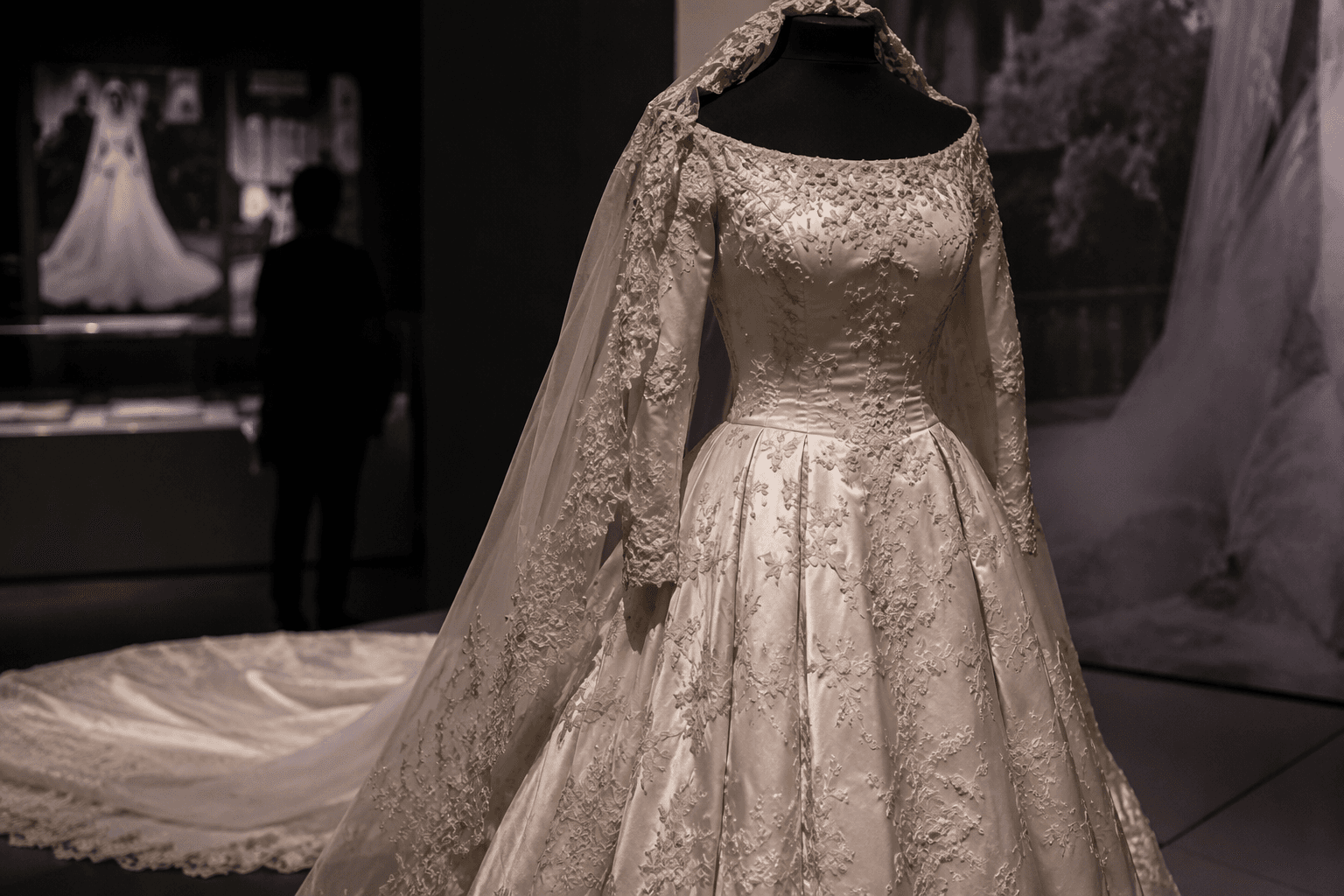
Handwork is the second. Lowe’s work is repeatedly associated with intricate hand-sewn details, structural elegance, and handmade fabric flowers, the sort of labor that does not read loudly from across a ballroom but changes how a dress moves up close. The Metropolitan Museum’s collection record for one Ann Lowe wedding dress lists cellulose acetate, a material choice that immediately reminds you bridal gowns are also objects of textile history, not just romance. In Lowe’s hands, the fabric choices and the finishing techniques made the dress feel modern in its own era, which is exactly what great custom work does.
Individuation is the third. Off-the-rack bridal can deliver a mood, but couture gives a bride a private architecture: a neckline scaled to her shoulders, a skirt set to her stride, a train that lands with intention rather than compromise. Lowe’s legacy argues that the real luxury is not excess but exactness. A bespoke gown does not merely appear expensive; it appears as if it could belong to no one else.
The Jackie Kennedy wedding and the power of social image
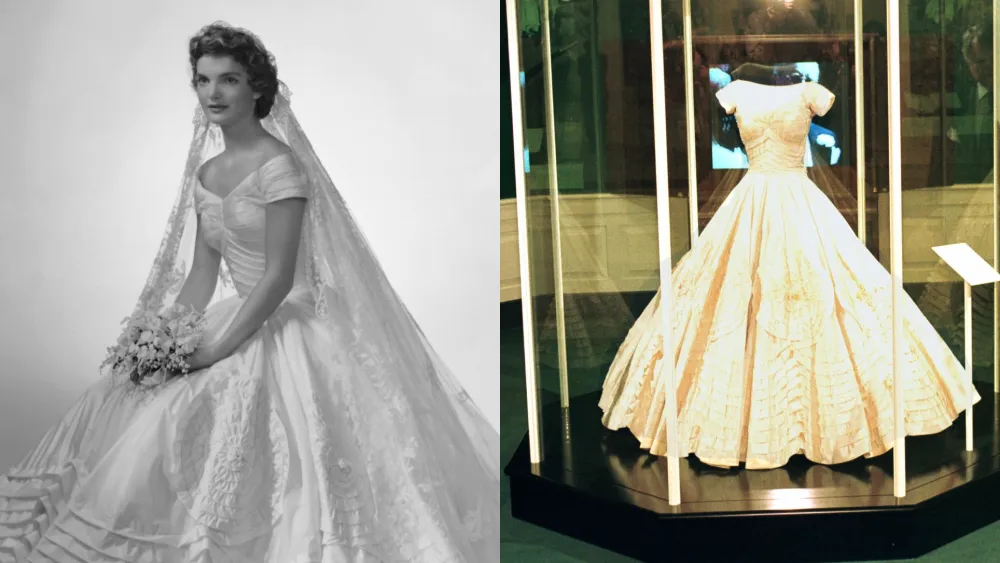
Lowe’s most famous commission arrived on September 12, 1953, when she designed Jacqueline Bouvier Kennedy’s wedding dress and the bridal party dresses for the ceremony at St. Mary’s Church in Newport, Rhode Island. The dress itself has become part of American visual memory. National Geographic describes it as an extravagant waterfall of ivory silk with hand-stitched pleats, swags, and rosettes, and that description is the blueprint for why custom bridalwear still captivates. The gown was not just white and formal; it was engineered to read as abundance, softness, and control all at once.
Winterthur Museum, Garden & Library has noted that Lowe designed couture-quality gowns for prominent debutantes, heiresses, actresses, and society brides including Jacqueline Kennedy, Olivia de Havilland, and Marjorie Merriweather Post. That client list shows the level at which she worked, where a gown was never only a gown. It was a social statement, a photograph in motion, and a family’s public language of arrival. In that world, custom was not a perk. It was the medium.
Lowe’s reputation was complicated by the era’s racial hierarchies. In 1964, The Saturday Evening Post called her “Society’s Best-Kept Secret,” a label that captures both her elite reach and the way her name was minimized in public. A note at the National Museum of American History identifies a 1964 profile from the same publication that called her a “dress designer,” an understatement for a couturier whose work helped define how one of America’s most watched brides should look.
What bespoke offers that ready-made cannot
Ann Lowe’s career offers a practical test for any bride deciding whether custom is worth the investment. Choose it when the dress must solve a problem ready-made cannot touch, or when the garment has to carry meaning beyond the aisle. That is when couture earns its place.
- When proportion matters, custom wins. A bridal bodice, sleeve, or train can be calibrated to the wearer rather than the average size chart.
- When finish matters, custom wins. Lowe’s legacy is built on hand-sewn detail, from pleats to rosettes, the kind of work that gives a dress its depth.
- When symbolism matters, custom wins. A wedding gown can signal family, class, taste, and identity at once, and bespoke design makes that message deliberate.
- When the dress must last beyond the photo, custom wins. Internal support, lining, and construction are what make a gown hold up through the ceremony and the room.
The clearest argument for custom is not that every bride needs it, but that some occasions demand a garment with intent baked into every seam. Lowe understood that a wedding dress can be a technical object, a social artifact, and a deeply personal image all at once.
Why Ann Lowe still matters now
Recent museum attention has only sharpened the case for Lowe’s relevance. Her bridal and couture work has been the subject of recent museum exhibitions and features, including a 2023 to 2024 Winterthur exhibition. That renewed focus is not nostalgia; it is correction. Lowe belongs in the center of American fashion history because she mastered the hardest version of bridal dressing, the kind where handwork, fit, and symbolism all have to land in the same frame.
In an era of mass-produced bridal solutions, Ann Lowe remains the argument for couture that earns its name. Her dresses did not merely clothe brides. They composed them.
This article was produced by Prism’s automated news system from verified source data, official records, and press releases, then run through automated quality and moderation checks before publishing. The system is built and supervised by the people who set the standards it runs under. Read our full AI policy.
Did this article answer your question?