Venetian Glass Beads, From Murano to Indian Bridal Tradition
A single bridal bead can trace a route from Murano to Gujarat, turning ornament into proof of trade, labor and inherited craft.

A bead with a passport
A wedding bead can look like pure decoration until you follow its route. The Venetian glass bead, especially the tiny ones that catch light at the throat or along a veil, is not just embellishment but evidence of a long marriage between craft and commerce, one that begins in Venice and ends in Indian bridal tradition.
That is what makes this story matter to fashion now. When you understand that these beads traveled for centuries across Africa, the Americas and India, bridal ornament stops being a finishing touch and starts reading like a global archive. The sparkle is still beautiful, but it is also historical, shaped by maritime trade, artisanal labor and the way ornament moves from one culture to another without losing its charge.
Murano’s three bead languages
Venice began producing glass beads in the fourteenth century, and Murano became the place where that precision turned into export power. The Museo del Vetro identifies three principal Venetian bead techniques: conteria, or seed beads; rosetta, better known as chevron beads; and a lume, the lamp-worked beads that carry a more handmade, flame-shaped character.
The chevron bead is the most storied of the group. Invented in the fifteenth century by Marietta Barovier, Angelo Barovier’s daughter, it reminds you that this history is not just about trade routes but about women’s innovation inside an industry often told through male names. In bridal terms, that matters because the bead on your blouse or necklace may look small, even anonymous, yet it belongs to a vocabulary of invention that was precise enough to be exported and recognizable enough to endure.
If you are choosing ornament with intention, this distinction is useful. Seed beads create a dense, almost liquid surface. Chevron beads bring a clearer rhythm and graphic punch. Lamp-worked beads feel more individual, more visibly made by hand. The difference changes how a piece reads on the body: one can disappear into shimmer, another can become the entire focal point.
From trade good to bridal code
The museum’s larger point is blunt and elegant at once: Venetian beads were invaluable trade goods for centuries, moving through Africa, the Americas and India. For brides, that history changes the emotional temperature of a necklace, sari border or embroidered panel. A bead is no longer only a decorative unit; it is a carrier of exchange, something that arrived through ports before it arrived in wardrobes.
That global migration helps explain why beads fit so naturally into wedding dress codes that prize abundance, shine and layered symbolism. In Indian bridal fashion, embellishment is rarely incidental. It often marks blessing, lineage and status, but it also marks touch, labor and time. Venetian glass beads slipped into that world not as an outsider but as a material that could be absorbed, reinterpreted and made local.
The result is a useful reminder for modern bridal shopping. If you are drawn to beadwork, look beyond the immediate dazzle and ask what kind of surface you want to wear. Do you want the crisp regularity of seed beads, the architectural pattern of chevrons, or the softer irregularity of lamp-worked glass? That choice changes everything, from how a neckline reflects light in a ceremony hall to how a dupatta or veil moves under flash photography.
Gujarat, Saurashtra and the older story of Indian beadwork
Medha Bhatt’s work sharpens the picture in India, especially in Gujarat and Saurashtra. She argues that the oldest available beadwork artifact from Saurashtra used imported Venetian glass beads made in Murano, and that the beadwork tradition there may reach back to the sixteenth century rather than the nineteenth, which is the date often assumed. That is not a minor adjustment in a craft timeline. It pushes bridal and ceremonial beadwork into a much deeper history than many people realize.
Bhatt also links bead circulation in Gujarat to Indian Ocean trade networks that ran through East Africa, the Red Sea and the Persian Gulf. That matters because bridal jewelry is often discussed as if it were born fully formed inside one region. Here, the reality is more interesting. The beads arriving in Indian textile culture were part of a wider, interlinked system, and Bhatt’s argument even suggests an African influence in how glass trade beads moved into Gujarat.
For a bride, that enlarges the meaning of ornament. A beaded border or necklace can still be chosen for color, weight and brilliance, but now it also sits inside a story of contact zones. The craft is not less personal for being global. It becomes more layered, more specific, and arguably more moving.
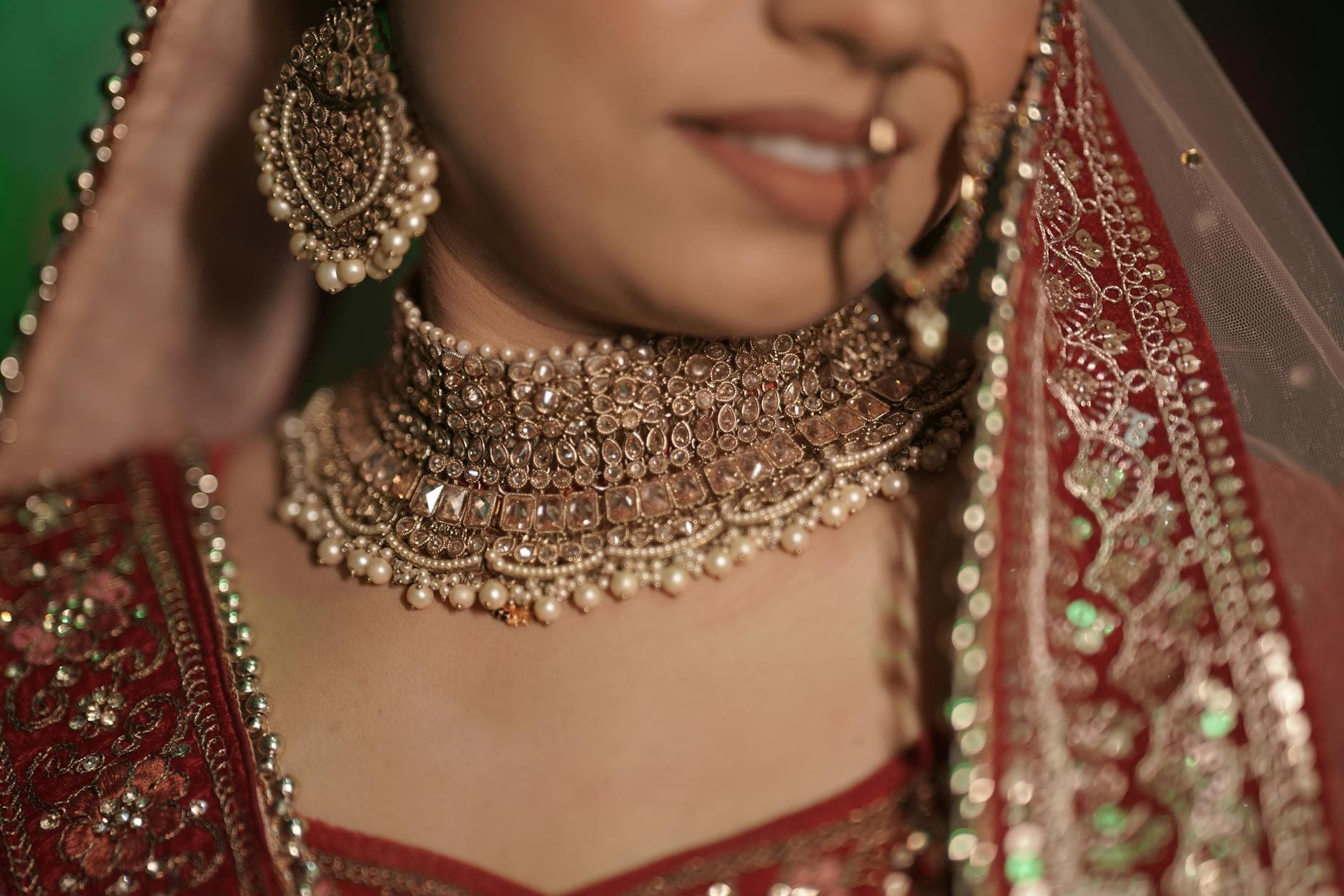
Why Murano’s beadmakers still matter
There is one more reason these beads resonate in bridal fashion: the labor behind them. The Museo del Vetro notes that bead production was the only sector of Murano glassmaking that flourished during the nineteenth-century crisis, which tells you how resilient the category was. Beads were not a minor sideline. They helped sustain the industry when other glass sectors faltered.
The museum also highlights the impiraresse, the female Venetian bead threaders who worked outdoors with beads on their laps. That detail should stay with you. Bridal adornment is often discussed as if it were only about surface effect, yet here the surface is the result of women’s repetitive, skilled work, done in public view and tied to a local economy. The tiny bead on a ceremonial garment carries not only aesthetic value but social history.
For contemporary brides and stylists, this adds a practical lens. When beadwork feels too ornate in the abstract, the answer is not always to avoid it. It may simply be to choose it with clearer knowledge of where it comes from. A piece inspired by Venetian glass beads can read restrained if the bead size is fine and the pattern is controlled. It can read ceremonial without tipping into excess if the silhouette is clean and the embellishment is placed with precision.
How provenance changes the way you wear it
Once you know the route, you begin styling differently. You pay attention to whether the beadwork should sit close to the face, where it catches light, or spread across a wider surface where its pattern can be read from a distance. You notice whether the bead color feels warm, cool or deliberately antique. You become less interested in ornament as filler and more interested in ornament as architecture.
That is the real value of tracing Venetian glass beads from Murano to Indian bridal tradition. It gives you a way to shop with sharper taste and to dress with a fuller sense of meaning. The bead you choose is still beautiful, but now it also knows where it came from, and that history is what makes it feel worthy of a wedding day.
This article was produced by Prism’s automated news system from verified source data, official records, and press releases, then run through automated quality and moderation checks before publishing. The system is built and supervised by the people who set the standards it runs under. Read our full AI policy.
Did this article answer your question?