Wedding Season 2026: A Guide For All The Brides
Spring 2026's runways built a bridal playbook for every type of wedding: here's how to map looks from One World Observatory to your actual altar.

Spring 2026 didn't arrive quietly on the bridal circuit. New York Bridal Fashion Week delivered its most visually layered season in years, with Ukrainian bridal houses, Hollywood-obsessed couture labels, and a Victorian-era revivalist all staking out very different territory on what a modern wedding dress should be. The through line: this season is less about one defining silhouette and more about having a plan. Lace, lightweight construction, languid fabric, and detachable everything are the building blocks. What follows is how to use them, no matter your venue, your budget, or your vision.
The Courthouse Bride: Structure Is Your Statement
If your wedding is intentional, intimate, and civil-ceremony-on-a-Tuesday, the runway has exactly what you need. Victor de Souza, presenting at his NYC flagship perfumery Emanuel New York, delivered the most genuinely wearable looks of the season. He looked squarely at the 19th century, with Princess Alexandra of Wales as his muse, and extracted Victorian elegance without the excess: tailored trousers, monochrome textures, and lace placed with precision rather than applied head-to-toe. His silk floral jacquard pieces hit the sweet spot between sculptural and sensual, and the tailored trouser option is a genuine gift for the bride who has zero interest in a ballgown at a 10 a.m. ceremony. The ruffles and sequin detailing that ran through the collection gave even the most stripped-back looks a finish that still reads as bridal.
Swap-in: The tailored-trouser directive translates easily at any price point. A high-waist wide-leg in ivory, champagne, or a soft stone linen, paired with a lace-trimmed blouse or an architectural corset top, delivers the same energy. Keep the palette monochrome, keep the tailoring sharp. One strong fabric, structured crepe, silk charmeuse, or a textured brocade, does what a gown does but earns its place at a courthouse counter.
The Destination Bride: Silk Chiffon Runs the Show
Humidity is the natural enemy of structured bridal. If you're marrying on a beach, in a hillside vineyard, or anywhere the sun is doing the most, the answer from Spring 2026 is silk chiffon and silhouettes that look like they were designed to move outdoors. MILLA NOVA's La Maison Rose collection, drawn from the garden romance of the Roseraie de la Normandie, leaned fully into softness: loose, flowing construction with a feminine ease that photographs beautifully in natural light. These are dresses built for warmth, not against it.
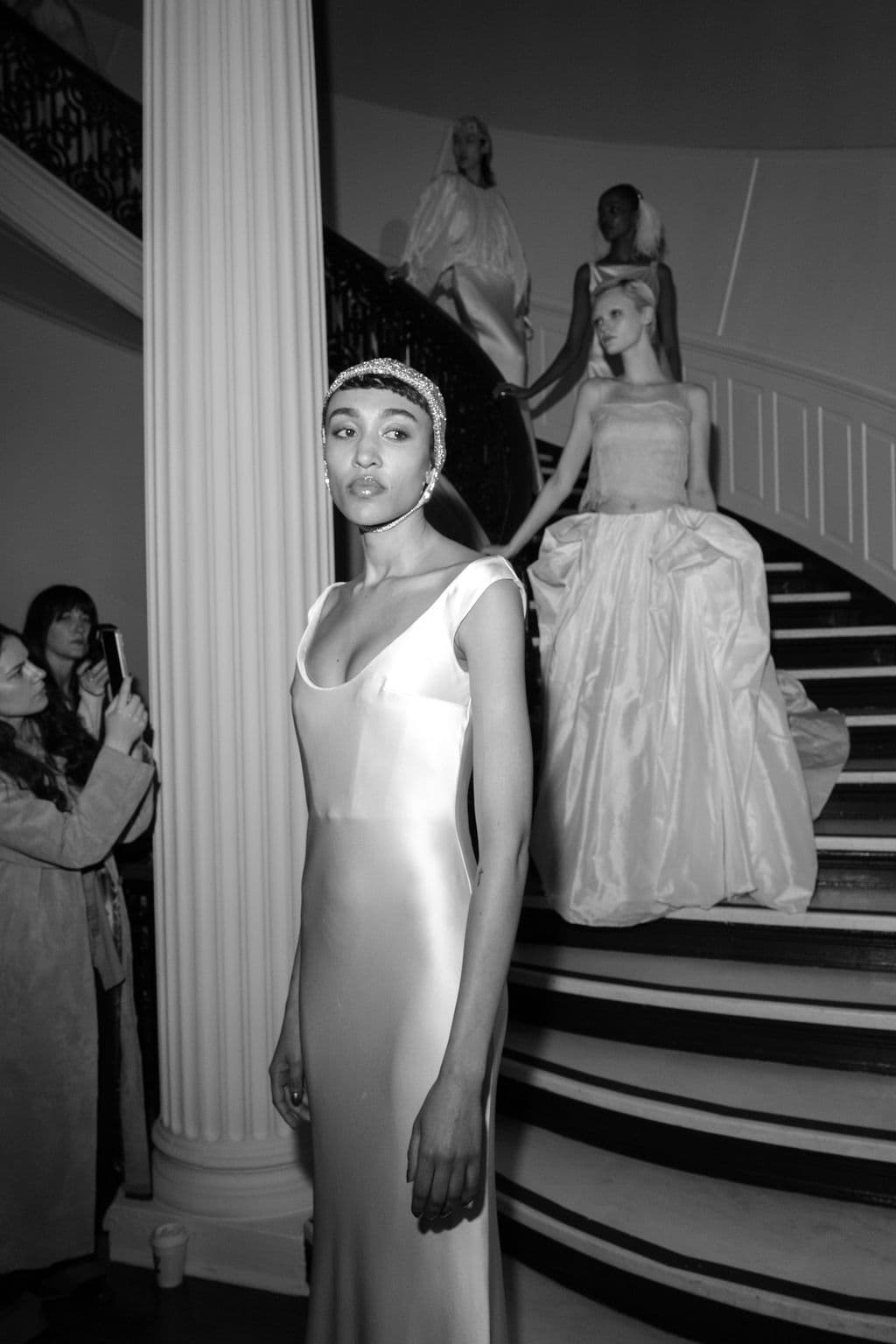
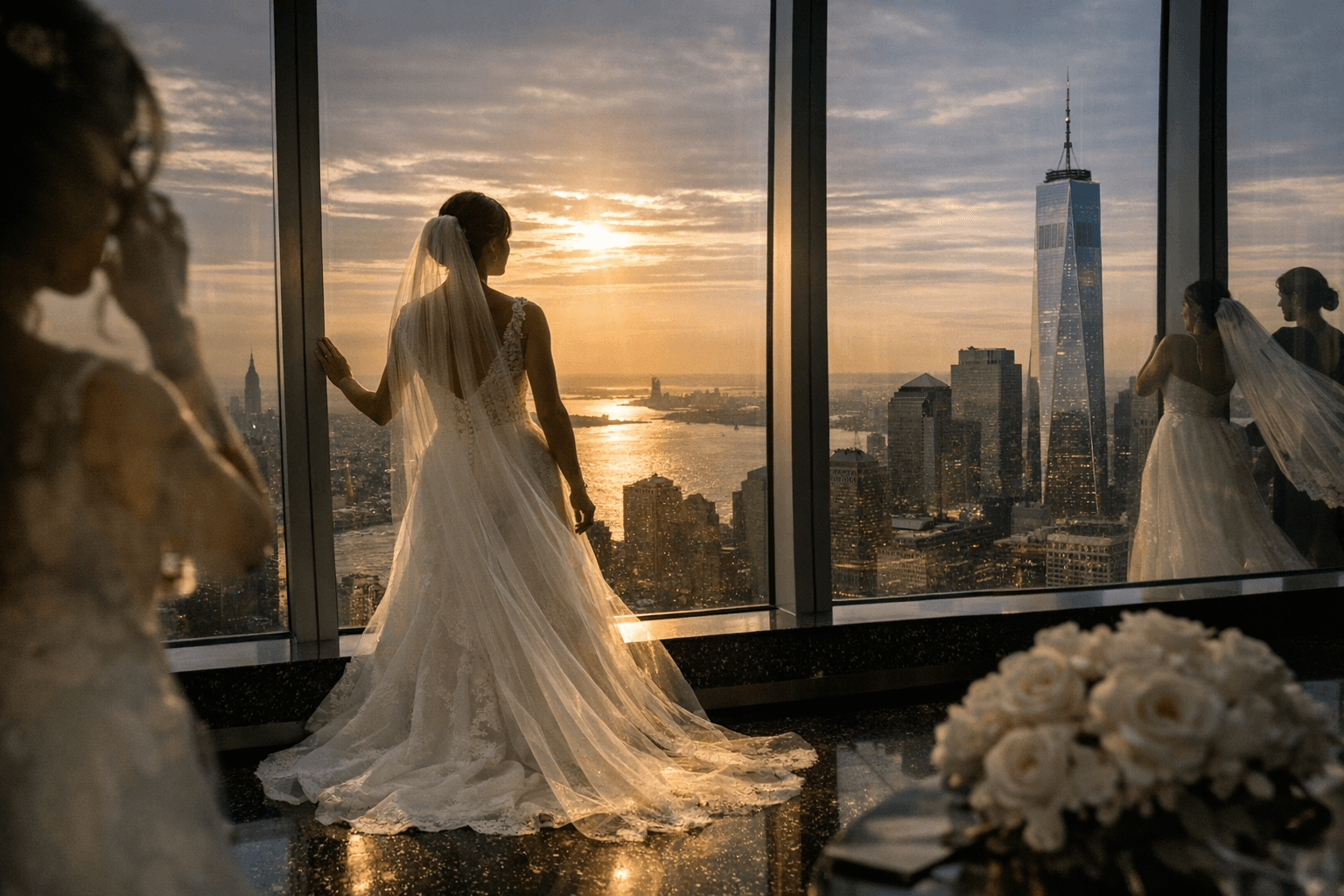
The joint WONÁ Concept and Eva Lendel presentation, staged atop One World Observatory in New York, produced some of the season's most transferable destination looks. Silk chiffon mint gowns caught the afternoon light exactly as they would at a coastal ceremony. Organza pieces moved lightly enough to handle a sea breeze. Italian silks and mikado framed the more structured gowns, but the chiffon was undeniably the crowd-pleaser and the most practical fabric story of the show.
Swap-in: Chiffon is a fabric conversation, not a designer one. A bias-cut silk chiffon or lightweight georgette gown at an accessible price point delivers the same languid drape. Skip polyester blends in direct sunlight as they hold heat and lose structure fast. If the mint palette from the WONÁ and Eva Lendel runway is calling, a soft pastel wedding dress is completely on-trend for 2026, not unconventional.
The Black-Tie Bride: Earn the Drama
For the bride who needs the room to stop when she walks in, Spring 2026 delivered full permission. The WONÁ Concept and Eva Lendel presentation at One World Observatory was the season's most theatrical moment: architectural cage corsetry, intricate lace construction, Italian silks, and cherry-red florals running the length of the runway. The models wore faux floral tattoos, a deliberate edge against an otherwise ultra-feminine aesthetic that made it clear where bridal is heading. Modern femininity in 2026 has a little bite to it, and the most interesting gowns this season lean into that tension rather than away from it.
MILLA NOVA's Set In Momento collection belongs squarely in the black-tie conversation. The collection drew from Hollywood sirens Josephine Baker and Grace Kelly as its guiding references, bringing the kind of cinematic glamour that makes sense in a Manhattan ballroom or a formal garden at golden hour. This is old-Hollywood maximalism filtered through 2026 construction: precise, intentional, and unapologetically show-stopping.
Swap-in: The architectural corsetry look is the season's most-wanted silhouette, and it can be built without a couture budget. A boned structured bodice from a mid-tier bridal brand paired with a separate full skirt accomplishes the same visual impact. For the skirt, seek mikado or heavy organza, the fabrics that give the WONÁ and Eva Lendel looks their architectural weight. For those drawn to the lace detailing: layered lace over a slip foundation creates intricate visual depth without the full custom price point. Petite frames benefit from the corset structure because it creates a defined waist and elongates the torso; plus-size brides should look for a boned bodice with side panels cut to curve rather than compress.
The Romantic Bride: Second Look, Full Commitment
Claire Pettibone closed out the New York Bridal Fashion Week day with The Archive Collection, a presentation built around one idea: total devotion to the beauty of a bride. Pettibone's work operates in a category of its own, deeply romantic, historically informed, and executed with a craftsmanship that makes everything else feel slightly hurried by comparison. The Archive Collection is an homage to bridal in its most unhurried form, and it showed.
For the bride who wants romance at the ceremony and movement at the reception, the season's broader detachable element trend is your answer. Remove the overskirt after the processional. Trade the cathedral veil for a shorter cut or drop it entirely. Switch out the structured bodice for something softer once the dinner service starts. The runway presented detachable components as a considered design decision, and that framing rethinks what a single dress can cover across an entire wedding day. Victor de Souza's tulle petals and sequin work also fit the second-look moment, his sparkle detailing is restrained enough for the ceremony and alive enough for the dance floor.
Swap-in: If two dresses aren't in the budget, invest in one designed with built-in versatility. A structured corset gown with a removable overskirt panel in tulle or organza, or a clean column dress with a detachable train, handles the full day. Swapping a cathedral veil for a fingertip or blusher length post-ceremony, or removing it entirely, is the lowest-effort version of this and costs nothing extra.
The Fabric Playbook
Spring 2026 showed up in Italian silks, mikado, organza, silk chiffon, and silk floral jacquard. These aren't just luxury names, they're construction signals that tell you how a dress will feel, move, and hold up across a full wedding day.
- Silk chiffon: Floaty, transparent, heat-friendly. The right choice for outdoor and destination weddings. Moves beautifully, photographs softly, and stays comfortable in warm weather.
- Mikado: Heavy, structured, slightly matte. Holds silhouette without boning. The black-tie fabric when you want drama without frills.
- Organza: Crisp and voluminous. The backbone of the architectural shapes at WONÁ and Eva Lendel. Looks expensive because the construction demands precision.
- Silk floral jacquard: Victor de Souza's signature this season. Pattern woven directly into the fabric rather than printed or embroidered. The texture reads as couture at a distance, and it is.
- Lace: Non-negotiable in 2026, but the runway shifted it from all-over coverage to precision placement: sleeves, necklines, hemlines, and corset panels rather than gown-length saturation.
Hand-painted florals, a trend that ran through several Spring 2026 collections, represent the most singular option for the bride who wants something that cannot be duplicated. The application adds visual weight, movement, and a one-of-one quality that no off-the-rack piece can replicate, and for the bride who has been planning this specific look for years, the investment is fully justified.
The Spring 2026 bridal season made a coherent collective argument: the best wedding dress maps to your actual wedding day, not a Pinterest board version of it. WONÁ Concept and Eva Lendel pushed femininity with an architectural edge. MILLA NOVA pulled in Hollywood grandeur with La Maison Rose softness as its counterweight. Victor de Souza made the Victorian relevant and genuinely wearable. Claire Pettibone reminded the industry that pure romance, executed with intention, never loses its power. Read the runway as a menu. Take the silk chiffon if that's your day. Take the cage corsetry if you've been waiting for a reason. Take the tailored trousers if the ballgown was never yours to begin with. The 2026 bride gets to make that call.
This article was produced by Prism’s automated news system from verified source data, official records, and press releases, then run through automated quality and moderation checks before publishing. The system is built and supervised by the people who set the standards it runs under. Read our full AI policy.
Did this article answer your question?