Build a Quiet Luxury Spring Capsule Without the Designer Price Tag
Quiet luxury doesn't require a Totême budget: three fabrics, a five-shade palette, and smart secondhand sourcing can get you there for under $3 a wear.

Most spring wardrobes fail before they begin. Not from lack of options, but from too many: a coral linen set bought on impulse in March, a broderie top that only works with one pair of trousers, a trench coat in the wrong shade of taupe. The quiet luxury approach that has defined 2026's most refined dressing isn't really about what you buy. It's about what you stop buying. Capsule research consistently shows that a well-curated 20-piece wardrobe generates over $1,500 in annual savings, not because the pieces are cheap, but because you stop filling gaps with purchases that create new ones.
The question isn't whether you can afford quiet luxury. It's whether you can afford to keep shopping the way you have been.
Start With the Palette, Not the Pieces
Before you think about silhouette or sourcing, settle the palette. Quiet luxury in 2026 operates on a simple ratio: 70% neutrals anchoring every outfit, with one or two accent shades used sparingly. For spring, that means building around ivory, warm beige, soft black, and ecru, then introducing a single accent: a deep sage, a warm terracotta, or a dusty blush. Every piece you buy must sit within this range.
The discipline here is the point. When your palette is this tight, you never dress badly. A linen trouser in warm beige works with every top you own. An ivory tank layers under every blazer. The perceived elegance of Sofia Richie Grainge's off-duty wardrobe or Totême's runway imagery isn't the product of expensive pieces in isolation; it's the product of radical colour restraint applied to simple forms. Decide your five shades before you spend a single pound or dollar, and the rest of the build becomes mechanical.
The Three Fabrics Worth Your Money
Quiet luxury is a fabric story. Specifically, a story about linen, cotton poplin, and lightweight wool or fine knit. These three materials photograph as expensive, drape with authority, and improve with age in a way that polyester blends never will.
Linen is your spring workhorse. A wide-leg linen trouser in ecru or warm stone reads as elevated regardless of what it's paired with, and a linen button-down shirt, left slightly open and half-tucked, has replaced the printed blouse as the shorthand for effortless refinement. Cotton poplin brings the same breathability with a crisper, more structured hand; it's the fabric behind the best trench coats and the smartest poplin-silhouette shirts this season. Lightweight knit, in either fine merino or cotton rib, fills the third slot: it bridges cool mornings and warm afternoons without bulk, and in a neutral hue it reads as cashmere at a fraction of the price.
The Hero Pieces and Where to Find Them
Build the spring capsule around six hero pieces: wide-leg linen trousers, a white or ecru linen or poplin button-down, a fitted cotton tank in two neutrals, a structured blazer in wool or cotton, a trench coat, and one elevated bag. Everything else flows from these.
For each piece, the sourcing strategy runs in three tiers: secondhand first, accessible brand second, investment buy only when the secondhand market is dry.
For the linen trousers, search ThredUp or Depop using the terms "wide leg linen trousers" and "linen wide leg pants" in your neutral shades. New, Quince's European linen trousers sit around $50, Mango's tailored linen pull-ons hover near $60, and COS reliably offers clean-lined linen in seasonal neutrals at a similar price point.
For the poplin or linen shirt, Poshmark is rich with J.Crew and Aritzia returns in pristine condition. New, Quince's linen button-ups represent some of the best value in this category, with Aritzia's poplin option and J.Crew's classic linen shirt offering slightly more structure for those who prefer a crisper collar.
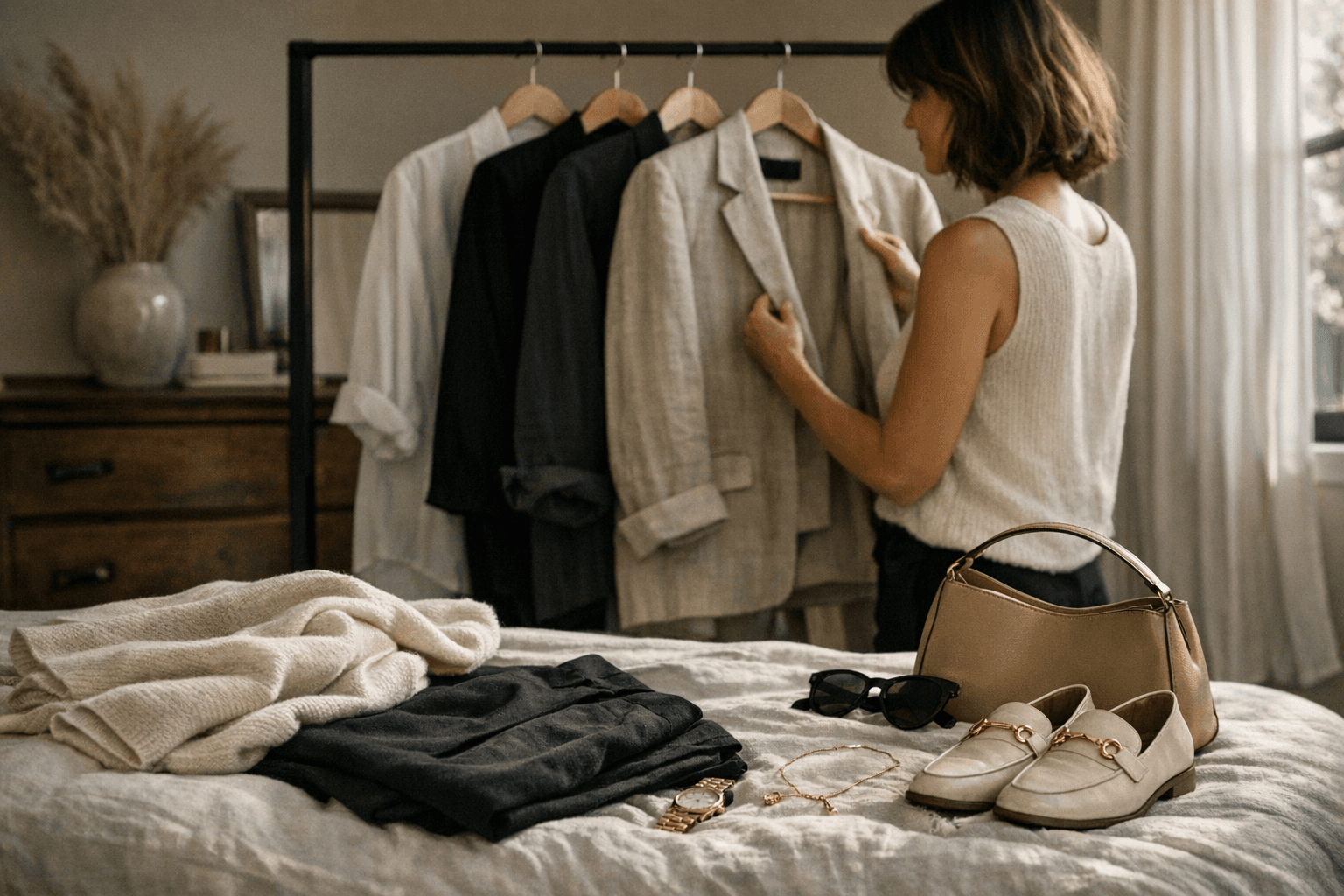
For the blazer, search secondhand platforms for "tailored cotton blazer" or "structured wool blazer" alongside your palette shades. New at accessible price points, Everlane's tailored options, COS's clean-lined blazers, and Mango Premium's suiting separates all deliver the minimal, sculptural shoulder that defines quiet luxury tailoring right now.
The trench coat is worth spending a little more on, because nothing else in the capsule earns its cost-per-wear faster. Layered over a tank and tailored trousers for the office or thrown over a midi dress for dinner, it's genuinely two coats in one.
Outfit Formulas That Multiply the Wardrobe
Six pieces sound restrictive until you map the combinations. Three formulas do the heaviest lifting:
- Tailored linen trouser + fitted tank + oversized linen shirt (worn open as a layer): daytime, dinner, and weekend in one formula depending on footwear.
- Linen button-down + midi skirt in a tonal palette + structured blazer: the formula that reads most dressed-up and travels furthest from casual to professional without a single additional purchase.
- Wide-leg trousers + fine knit + loafers: the default quiet luxury weekend uniform that photographs as deliberately styled even when you assembled it in four minutes.
Accessories are where the multiplication happens. A woven leather tote worn with outfit formula one reads entirely differently from a minimal structured bag, which shifts the same combination toward evening. A silk scarf tied at the neck or looped through a bag handle adds a layer of perceived intentionality that no individual garment can. Keep accessories within your palette and resist the urge to use them as accent colour vehicles; the restraint is the luxury signal.
The Cost-Per-Wear Target
The financial case for this approach is straightforward. Long-term capsule wardrobe analysis places sustainable cost-per-wear targets at under $3 per piece, which means a $150 linen trouser worn twice a week for a full spring and summer season reaches its target cost by mid-June. A $30 Quince tank top hits it before the end of April.
Trend-driven purchases rarely get there. A micro-trend piece worn four times before it feels dated and leaves your wardrobe costs roughly $15 per wear and contributes nothing to the six-piece architecture you're building.
The quiet luxury wardrobe is, at its core, a low-waste spending strategy dressed in excellent fabric. Start with the palette, commit to the three materials, source secondhand where the market allows, and fill gaps only from brands that operate with clean lines and neutral ranges. By the time the heat of summer arrives, you'll have a wardrobe that looks considered because it is, built from fewer decisions made far more carefully.
This article was produced by Prism’s automated news system from verified source data, official records, and press releases, then run through automated quality and moderation checks before publishing. The system is built and supervised by the people who set the standards it runs under. Read our full AI policy.
Did this article answer your question?