Carhartt WIP and F.C. Real Bristol Unite Workwear with Football Street Style
Carhartt WIP teams up with Tokyo's F.C. Real Bristol on football-inspired pieces that wear sharper on the commute than on any pitch.
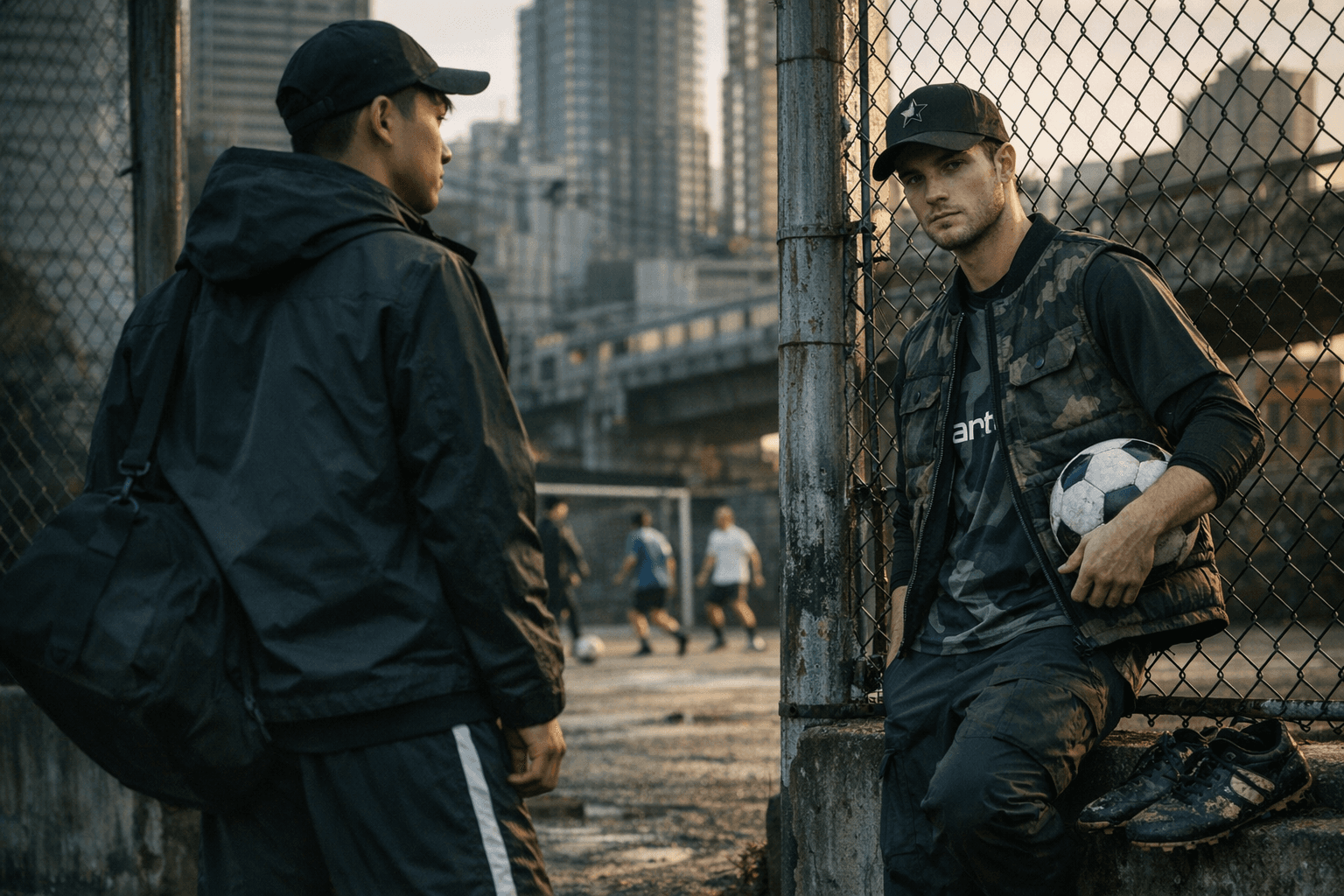
Nine objects, seven of them wearable. That is the inventory at the centre of the first collaboration between Carhartt WIP and Tokyo's F.C. Real Bristol, and it is enough to reframe how football-coded clothing belongs in a city wardrobe. The shared design problem the two labels set out to solve is specific: take the technical language of the sport, moisture-wicking weaves, nylon satin warm-up shells, heavyweight interlock varsity jackets, knitted supporter scarves, and translate each piece into something that belongs on a commute, a train platform, or a rain-soaked Tuesday morning rather than exclusively on a touchline. Their first collaborative capsule, announced April 3 and set to drop in stores April 10, 2026, is as precise an answer as the question deserves.
The capsule brings together two labels that share a surprisingly overlapping DNA. Carhartt WIP has spent decades converting American heavy-industry workwear into something that resonates in European cities and Japanese streetwear culture. F.C. Real Bristol, the Tokyo-based label operating under SOPH. and founded by designer Hirofumi Kiyonaga in 1999, began with a not dissimilar provocation: what if football kit, a category of clothing almost entirely ignored as genuine fashion wear, could carry the same utilitarian seriousness that Carhartt had always applied to work clothes? Kiyonaga launched F.C.R.B. ahead of the 2002 FIFA World Cup in Japan, framing the project around a fictional football club and treating every garment as gear for players, managers, and supporters alike. That founding instinct, function dressed as culture, is exactly what this collaboration leans into.
The fictional-club concept is not a gimmick. Over 25 years, F.C. Real Bristol has collaborated with Casio, Mastermind, Helinox, and Swarovski, each time using the football club framework as editorial cover to explore sportswear from angles that conventional brands rarely reach. Carhartt WIP, with its own long history of thoughtful partnerships including sacai and Nicholas Daley, brings the kind of workwear-rooted construction credibility that elevates technical fabrics beyond their athletic origins. Together, the two brands have produced something that earns the words "capsule collection" in the truest sense: a contained, coherent set of objects that all speak the same design language.
The apparel anchors the collection. Varsity jackets arrive in thick interlock cotton, a fabric choice that immediately removes them from the gym locker room and places them somewhere between prep and post-industrial. The weight of the interlock matters: it gives the jacket enough structure to layer over a midi dress or under an overcoat without the collapse that lighter fleece alternatives suffer. Warm-up jackets in lightweight nylon satin are the collection's most versatile and most underestimated piece. The nylon satin finish, glossy but not loud, hits differently when paired with tailored trousers instead of the expected wide-leg jogger. This is the single styling swap worth stealing from the entire drop: a slim or straight-cut trouser in a neutral wool or heavy cotton canvas, worn with the nylon satin warm-up jacket zipped two-thirds of the way, and a clean white crew-neck underneath. The silhouette reads as intentional, not fan gear, because the satin shell borrows visual grammar from luxury outerwear while remaining light enough to commute in.
Game shirts and shorts in moisture-wicking weaves round out the core apparel. On their own, worn as separates rather than a set, the shirts earn a place in the commuter wardrobe: tucked into cargo trousers or worn loose over a slim ribbed tank, they read as contemporary sportswear rather than replica kit. The co-branded canvas cap keeps the headwear proportionate, flat-brimmed and uncluttered, a format that travels from airport to city walk without styling effort. The knitted supporter scarf is the piece most explicitly rooted in football culture, and consequently the one that requires the most considered placement; worn loosely draped over a heavy topcoat or tucked halfway into a jacket front pocket, it functions as a colour accent without broadcasting tribal loyalty.
The socks are not an afterthought. Football sock details, tonal ribbing, logo placement at the ankle, are among the most borrowed sportswear elements in contemporary streetwear, and the F.C.R.B. x Carhartt WIP version carries enough co-branding restraint to sit comfortably with both workwear-adjacent styling and the sharper end of casual dressing. Visible above a clean sneaker or a chunky boot, they do the work that accessories always should: they close a look quietly.
Beyond the wearables, the capsule includes two objects that make the collaboration's cultural intent explicit. A custom co-branded football and a brown rubber duck are football memorabilia in the spirit of F.C. Real Bristol's fictional-club worldbuilding, props from a club that exists entirely in the imagination of its designers and the wardrobes of people who understand the reference. They are not for wearing, but they clarify what the wearable pieces are for: signalling membership in a particular kind of aesthetic literacy, one that knows the difference between a supporter's scarf as knitwear and a supporter's scarf as kit.
For styling purposes across function-first dressing, the collection maps cleanly onto several real scenarios. For the daily commute, the nylon satin warm-up jacket over a midi-length wool skirt and white sneakers handles rain and wind while maintaining visual coherence. For travel, the moisture-wicking game shirt layers under the varsity jacket for a combination that regulates temperature across changing climates without requiring a bag change. For the kind of rainy-day layering that city dressing demands, the knitted scarf draped over the interlock varsity adds volume and warmth without bulk. The canvas cap keeps the top half neat under any of the above. What makes these combinations work, rather than reading as team kits worn by someone who missed the bus to the stadium, is the specific material weight Carhartt WIP brings to the construction: these are not fast-fashion football tributes. They are built clothes that happen to carry football codes.
The collection launches April 10 at Carhartt WIP's online store and select global retailers. To mark the release, Carhartt WIP stores across ten cities including Amsterdam, Barcelona, London, Milan, New York, Paris, Seoul, Tokyo, Kuala Lumpur, and Toronto will host a series of public table football tournaments under the name Progress League 2026, running April 9 and 10. The events are open to the public, a deliberate extension of the collaboration's logic: if the clothes are designed to be worn outside the context of an actual game, the activation should be too. Table football in a shop is not a stadium. It is, like the clothes themselves, a way of holding football culture in a space where the pitch is notional and the styling decisions are entirely real.
What ultimately makes this capsule worth tracking is not novelty but coherence. Both brands have built reputations on the idea that utilitarian clothing does not require an industrial or athletic context to justify its construction. Carhartt WIP brought that argument to the streets of Europe and Japan from the factories of North America. Hirofumi Kiyonaga built an entire fictional football club to make the same argument from the other direction. The clothes they have made together are not complicated, but they are resolved. Nine objects, built for people who understand that a warm-up jacket worn well on a cold morning commute is not a lesser use of the garment. It may be the point of it entirely.
This article was produced by Prism’s automated news system from verified source data, official records, and press releases, then run through automated quality and moderation checks before publishing. The system is built and supervised by the people who set the standards it runs under. Read our full AI policy.
Did this article answer your question?