Marine Biomass Steps Into Fashion’s Sustainable Materials Future
Seaweed fibers are moving from concept to closet, and the most convincing versions are the ones that can drape, knit and scale with real style credibility.
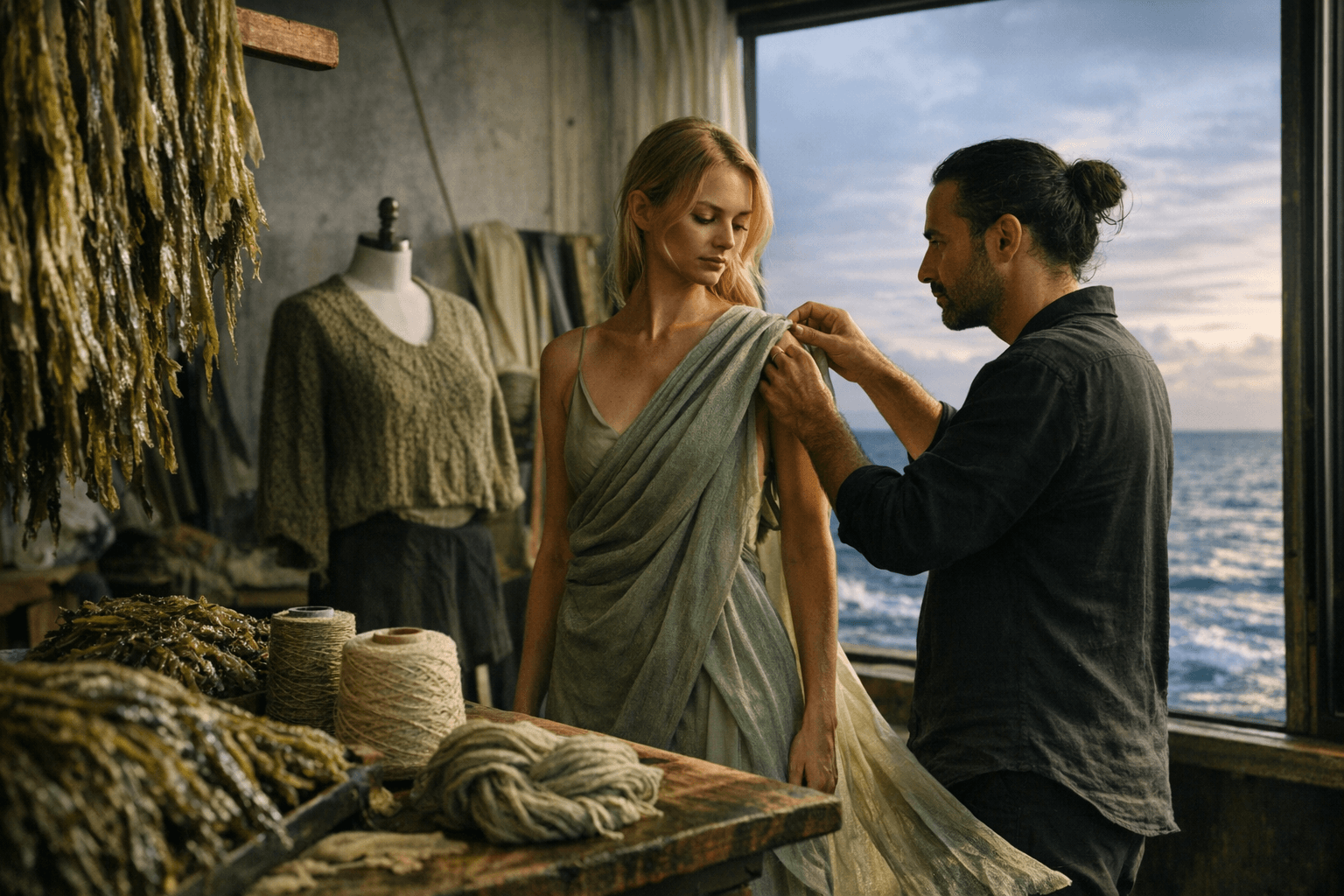
The sea is no longer just a mood board for fashion. Marine biomass is starting to look like a serious material story, with A Blue World backing lab research and scale, and Eugène Riconneaus turning invasive seaweed and seafood waste into fibers that are meant to behave like real clothes, not green novelty.
Why fashion is looking offshore
The industry’s appetite for virgin fiber is still enormous, and that is exactly why marine-based materials are getting attention. Textile Exchange reported that global fiber production hit 116 million tonnes in 2022, and warned it could climb to 147 million tonnes by 2030 if business continues as usual. That scale makes the case for alternatives feel less like brand theater and more like material necessity.
The waste picture is just as stark. UNEP says the world generates 92 million tonnes of textile waste every year, while only 8% of textile fibers in 2023 were made from recycled sources. Then there is the ocean plastics problem, where IUCN says synthetic textiles account for 12% of global plastic use and are a major source of ocean microplastics. Against that backdrop, seaweed-derived fibers and marine biomass suddenly feel less niche and more like fashion trying to redesign its own supply chain.
What marine biomass actually offers a wardrobe
The easiest way to understand this category is to think beyond the slogan. A Blue World is positioning marine-based materials as a blue-biotechnology platform, one that supports lab research and then tries to move the results into sustainable fashion and consumer products. That matters because it shifts the conversation away from one-off eco capsules and toward materials that might actually enter regular production.
For the eye and the hand, the appeal depends on whether these fibers can deliver the three things fashion cares about most: texture, drape and durability. Seaweed-based materials have the advantage of being able to move from biomass into fibers, pigments and polymers, which gives designers more than one way to work with them. If the result is too stiff, too precious or too fragile, it stays in the concept drawer. If it can be spun, knitted or woven cleanly, it starts to look like clothing.
The most wearable lane right now
Marine biomass is not equally strong across every category, and that is part of its charm. The most convincing uses are the ones where texture is already part of the point, which is why accessories, occasionwear and knits make the best case for seaweed-derived materials today.
- Accessories can carry the material story without demanding full-garment performance from day one. A structured bag, a belt or a shoe detail can sell the idea of ocean-derived innovation while keeping the silhouette clean.
- Occasionwear is where the material can feel genuinely aspirational. A sculptural dress made from a seaweed fiber does not need to be basic, it needs to move beautifully and hold its shape with enough presence to justify the drama.
- Knits may be the most practical frontier because they allow a fiber like SeiFibre to show its strength in yarn form. If a material can be spun and knitted without losing its character, it has a real shot at becoming part of everyday dressing.
That is why the styling question matters so much. Fashion readers do not need another ingredient list, they need to know whether a fabric will skim the body, hold a shoulder, or soften into a sweater that feels effortless rather than engineered.
Eugène Riconneaus gives the category a real precedent
Riconneaus has made the marine-material conversation concrete. He unveiled ER Ocean Recherche in Paris on April 17, 2025, after starting with invasive seaweed and seafood waste from Nouvelle-Aquitaine, France. His line now includes SeiShell™, SeiYarn™ and SeiFibre™, and ER Ocean Recherche describes SeiFibre as a staple fiber made mostly from algae that can be spun into yarn and turned into fabrics.
What makes his work useful is that it is not framed as a one-season stunt. Riconneaus has said he began by looking for next-generation materials that met designers’ expectations and could scale, then studied the science to make them himself. The line’s emphasis on lower water use, plastic-free bio-based fibers and lifecycle assessment gives it a stronger industrial posture than a purely conceptual textile project.
WWD reported on April 3, 2026 that Riconneaus showed a couture dress made from scalable seaweed fiber at ChangeNow, alongside T-shirts, which is exactly the kind of styling spectrum that matters. The couture dress signals ambition and polish; the T-shirts suggest the material is being tested outside fantasy dressing. That is a meaningful shift from novelty to viability.
The wider ecosystem is getting louder
This is no longer a lone-designer experiment. World Collective announced a partnership with A Blue World on June 11, 2025, aimed at connecting marine-based innovation to buyers, traceability and supply-chain pathways. That kind of partnership matters because beautiful material science does not become fashion until it can move through sourcing, manufacturing and distribution with some reliability.
Saudi Arabia is also treating seaweed textiles as more than a curiosity. The Saudi Fashion Commission presented its Red Sea Seaweed Textile Innovation initiative at the Misk Global Forum, with Burak Çakmak of the Fashion Commission, Fiona Symes of KAUST Beacon Development and Regina Polanco of PYRATEX on the panel. When government, research and textile specialists are all in the same room, the signal is clear: seaweed is being treated as an innovation lane, not a gimmick.
There is also precedent here. SeaCell, a seaweed-blended fiber developed in the early 2000s by German company smartfiber AG, shows that ocean-derived textiles have been in development for years. What feels different now is the scale of the ambition, with the current wave explicitly focused on traceability, replacement of petrochemical inputs and applications that stretch from fashion into beauty, wellness and other consumer categories.
So does it look chic yet?
Yes, but selectively. Marine biomass is most convincing when it is allowed to behave like a premium material with a point of view, not when it is dressed up as a sustainability slogan. Accessories and knitwear already feel commercially legible; occasionwear gives the category its glamour; T-shirts test whether it can become everyday.
The real promise is not that seaweed will replace every fiber in your closet tomorrow. It is that fashion is finally starting to treat the ocean as a source of materials with texture, polish and scale, and that is how a trend stops being experimental and starts feeling inevitable.
Know something we missed? Have a correction or additional information?
Submit a Tip