A Blue World Pushes Seaweed Textiles Into Fashion’s Supply Chain
Seaweed is moving beyond novelty: A Blue World is pitching Seacell and other marine materials as replacements for petrochemical inputs, with Another Tomorrow and Sylva already testing the waters.
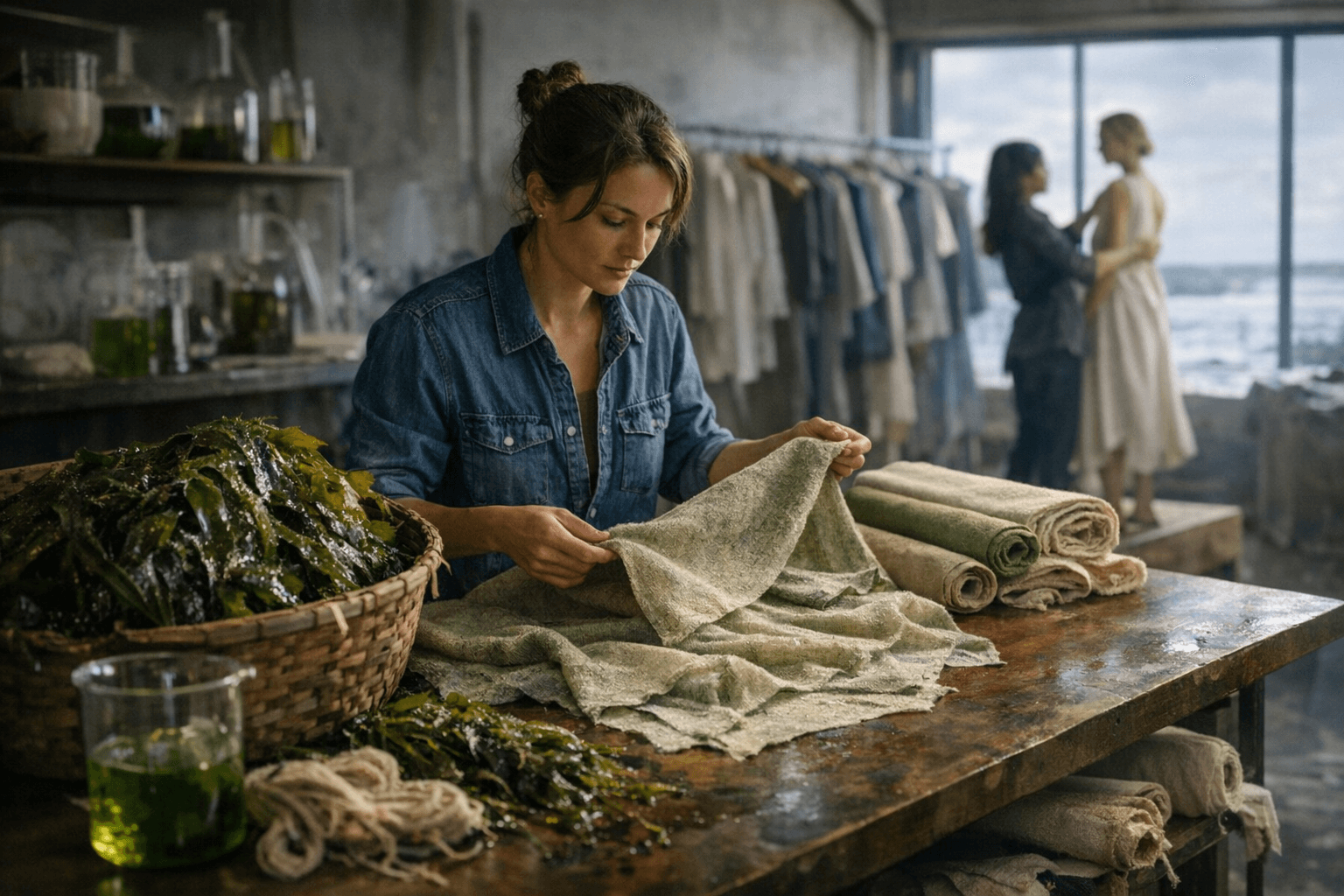
Seaweed textiles are no longer being treated like a science-fair curiosity. A Blue World, led by Christopher Suarez, Baptiste Auzéau, Athina Karamalis and Julia von Boehm, is pushing marine-based materials such as seaweed and Seacell as practical substitutes for petrochemical inputs, with the aim of moving lab research into consumer products across fashion, beauty and wellness.
The pitch matters because it lands at the exact pressure point fashion keeps trying to solve: how to cut reliance on fossil-based fibers and microplastic-generating synthetics without giving up performance, hand-feel or scalability. Seacell is one of Smartfiber AG’s patented fibers, made from cellulose and brown seaweed, and Smartfiber says it is trusted by Another Tomorrow, the New York-based, B-Corp-certified luxury brand. WWD described Seacell as 100 percent biodegradable and compostable, and said it is already being used in pieces ranging from underwear and loungewear to soft furnishings.
That breadth is the real test. A material can look compelling in a swatch book and still fail once it meets manufacturing reality, price pressure and the demands of modern wardrobes. Cotton remains the baseline for familiarity and volume; synthetics still win on cost and durability; newer bio-materials often get stuck in the gap between promising research and products people can actually buy. Seaweed fabrics have to prove they can do more than deliver an eco-friendly story. They need to offer comfort, breathability, traceability and a supply chain that can scale without becoming prohibitively expensive.
Early adopters give the category some credibility. WWD identified Another Tomorrow and Sylva as labels working with breathable, low-impact Seacell textiles. Sylva was founded by Tallulah Harlech, who said she launched the brand in response to her own severe psoriasis and positioned it as “skin-first, eco-sourced.” That framing gives seaweed textiles a sharper commercial case than vague sustainability branding ever could: the material is not only meant to be better for the planet, but also gentler on skin and viable in clothes people want to wear every day.
The bigger infrastructure play sits behind the fabric itself. World Collective said in 2025 that it partnered with A Blue World to build a bridge between blue biotechnology and the global fashion and textile supply chain, with the goal of making marine-based materials scalable, traceable and market-ready. If that bridge holds, seaweed could move from niche innovation to a new raw-material lane for brands that want lower-impact inputs without sacrificing modern production standards. For fashion, that would be the real shift: not another green promise, but a usable material system with room to grow.
This article was produced by Prism’s automated news system from verified source data, official records, and press releases, then run through automated quality and moderation checks before publishing. The system is built and supervised by the people who set the standards it runs under. Read our full AI policy.
Did this article answer your question?


